
Scientists Make Thrilling Discovery of Record-Breaking Ancient Galaxy Cluster
Astronomers have made an extraordinary discovery that's rewriting our understanding of the early universe. A remarkable cluster of over 30 galaxies, burning surprisingly hot and formed just 1.4 billion years after the Big Bang, is teaching us that the cosmos developed far more dynamically and quickly than we ever imagined.
In an exciting development that's pushing the boundaries of cosmic knowledge, astronomers using Chile's powerful Atacama Large Millimeter/submillimeter Array have discovered something truly remarkable: the earliest known fully-formed galaxy cluster in the universe, and it's teaching us that the cosmos is far more dynamic and fascinating than we previously understood.
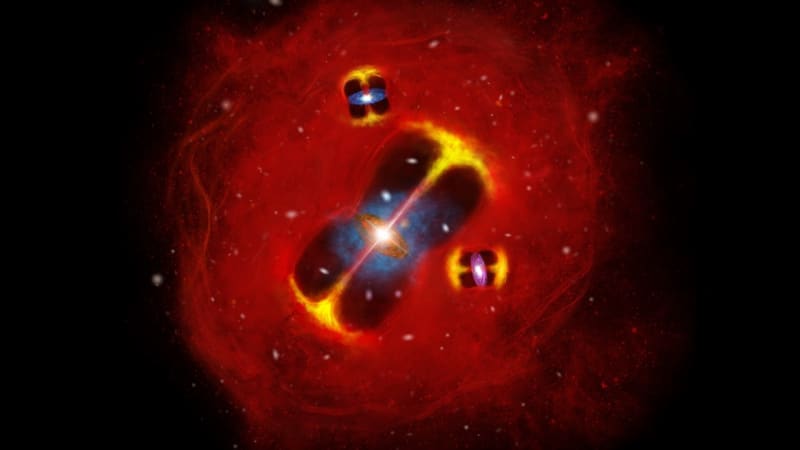
The galaxy cluster, designated SPT2349-56, contains more than 30 galaxies packed into a space just 500,000 light-years across. What makes this discovery particularly thrilling is that this cosmic neighborhood was already bustling with activity just 1.4 billion years after the Big Bang—much earlier than scientists thought possible.
"This tells us that something in the early universe, likely three recently discovered supermassive black holes in the cluster, were already pumping huge amounts of energy into the surroundings and shaping the young cluster, much earlier and more strongly than we thought," explained Scott Chapman, a professor of astronomy at Dalhousie University in Nova Scotia, Canada. Rather than seeing this as a problem, scientists are celebrating this puzzle as an opportunity to deepen our understanding of cosmic evolution.
The most surprising aspect of SPT2349-56 is its temperature. The gas atmosphere surrounding these galaxies—what researchers call the intracluster medium—is at least five times hotter than theoretical models predicted, even surpassing many present-day clusters. "We didn't expect to see such a hot cluster atmosphere so early in cosmic history," said Dazhi Zhou, a PhD candidate at the University of British Columbia and lead author of the groundbreaking study.
This discovery showcases the incredible progress being made in astronomical observation techniques. Scientists measured the cluster's temperature indirectly using the Sunyaev-Zeldovich effect, observing how the cluster's hot gas affects ancient light from the Big Bang. This sophisticated method demonstrates how creative scientific thinking continues to unlock the universe's secrets.
What makes SPT2349-56 particularly special is its frantic star-forming activity. Within its member galaxies, stars are being born at a rate five thousand times faster than in our own Milky Way. This cosmic fireworks display offers scientists an unprecedented window into how galaxies grow and evolve.
The discovery joins other exciting recent findings, including even earlier protoclusters spotted by the James Webb Space Telescope. Together, these observations are painting an increasingly vivid picture of the universe's infancy, revealing that the cosmos was far more active and energetic in its youth than previously believed.
"We want to figure out how the intense star formation, the active black holes and this overheated atmosphere interact, and what it tells us about how present galaxy clusters were built," Zhou enthusiastically shared. This question represents not a limitation of our knowledge, but an exciting frontier waiting to be explored.
The findings, published in the prestigious journal Nature, remind us that the universe still holds wonderful surprises. Each discovery like SPT2349-56 doesn't just challenge our assumptions—it invites us to think bigger, look deeper, and remain open to the extraordinary possibilities that await us in the cosmos. As our tools and techniques improve, who knows what other marvels we'll uncover in the universe's earliest moments?
More Images


Based on reporting by Space.com
This story was written by BrightWire based on verified news reports.
Spread the positivity! 🌟
Share this good news with someone who needs it
More Good News
 🚀 Innovation
Scientists Discover Galaxy Cluster Blazing 12 Billion Years Ago Defies Predictions
 🚀 Innovation
NASA's 25-Year Timelapse Reveals 400-Year-Old Supernova Still Dazzling Scientists
 🚀 Innovation
Philanthropists Fund Hubble-Beating Space Telescope in Just 3 Years for Fraction of Cost
Joke of the Day
Why did the calendar go on vacation?
Explore Categories
Quote of the Day
"A friend is someone who knows all about you and still loves you."
— Elbert Hubbard