Scientists Map Ancient Ocean the Size of the Arctic on Mars
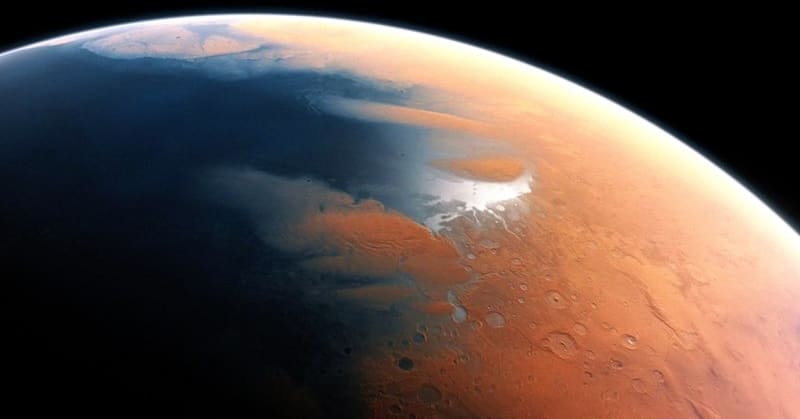
New satellite imagery reveals Mars once had a massive ocean covering its northern hemisphere 3 billion years ago. High-resolution photos show river deltas that match Earth's coastal features almost perfectly.
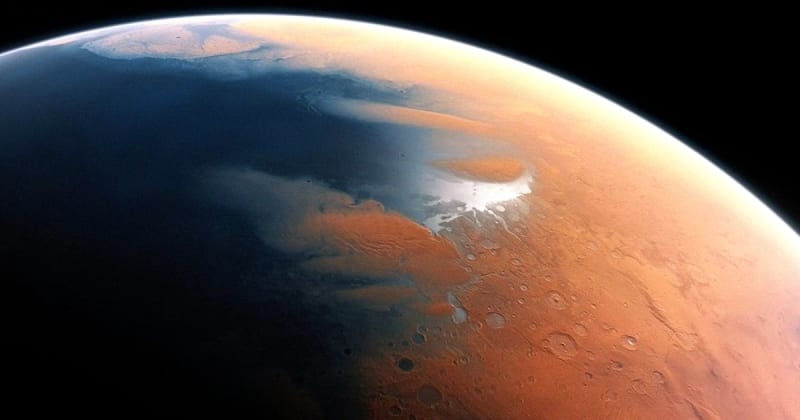
Scientists just confirmed that Mars wasn't just wet billions of years ago. It had an ocean the size of Earth's Arctic.
An international research team used cutting-edge satellite data to reconstruct what the Red Planet looked like when water still flowed across its surface. They focused on Coprates Chasma, a canyon within Valles Marineris, the largest canyon system in our solar system.
The breakthrough came when University of Bern PhD student Ignatius Argadestya spotted something familiar in the Mars images. "I was particularly impressed by the deltas that I discovered at the edge of one of the mountains," he said.
These weren't just any geological features. The team identified fan deltas, the distinctive cone-shaped sediment deposits that form when mountain rivers empty into oceans, exactly like the ones on Earth.
The researchers combined data from the European Space Agency's ExoMars Trace Gas Orbiter and Mars Express, plus NASA's Mars Reconnaissance Orbiter. The high-resolution images let them measure and map the Martian landscape in unprecedented detail.
Geology professor Fritz Schlunegger confirmed what the images revealed. "The structures that we were able to identify in the images are clearly the mouth of a river into an ocean," he explained.
By tracing where these ancient rivers met the ocean, the team reconstructed the sea level from 3 billion years ago. This period represents the time when Mars had the most surface water in its entire history.
The ocean stretched across the entire northern hemisphere of the planet. Previous studies had suggested Mars might have had water, but this research provides the clearest evidence yet of an actual coastline.
Why This Inspires
This discovery transforms how we picture our neighboring planet. Mars wasn't a dusty rock that happened to have some water. It was a blue world with river systems, coastlines, and an ocean spanning half the planet.
The findings open new questions about whether ancient Mars could have supported life. If Earth's oceans became home to the first living organisms, could Mars' ancient seas have done the same?
The team's work shows what becomes possible when scientists combine data from multiple space agencies and push satellite imaging technology to its limits. What once seemed like speculation now rests on solid geological evidence captured from orbit.
Each new Mars mission brings us closer to understanding whether life ever took hold beyond Earth, and this massive ancient ocean makes that possibility feel more real than ever.
More Images
Based on reporting by Futurism
This story was written by BrightWire based on verified news reports.
Spread the positivity!
Share this good news with someone who needs it