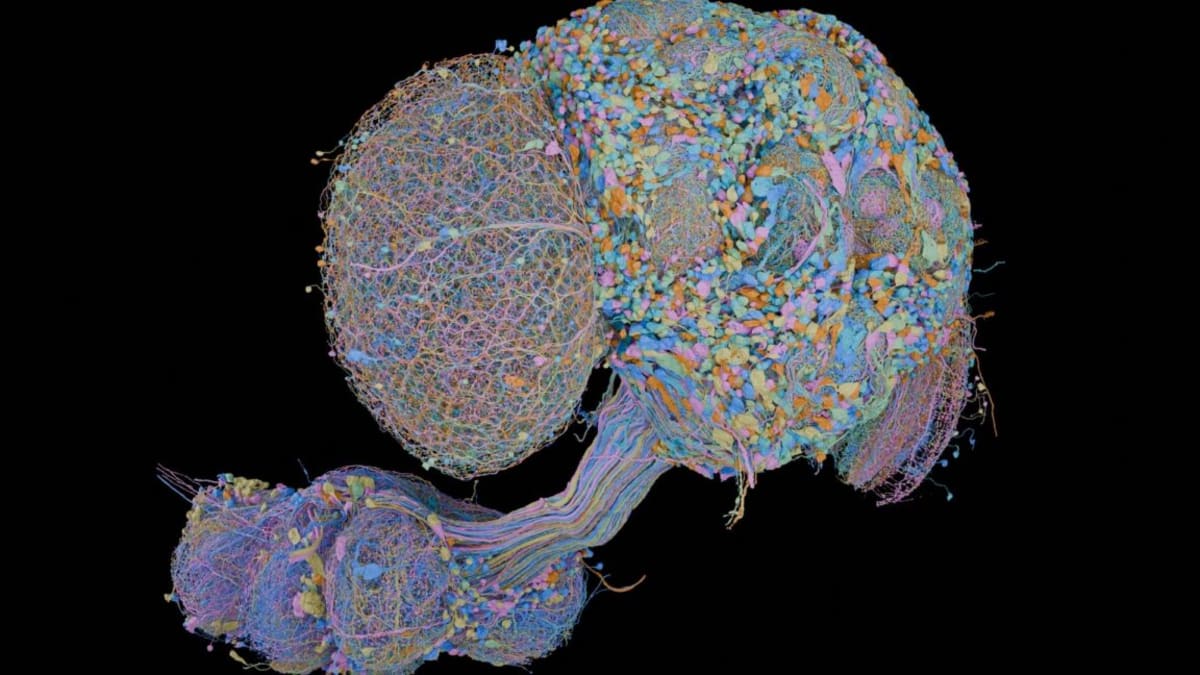
Scientists Map Every Neuron in a Fruit Fly Brain
Researchers just completed a map of every neuron and 300 million connections in a male fruit fly's brain, creating a powerful new tool that could unlock how brains work. The breakthrough combines cutting-edge biology with AI to chart the complete wiring of one of nature's most sophisticated computers.
Scientists have created the most detailed map ever made of an animal's brain, charting every single neuron and connection in a male fruit fly's nervous system.
The achievement represents years of collaboration between biologists at Howard Hughes Medical Institute and computer scientists at Google. Together, they mapped roughly 150,000 neurons and over 300 million synaptic connections, creating what researchers call a "connectome."
Think of it like having the complete wiring diagram for a sophisticated computer. Understanding which neurons connect to which others reveals how information flows through the brain, from sensing light or sound to forming memories or moving muscles.
The challenge was enormous. Researchers sliced a fruit fly brain into thousands of ultra-thin sections, then used electron microscopes to photograph each one at incredibly high resolution.
That's where AI became essential. Google's team developed specialized algorithms that stitched the images back together in 3D space, filled in gaps where tissue was lost during slicing, and traced individual neurons across hundreds of images.
"The computers were nowhere near powerful enough" when scientists tried this approach in the 1970s with a much simpler worm brain, explained Gerry Rubin, one of the project's senior leaders. That earlier attempt took colored markers and hand tracing to complete.
This new fruit fly connectome joins a female fruit fly brain map completed earlier this year. Having both male and female maps lets scientists compare how brain wiring differs between sexes in the same species.
Why This Inspires
The tools developed for this project are already being refined for more complex nervous systems. What once seemed impossible without decades of hand tracing now happens through the partnership of human expertise and artificial intelligence.
Every breakthrough in understanding how brains work brings us closer to treatments for neurological conditions and insights into how we think, learn, and remember. The fruit fly's brain may be tiny, but it performs remarkably sophisticated tasks, from navigating in three dimensions to recognizing food sources to choosing mates.
By mapping exactly how those 150,000 neurons wire together to create complex behavior, scientists gain a foundation for understanding the principles that might apply to brains of all sizes, potentially including our own.
The research team believes the investment will prove worthwhile as neurobiologists now have an unprecedented tool for testing theories about how brain circuits actually function. Sometimes the smallest subjects reveal the biggest truths.
More Images


Based on reporting by Google News - Science
This story was written by BrightWire based on verified news reports.
Spread the positivity!
Share this good news with someone who needs it