Scientists Map Fruit Fly Brain, Find No Central Control
An international team created the first complete wiring diagram of a fruit fly's nervous system, revealing that complex behaviors emerge from teamwork between brain and body circuits rather than a single command center. The breakthrough gives researchers a powerful new tool to understand how all nervous systems work.
Scientists just mapped every single connection in a fruit fly's nervous system, and what they found challenges everything we thought about how brains control our bodies.
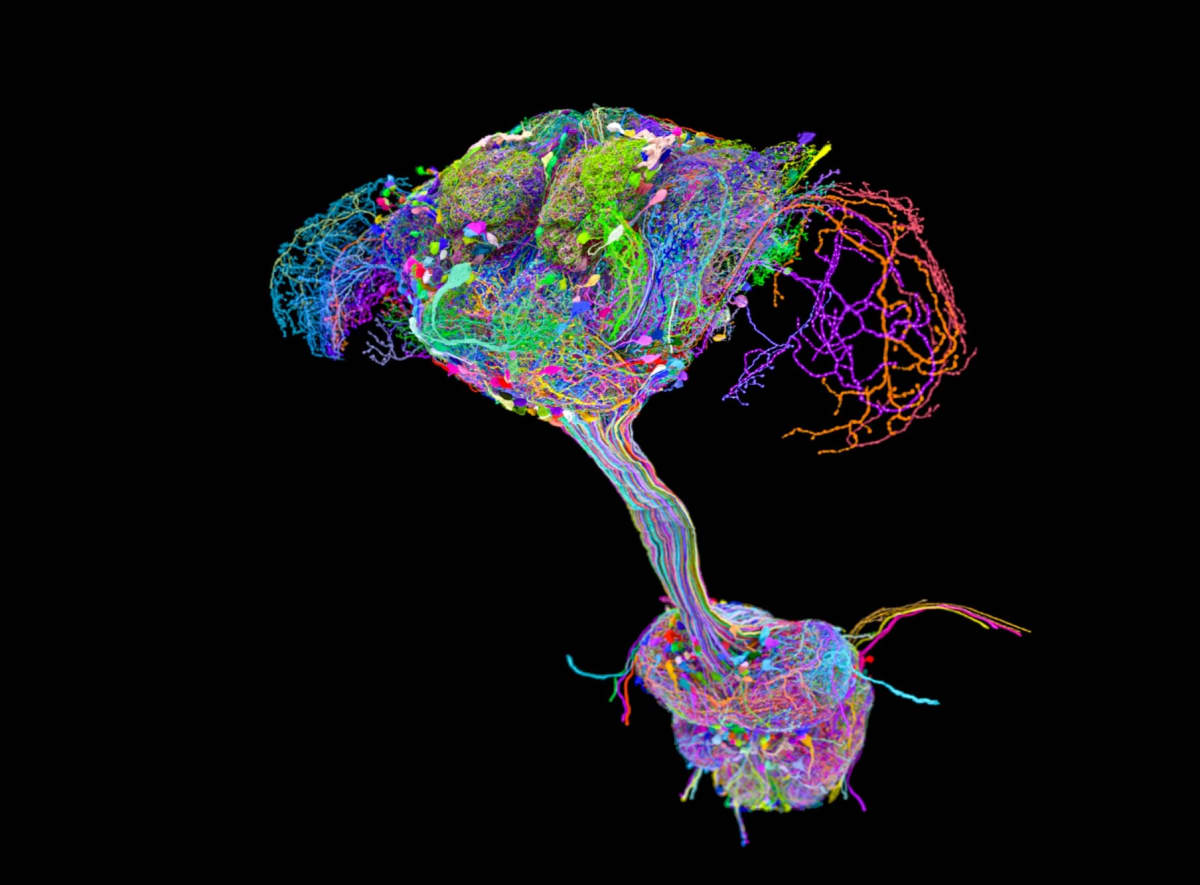
An international team led by Harvard Medical School and Princeton University completed the first full wiring diagram of a fruit fly's central nervous system, capturing all 160,000 neurons and their connections. The massive project took years of slicing a single fly into thousands of thin sections, imaging them with electron microscopes, and using AI to assemble millions of images into one complete 3D map.
The real surprise came when researchers analyzed how the fly moves and behaves. Instead of finding a command center in the brain directing every action, they discovered something more beautiful: complex behaviors emerge from local circuits working together throughout the body.
"We can see all of the neurons and their connections as a complete unit for the first time," said Rachel Wilson, a neurobiology professor at Harvard Medical School. The discovery suggests that walking, flying, and other sophisticated movements aren't controlled by a boss sending orders from headquarters, but by teams of neurons collaborating across the brain and body.
The breakthrough combines two major achievements. In 2024, the FlyWire Consortium mapped the fruit fly brain. Meanwhile, Wei-Chung Allen Lee and his team at Harvard were mapping the nerve cord, which connects the brain to legs, wings, and other body parts. Linking these two datasets created the first complete picture of how information flows from sensation to action in an entire nervous system.
Why This Inspires
This connectome represents more than just mapping neurons. It's a freely available resource that scientists worldwide can use to unlock mysteries about how all nervous systems function, including our own.
Fruit flies make perfect study subjects because they're simple enough to map completely yet complex enough to learn, navigate, and interact socially. They also offer sophisticated genetic tools that let researchers zoom in on individual neurons to watch them work in real time.
The team has already used their map to rethink motor control, generating new hypotheses about how brains and bodies cooperate. Lee compares the connectome to having detailed Google Maps information: researchers can now plan smarter experiments based on the actual wiring diagram instead of guessing at connections.
The findings suggest that intelligence and behavior might work more like democracy than dictatorship. Rather than a single controller making all decisions, nervous systems succeed through distributed networks where specialized circuits handle local challenges while staying connected to the whole.
This collaborative approach to understanding the brain mirrors what the research revealed: progress happens when different parts work together toward a common goal. The complete connectome is now available online, ready to help scientists worldwide advance our understanding of how nervous systems create the miracle of coordinated life.
More Images
Based on reporting by Google News - Science
This story was written by BrightWire based on verified news reports.
Spread the positivity!
Share this good news with someone who needs it