Scientists Map Merging Black Holes With Gravitational Waves
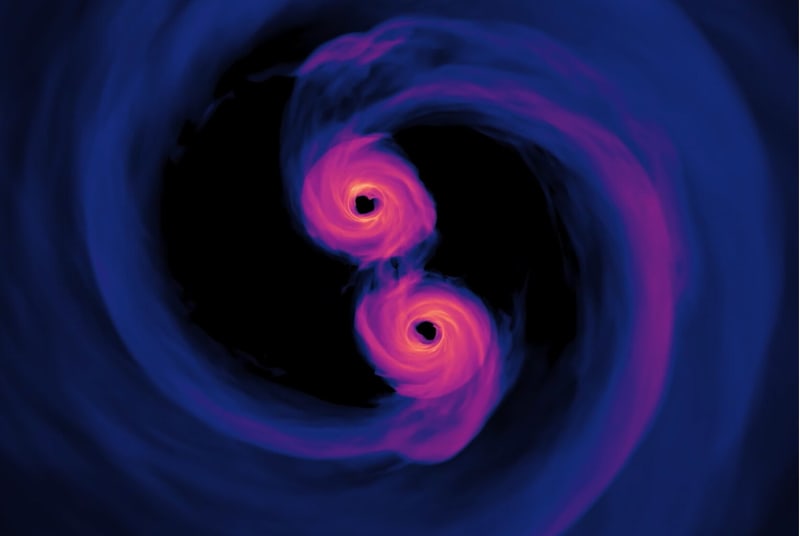
Astrophysicists just created the first detection system that uses gravitational waves to locate merging black holes across the universe, opening a revolutionary new way to explore space. The breakthrough already identified two supermassive black hole pairs nicknamed after Lord of the Rings locations.
Scientists just unlocked a new way to see the universe, and it could transform our understanding of space as dramatically as the discovery of X-rays did generations ago.
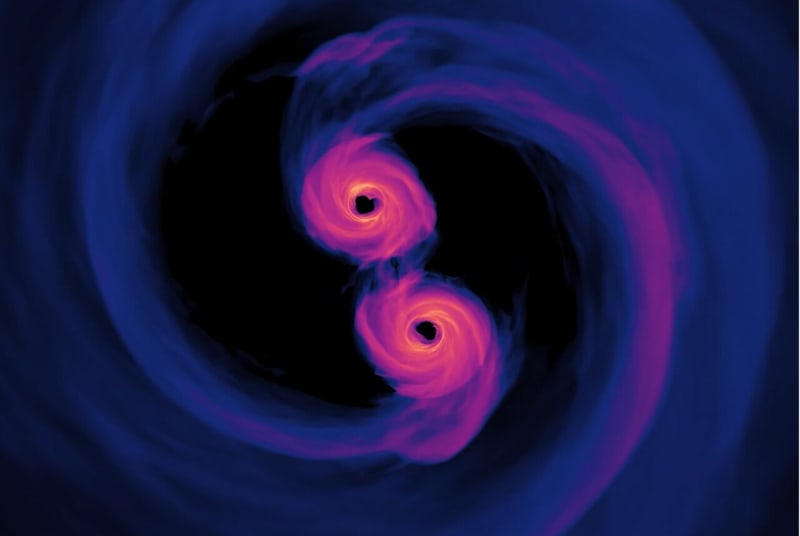
An international team of astrophysicists, including researchers from Yale University, developed a detection system that maps merging black holes using gravitational waves. These ripples in space-time, caused by massive cosmic events, now serve as cosmic GPS coordinates for finding supermassive black hole pairs throughout the universe.
The North American Nanohertz Observatory for Gravitational Waves (NANOGrav) created and tested the new protocol. Their system focuses on pulsars, the collapsed cores of exploded stars that emit precisely timed radio signals, to detect disturbances caused by gravitational waves.
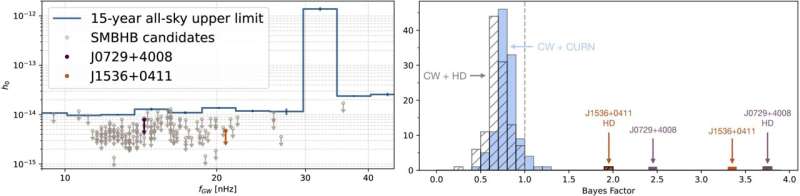
The team already found their first two candidates. They nicknamed them Rohan and Gondor after locations in J.R.R. Tolkien's Lord of the Rings novels, because as Yale physicist Chiara Mingarelli explained, "the beacons were lit!"
Rohan earned its name from Rohan Shivakumar, the Yale student who first analyzed it. The discovery came after researchers searched 114 active galactic nuclei, areas where black holes are drawing in matter at the centers of galaxies.
The breakthrough builds on NANOGrav's 2023 discovery of the first direct evidence of a gravitational wave background. That finding suggested these waves from slowly merging supermassive black holes could be detected from Earth within a low-frequency energy field.
The Ripple Effect
This detection system opens doors across multiple fields of space research. Scientists can now study gravitational wave theory, galaxy mergers, and black hole behavior in ways never before possible.
The team combined measurements of the gravitational wave background with observations of quasars, bright beacons in space fueled by gases falling into black holes. Earlier research suggested black hole mergers happen five times more often in galaxies with quasars, giving scientists targets to focus their search.
Mingarelli says their work provides the scientific community with the first concrete benchmarks for developing detection protocols. In the coming months, NANOGrav will continue identifying and locating more black hole pairs to build out their cosmic map.
Even finding a small number of confirmed black hole binaries will help anchor a complete map of the gravitational wave background. The published study in The Astrophysical Journal Letters details an end-to-end framework for future searches.
The universe just became a little easier to navigate, one gravitational wave at a time.
More Images
Based on reporting by Google News - Science
This story was written by BrightWire based on verified news reports.
Spread the positivity!
Share this good news with someone who needs it