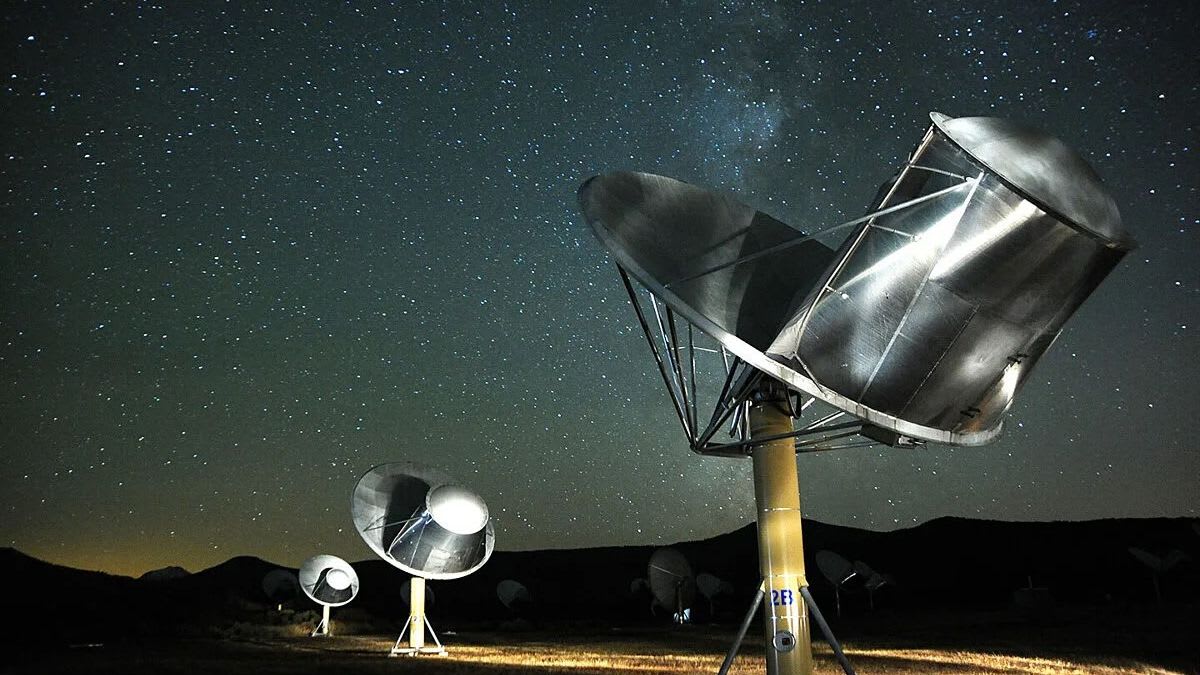
Scientists May Have Solved Why We Haven't Found Aliens Yet
New research suggests space weather might be scrambling alien radio signals before they reach us, offering hope that extraterrestrial civilizations could be out there trying to communicate. Scientists at the SETI Institute discovered how stellar activity disrupts transmissions, and they're already working on ways to detect these hidden messages.
The search for alien life just got a promising new lead that could explain decades of cosmic silence.
Scientists at the SETI Institute in California discovered that space weather around distant stars might be scrambling alien radio signals, making them nearly impossible for us to detect. Think of it like trying to hear someone whisper during a thunderstorm, except the storm is happening in space.
Researchers Vishal Gajjar and Grayce Brown studied how stars blast plasma and electrons into space, similar to our sun's solar wind and coronal mass ejections. These energetic bursts act like static interference, spreading out tightly focused alien transmissions across wider frequency ranges and weakening their strength.
The finding matters because SETI searches specifically look for narrowband signals spanning just a few frequencies. Nothing in nature creates such precise radio waves, making them a telltale sign of technology. But when space weather hits these signals, they spread out and blend into the cosmic background noise.
The team tested their theory by studying radio communications between Earth and solar system spacecraft during solar storms. They measured how our sun's activity disrupts signals, then applied those calculations to simulate searches around a million nearby stars.
The results were eye-opening. Around 70% of sun-like stars and red dwarf stars produce enough interference to broaden signals by more than 1 Hz. Red dwarfs, which make up three-quarters of all stars in our galaxy, create even more disruption due to their intense stellar activity.
Why This Inspires
This discovery transforms the alien silence from a discouraging mystery into a solvable technical challenge. Instead of concluding nobody's out there, scientists now have concrete evidence that messages could be reaching us in distorted forms we haven't learned to recognize yet.
The research team is already developing new detection methods to account for space weather effects. By adjusting search parameters and looking for broader signal patterns, future SETI efforts could potentially uncover transmissions that previous searches missed entirely.
The work also helps explain why narrowband searches haven't succeeded despite decades of effort. Alien civilizations facing similar space weather challenges might have already developed advanced techniques to compensate, teaching us valuable lessons about interstellar communication.
Brown and Gajjar's findings suggest the universe might be far chattier than we thought, with countless civilizations potentially broadcasting messages that are simply getting scrambled en route. Understanding and accounting for these natural interference patterns brings humanity one step closer to answering whether we're alone in the cosmos.
More Images


Based on reporting by Space.com
This story was written by BrightWire based on verified news reports.
Spread the positivity!
Share this good news with someone who needs it


%2Fhttps%3A%2F%2Ftf-cmsv2-smithsonianmag-media.s3.amazonaws.com%2Ffiler_public%2Ff0%2Ffe%2Ff0fe19e4-e68b-474d-b0a4-19c5beb9d19d%2Fspeedy-star.webp)