Scientists Measure Black Hole Jets as Strong as 10,000 Suns
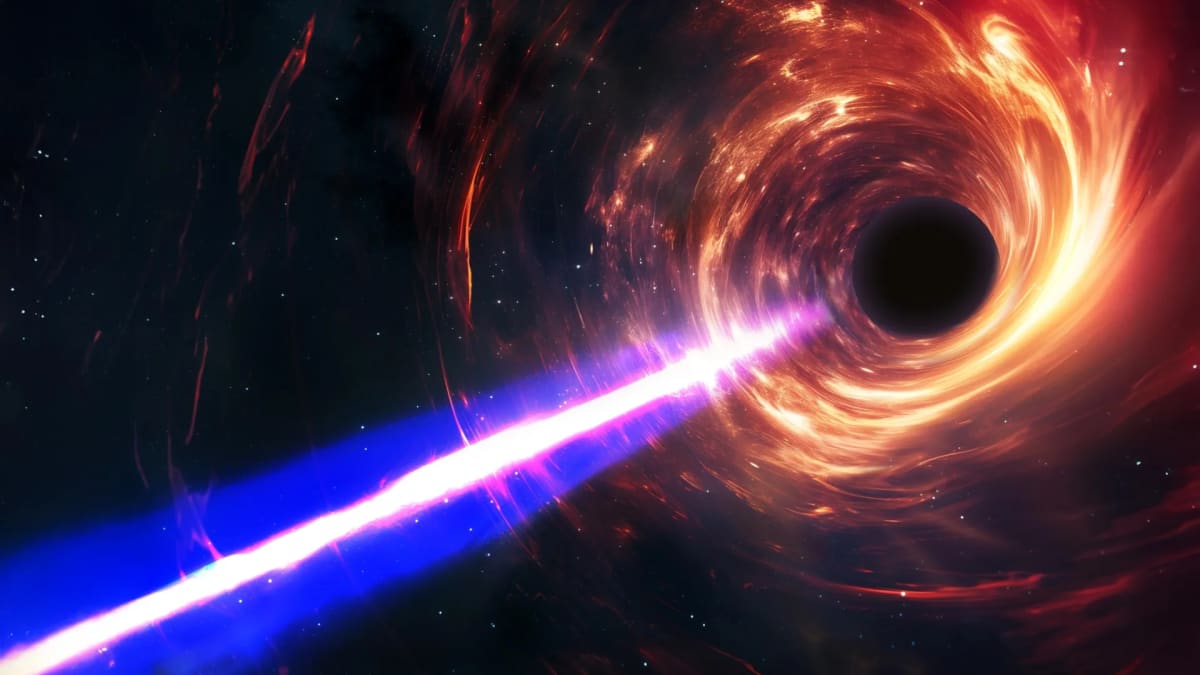
Astronomers have measured the true power of black hole jets for the first time, finding they pack the energy of 10,000 Suns and travel at half the speed of light. The breakthrough confirms theories about how black holes shape galaxies across the universe.
Scientists just confirmed that black hole jets blast through space with the power of 10,000 Suns, solving a decades-old mystery about one of the universe's most spectacular phenomena.
Researchers at Curtin University used a planet-sized network of radio telescopes to watch jets shooting from Cygnus X-1, one of the first black holes ever discovered. What they saw was breathtaking: streams of energy moving at 150,000 kilometers per second, or half the speed of light.
The breakthrough came from watching these jets "dance." As the black hole orbited its companion supergiant star, powerful stellar winds pushed and bent the jets like gusts bending water from a fountain. By measuring how much the jets deflected, scientists calculated their exact power for the first time ever.
Dr. Steve Prabu, who led the study now published in Nature Astronomy, explained that tracking these shifting jets revealed how black holes transfer energy into their surroundings. The team discovered that about 10 percent of the energy from matter falling into the black hole gets carried away by its jets.
That 10 percent figure matters more than it sounds. Scientists have assumed this ratio for years when building computer models of how the universe evolves, but they've never been able to confirm it through direct observation until now.
Professor James Miller-Jones noted that earlier methods could only estimate jet power over thousands or millions of years, making it impossible to match up with the X-ray emissions happening in real time. This new technique captures the power at a specific moment, giving scientists a precise snapshot instead of a blurry average.
The timing couldn't be better. The Square Kilometre Array Observatory is currently under construction in Western Australia and South Africa, and it will detect jets from millions of distant galaxies. This new measurement gives astronomers an anchor point to calibrate the power of all those jets, whether they come from black holes 10 times or 10 million times the mass of our Sun.
Why This Inspires
This discovery shows how persistence pays off in science. For decades, astronomers knew black hole jets existed and suspected they were incredibly powerful, but they couldn't prove it. By cleverly using stellar winds as a natural measuring tool, researchers turned an obstacle into an opportunity.
The findings also reveal how black holes aren't just cosmic vacuum cleaners. They're sculptors, pumping enormous amounts of energy back into space and influencing how galaxies form and evolve. Understanding this feedback loop helps us piece together the story of how our universe became what it is today.
Scientists can now confidently say that black hole physics works similarly across vastly different scales, from stellar-mass black holes like Cygnus X-1 to the supermassive monsters at galaxy centers.
The universe just became a little less mysterious, and our understanding of cosmic evolution took a giant leap forward.
Based on reporting by Science Daily
This story was written by BrightWire based on verified news reports.
Spread the positivity!
Share this good news with someone who needs it