Scientists Overturn 70-Year Brain Evolution Myth
The "lizard brain" theory that shaped psychology for decades is wrong, new research reveals. Scientists found our brains evolved through a fascinating tug-of-war between two wiring systems, not simple layering.
For 70 years, we've been told our rational thoughts battle an ancient "lizard brain" full of primitive emotions. New research from Georgia Tech just proved that popular idea completely misunderstands how our brains actually evolved.
The traditional theory claimed the brain developed in neat layers, starting with basic survival instincts in reptiles and building up to human reasoning. But that's not how evolution works, says Nabil Imam, assistant professor at Georgia Tech's School of Computational Science and Engineering.
His team discovered something far more interesting. Instead of stacking new parts on top of old ones, evolution appears to balance two competing wiring strategies within the brain itself.
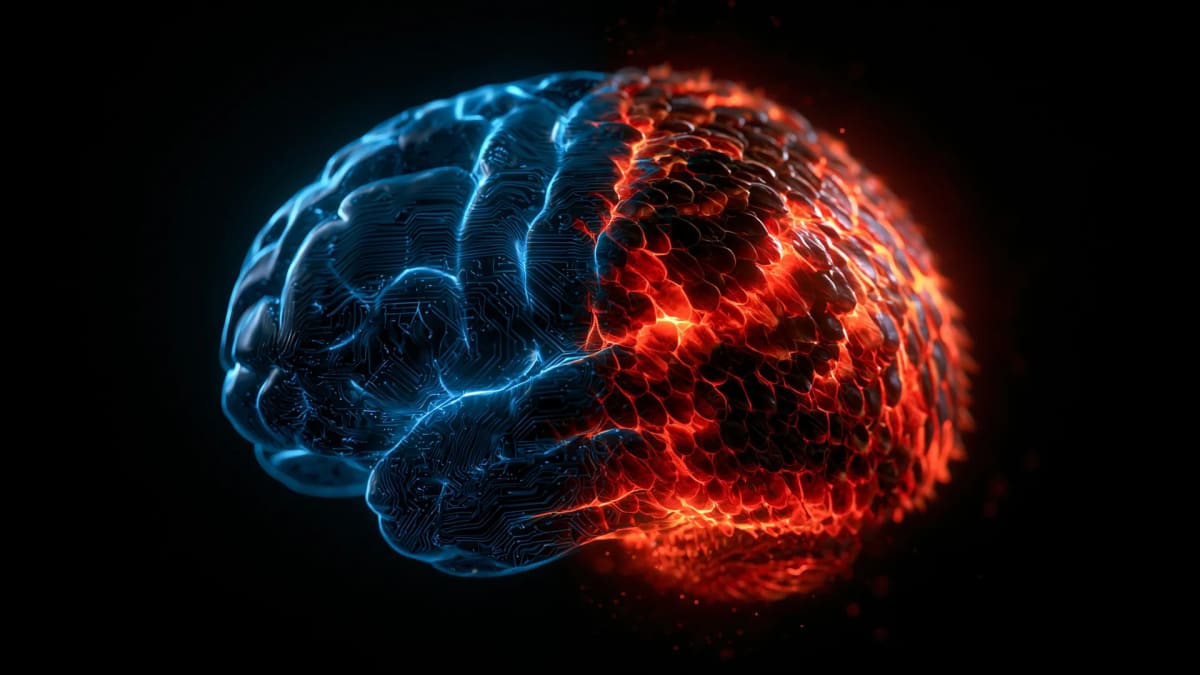
The research, published in Science Advances, examined 182 species and found a surprising pattern. When the limbic system (the so-called "lizard brain") was large, the neocortex (associated with reasoning) was typically smaller, and vice versa.
This isn't random. The two systems use fundamentally different approaches to organizing information, even before birth.
The neocortex arranges itself like a detailed map, with nearby body parts represented in nearby brain regions. The limbic system works more like a barcode, with distributed patterns encoding complex memories and smells.
Why This Inspires
This discovery does more than correct a scientific mistake. It reveals nature's brilliant solution to designing brains with limited space and energy.
The researchers tested their theory using artificial intelligence networks. When they made spatial and distributed systems compete for resources, whichever system was most useful for survival won out.
Real animals show this beautifully. The nine-banded armadillo, which depends heavily on smell, evolved a massive limbic system. The squirrel monkey, which relies on sharp vision, developed a brain dominated by the neocortex.
Neither brain is "better" or more "evolved." Each species got exactly what it needed to thrive in its environment.
The implications stretch beyond understanding ourselves. These findings could revolutionize how we build artificial intelligence systems that use less data and energy by mimicking nature's efficiency.
The "logical versus emotional" story made for catchy psychology books, but the truth is more empowering. Our brains aren't battling against outdated reptilian instincts. They're sophisticated systems shaped by millions of years of fine-tuning for survival.
Next time someone dismisses emotional responses as your "lizard brain" taking over, you can share a better story about how evolution actually crafted one of the universe's most remarkable achievements.
Based on reporting by Science Daily
This story was written by BrightWire based on verified news reports.
Spread the positivity!
Share this good news with someone who needs it