Scientists Race to Build World's Most Precise Clock by 2026
Physicists across the globe are on the verge of creating the first "nuclear clock" that could be more accurate than anything on Earth. After decades of searching, researchers finally cracked the code in 2024 and expect working prototypes this year.
The world's most precise timekeepers are about to get company, and the new arrival could change everything we know about measuring time.
Nearly a dozen research teams spanning four continents are racing to build the first nuclear clock, a device so accurate it would lose only one second every 40 billion years or longer. Scientists have been dreaming about this possibility for decades, but a critical breakthrough in 2024 finally made it real.
The key was thorium-229, a rare isotope with an unusual property. Unlike typical atomic clocks that track electron movements, nuclear clocks would measure energy transitions happening deep inside the atom's nucleus itself. For 50 years, scientists knew this was theoretically possible but couldn't pinpoint the exact energy level needed.
That changed when physicist Chuankun Zhang and his team at JILA in Colorado used a special laser to finally identify the precise transition point. It was like finding the exact frequency to tune into a radio station that had been static for half a century.
Now the race is on to build working models. Teams in China, Europe, Japan and the United States presented updates at the American Physical Society meeting in Denver this week, and the progress stunned even insiders. "You'll see nuclear clock measurements in 2026, I'm sure," says UCLA physicist Eric Hudson, who's building one himself.
The biggest challenge right now is creating the right kind of laser. Scientists need a powerful ultraviolet beam that can continuously excite thorium atoms, and that technology didn't exist until recently. A Chinese team at Tsinghua University just reported a promising design, while another group is testing specialized crystals that convert regular laser light into the exact wavelength needed.
The Ripple Effect
These super-precise clocks aren't just for bragging rights. They could revolutionize GPS navigation, making it accurate down to centimeters instead of meters. They might detect gravitational waves we can't currently measure or help scientists test fundamental physics theories about how time itself works.
What excites researchers most is that nuclear clocks could actually be smaller and tougher than current atomic clocks. Claire Cramer from UC Berkeley sees "really, really promising technology for commercial applications" because these devices could work outside pristine laboratory conditions.
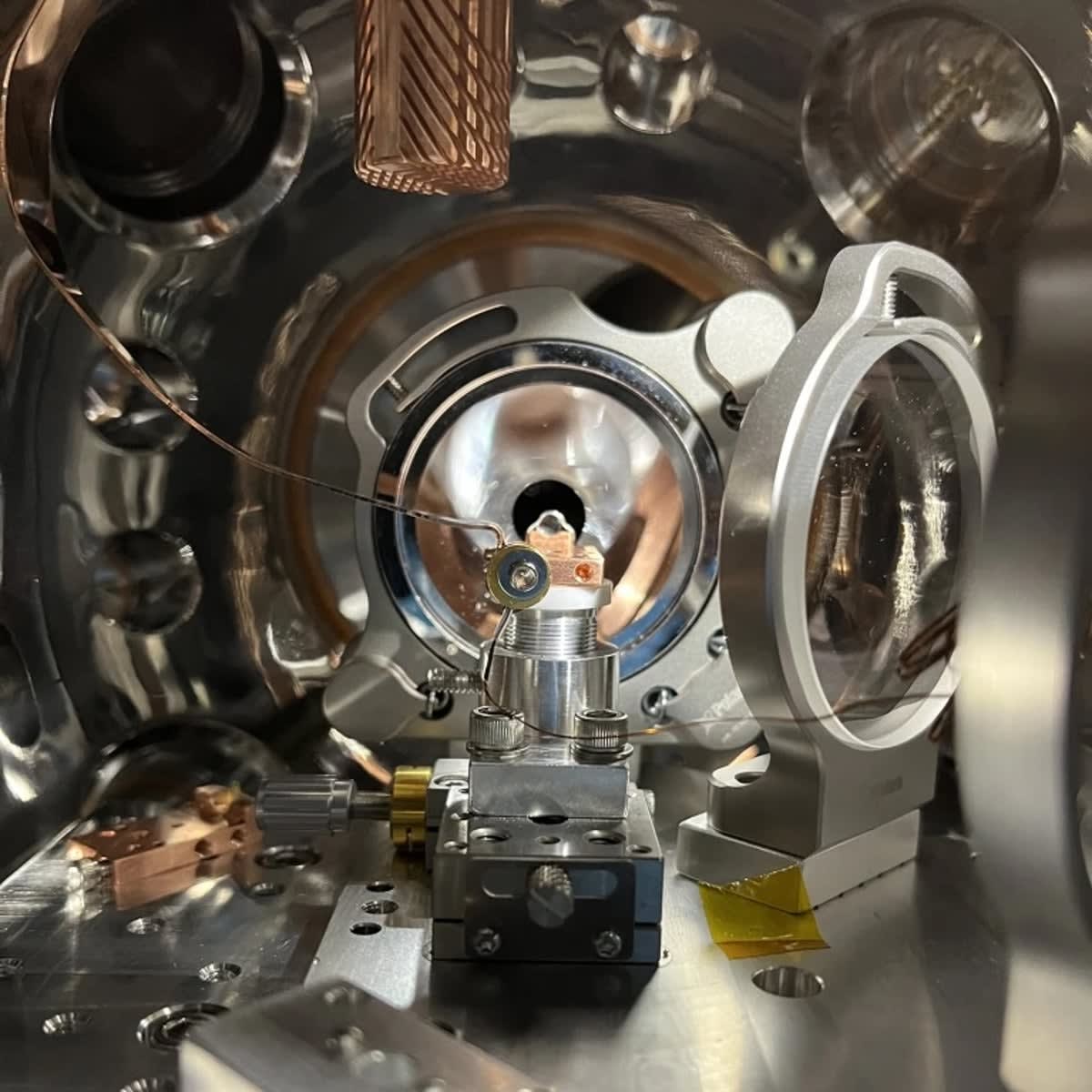
Some teams are embedding thorium in solid crystals, while others trap just a handful of atoms in electromagnetic fields. Each approach has trade-offs between signal strength and precision, but both are showing real promise.
The physics community hasn't felt this energized about timekeeping in years. As one researcher put it, building an ultraviolet laser powerful enough for nuclear clocks was "a technical problem that no one needed to solve before, and now we will solve it."
After 50 years of searching and setbacks, the countdown to a new era of timekeeping has finally begun.
More Images


Based on reporting by Scientific American
This story was written by BrightWire based on verified news reports.
Spread the positivity!
Share this good news with someone who needs it