Scientists Scan 2,000 Ants in a Week Using AI and X-Rays
Researchers combined particle accelerators, robotics, and AI to create detailed 3D models of 800 ant species in just seven days. The free digital library reveals microscopic anatomy that could revolutionize how we study and share Earth's biodiversity.
A project that would have taken six years with traditional equipment was just completed in one week, thanks to a groundbreaking combination of particle physics and artificial intelligence.
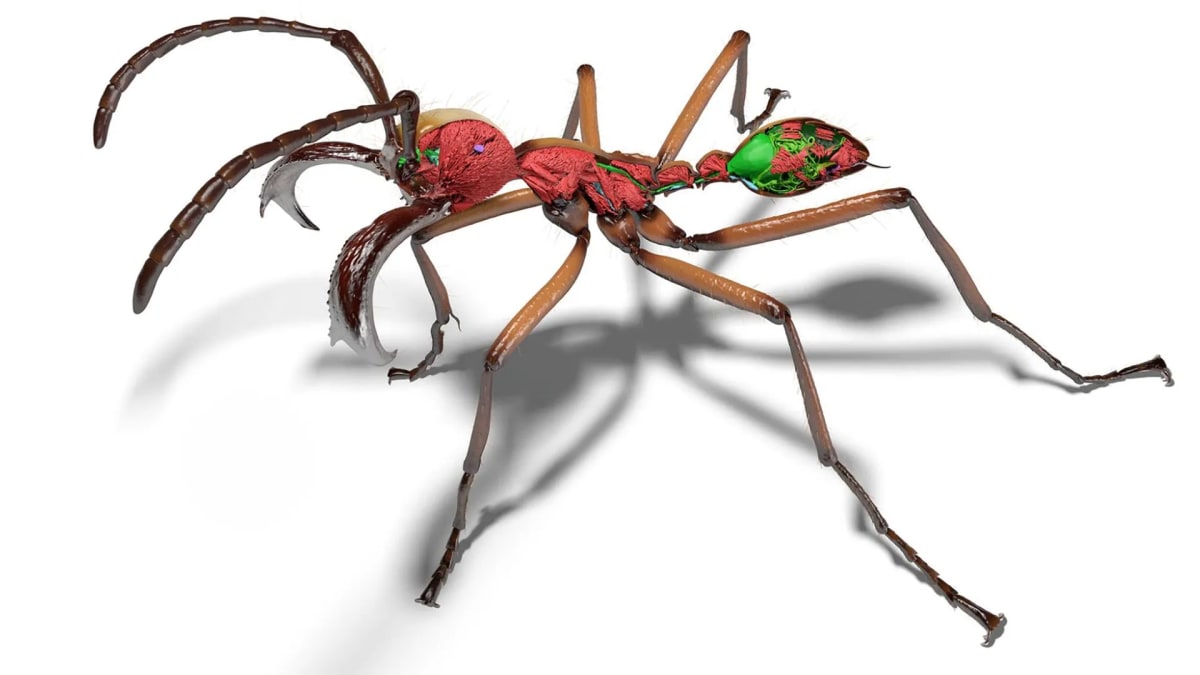
Scientists led by Evan Economo at the University of Maryland have created stunning 3D models of 800 ant species using a synchrotron particle accelerator, high-speed X-ray scanning, robotics, and AI. The team scanned 2,000 ant specimens in a single week at Germany's Karlsruhe Institute of Technology, capturing details down to the micrometer level.
For over a decade, Economo's lab struggled with a major bottleneck. Traditional micro-CT scanners produced rich 3D data but took up to 10 hours to scan just one tiny ant specimen.
The new system changed everything. A synchrotron accelerator generated an intense X-ray beam while a robotic arm rotated and replaced specimens every 30 seconds, creating stacks of images that computers assembled into complete 3D models.
The results are breathtaking. The digital ants reveal muscles, nervous systems, digestive organs, and stingers with incredible clarity, showing internal anatomy that was previously difficult to study.
But there was one problem. The scans initially captured ants in twisted, awkward positions that looked nothing like real insects.
University of Maryland computer science students stepped in to solve it. They developed AI tools that automatically adjust each scan so the ants appear in natural, lifelike poses similar to how they'd look in the wild.
The Ripple Effect
The free Antscan database is already fueling new discoveries. Scientists recently used the data to investigate whether ant colonies benefit more from many smaller workers or fewer individuals with stronger bodies, examining relationships across more than 500 species.
The implications extend far beyond entomology. When specimens are digitized at this scale, they become accessible to everyone from research laboratories to classrooms to filmmakers.
These interactive models can be animated, placed into virtual reality environments, or downloaded for free by anyone with internet access. Teachers can show students ant anatomy without expensive equipment, and researchers worldwide can study rare species without traveling to distant museums.
The technology also offers a blueprint for digitizing other organisms at scale. As AI continues improving, creating vast libraries of Earth's biodiversity becomes increasingly possible.
We're building a living digital library of life on Earth, one tiny insect at a time.
Based on reporting by Science Daily
This story was written by BrightWire based on verified news reports.
Spread the positivity!
Share this good news with someone who needs it