Scientists Solve 570-Million-Year-Old Fossil Mystery
Ancient ocean chemistry, not tough bodies, preserved Earth's strangest soft-bodied creatures in stunning detail. The discovery reveals how complex life emerged before animals took over the planet.
Scientists just cracked one of paleontology's biggest puzzles: how jellyfish-like creatures from 570 million years ago survived as fossils when soft bodies almost never do.
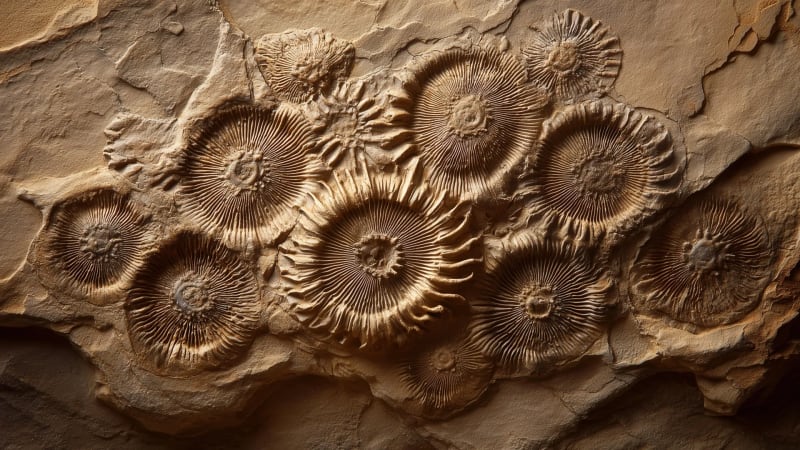
The Ediacara Biota are Earth's weirdest fossils. These ancient organisms had bizarre shapes with spiral arms, three-way symmetry, and fractal patterns that look nothing like modern life.
For decades, scientists assumed these creatures must have had unusually tough bodies to leave such detailed impressions in sandstone. But a new study from Yale University reveals the real secret was in the water itself.
Dr. Lidya Tarhan and her team analyzed lithium isotopes in fossils from Newfoundland and northwest Canada. They discovered that ancient seawater, rich in silica and iron, triggered clay minerals to form directly around buried organisms like natural cement.
These authigenic clays wrapped around soft tissues and locked their shapes into sandstone with remarkable precision. The process captured delicate details that should have vanished within days of death.
The finding completely rewrites our understanding of how these creatures were preserved. It wasn't about biological toughness at all but about perfect environmental conditions that no longer exist today.
The Ediacara Biota lived just tens of millions of years before the Cambrian Explosion, when complex animal life suddenly diversified around 540 million years ago. Scientists once thought that explosion appeared out of nowhere.
Now researchers see it as the end of a much longer story. Tarhan describes the Ediacara period as a "long fuse" leading to the Cambrian breakthrough, with these strange organisms representing an important early chapter in animal evolution.
Understanding how they were preserved helps scientists figure out what life actually looked like on the ancient seafloor. If preservation depended on special ocean chemistry rather than tough bodies, then these fossils might represent typical creatures from their time, not just the hardy survivors.
Why This Inspires
This discovery shows how asking the right questions can unlock mysteries that stumped experts for generations. By using innovative chemistry techniques instead of traditional fossil analysis, Tarhan's team revealed a preservation process that transformed our view of early life.
The research also reminds us that Earth itself was once dramatically different. Ancient oceans had chemistry that could turn sand into a time capsule, capturing fragile creatures in stone and delivering their stories across half a billion years.
Tarhan plans to test whether similar processes preserved other exceptional fossils from different times and places. Each answer brings us closer to understanding how complex life began its journey toward the vibrant world we see today.
Based on reporting by Google: fossil discovery
This story was written by BrightWire based on verified news reports.
Spread the positivity!
Share this good news with someone who needs it