Scientists Solve Mystery of "Little Red Dots" in Deep Space
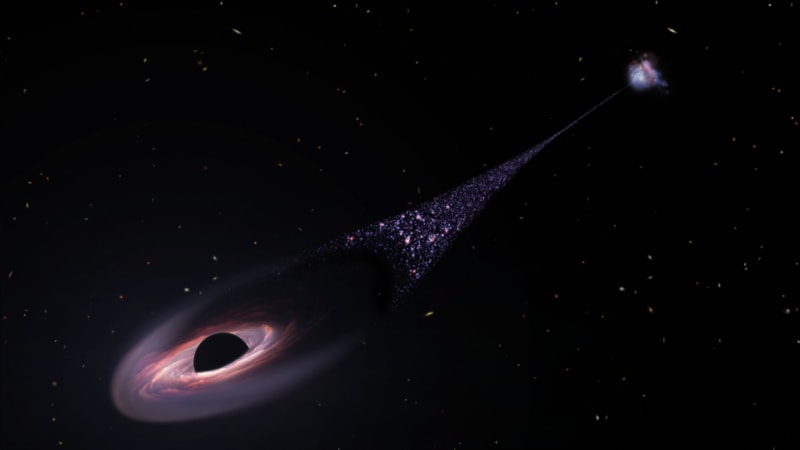
Astronomers puzzled by mysterious red dots in deep space images have discovered something beautiful: baby black holes growing inside protective cocoons of gas, like cosmic butterflies. The finding solves a year-long mystery and reveals a previously unknown stage in how supermassive black holes develop.
When the James Webb Space Telescope beamed back its first stunning images from deep space, astronomers spotted something strange: tiny glowing red dots that shouldn't exist.
These "Little Red Dots" were too bright to be normal galaxies and seemed to contain black holes far more massive than physics should allow. For months, scientists scratched their heads trying to explain what they were seeing.
Now a team led by astronomer Vadim Rusakov at the University of Manchester has cracked the case. The answer is surprisingly poetic: these are young supermassive black holes wrapped in dense cocoons of gas as they grow, much like caterpillars transforming into butterflies.
The mystery began because the dots looked impossibly massive. Based on their brightness, scientists calculated these black holes would need to weigh nearly as much as their entire host galaxies. That broke a fundamental rule astronomers had observed for decades: black holes typically account for just 0.1 percent of their galaxy's mass.
Even stranger, these objects appeared in images showing the universe when it was only 1 billion years old. Nothing should be able to grow that big, that fast.
The breakthrough came when Rusakov's team noticed the light signals looked weird. The spectral lines that help measure black hole mass had an unusual triangular shape instead of the typical bell curve. They also weren't detecting the X-rays that supermassive black holes normally emit.
The team realized they weren't looking at supersized black holes at all. They were seeing normal-sized young black holes surrounded by incredibly dense clouds of ionized gas. This fog of free electrons was scattering the light in ways that made the black holes appear 100 times more massive than they actually are.
Why This Inspires
This discovery does more than solve a cosmic puzzle. It reveals that black holes go through a vulnerable growth phase we'd never witnessed before, cocooned and protected as they develop.
"They look like a butterfly or something in this young state that grows wrapped in some sort of gas that also feeds it," Rusakov explains. The cocoon both shields the growing black hole and provides fuel for its development.
The finding shows that even the most extreme objects in the universe follow patterns we can understand. These aren't physics-defying monsters. They're young black holes between 10 million and 100 million times the mass of our Sun, following the same growth rules as their older cousins in nearby galaxies.
The James Webb Space Telescope caught these black holes at exactly the right moment in their lifecycle. We're seeing baby pictures of objects that will eventually become the giant black holes at the centers of mature galaxies.
What seemed impossible at first turned out to reveal something wonderful: the universe follows rules even in its most extreme corners, and we're getting better at reading them.
More Images



Based on reporting by Ars Technica Science
This story was written by BrightWire based on verified news reports.
Spread the positivity!
Share this good news with someone who needs it
%2Fhttps%3A%2F%2Ftf-cmsv2-smithsonianmag-media.s3.amazonaws.com%2Ffiler_public%2F3f%2F55%2F3f5579c8-c4a7-43a5-bb54-6498478792fd%2Fhelix1940__fitmaxwzk3mcw2ntbd.jpg)