Scientists Spot Universe's Brightest Microwave Laser
Astronomers discovered the brightest natural laser beam ever seen, created by two galaxies colliding nearly 8 billion light years away. The find opens a window into how the universe's earliest galaxies formed and merged.
Two galaxies crashing together 8 billion light years away just produced the brightest natural laser beam scientists have ever detected, and it's rewriting what we know about the early universe.
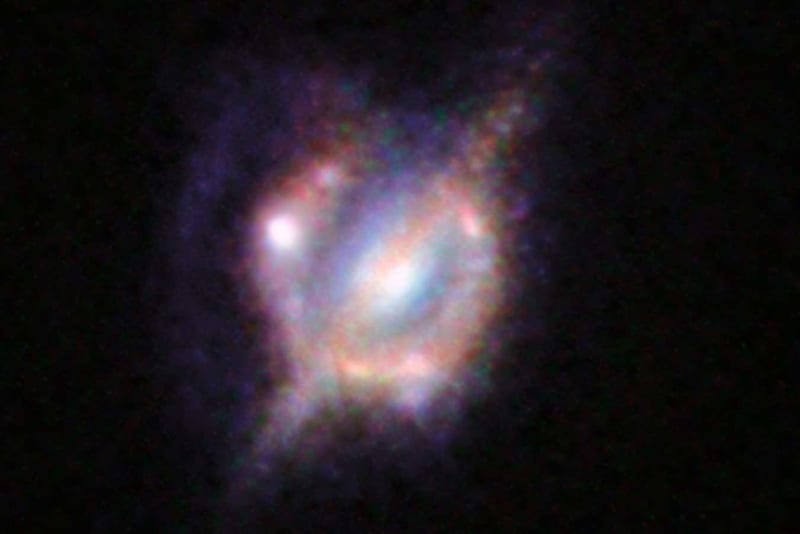
The discovery happened almost by accident. Roger Deane and his team at the University of Pretoria were using South Africa's MeerKAT telescope to search for hydrogen-rich galaxies when they pointed their instruments at a distant galaxy called H1429-0028. Instead of the expected signal, they found something far more spectacular.
"There was this booming, huge signal. It was immediately the record," says Deane. "It was serendipitous."
When galaxies collide, the gas from both gets compressed, sparking massive star formation. Light from these new stars travels through dust clouds and excites molecules made of hydrogen and oxygen. When radio waves from a supermassive black hole hit these excited molecules, they release focused beams of microwave radiation called masers. Think of it as nature's version of a laser, but using microwaves instead of visible light.
This particular maser is so powerful it might need its own category. Scientists are calling it a gigamaser, about 100,000 times brighter than our sun but concentrated into a tiny sliver of the electromagnetic spectrum. It's far more powerful than the megamasers previously observed in closer galaxies.
What makes the discovery even more remarkable is the cosmic magnifying glass that helped spot it. A massive galaxy sitting between Earth and H1429-0028 bends light through gravitational lensing, acting like nature's own telescope to make the distant signal visible.
The Ripple Effect
This breakthrough does more than set records. These ultra-bright masers only form under very specific conditions during galaxy mergers, making them perfect cosmic clocks for understanding how the universe evolved.
When South Africa's Square Kilometre Array telescope comes online in the coming years, it will detect similar masers from even more distant galaxies. These signals will come from some of the first galaxies ever formed, giving scientists precise information about cosmic history billions of years ago.
Matt Jarvis at the University of Oxford explains that finding these masers is like discovering cosmic fingerprints. The precise conditions needed reveal exactly what was happening during galaxy mergers in the early universe, answering questions about how galaxies grew and evolved over billions of years.
Sometimes the biggest discoveries happen when you're looking for something else entirely.
More Images

Based on reporting by New Scientist
This story was written by BrightWire based on verified news reports.
Spread the positivity!
Share this good news with someone who needs it