Scientists Track Water Worldwide Using Atomic Fingerprints
Researchers can now follow water's global journey using tiny atomic clues, creating the most accurate picture yet of how water moves across Earth. This breakthrough helps predict extreme weather and understand climate change impacts on future water patterns.
Scientists have figured out how to track a single drop of water as it travels around the entire planet.
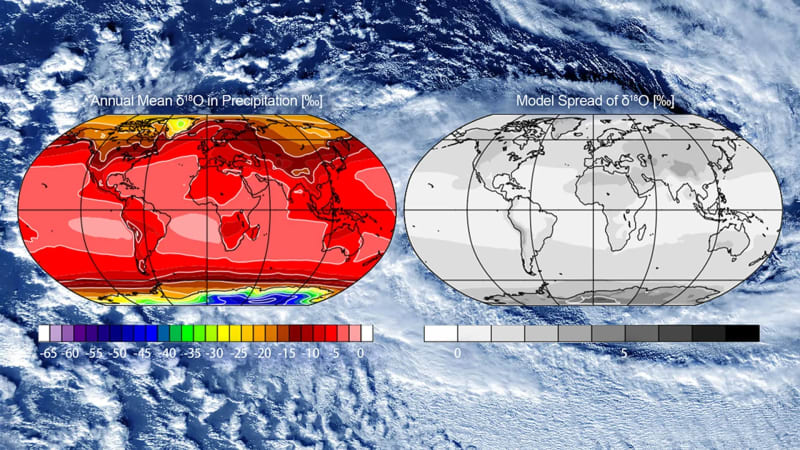
The breakthrough comes from researchers at the University of Tokyo, who combined eight advanced climate models to map water's global journey over 45 years. By reading tiny atomic fingerprints in water molecules, they created the most accurate simulation yet of Earth's water circulation.
Here's how it works: water contains slightly heavier versions of hydrogen and oxygen called isotopes. As water evaporates, forms clouds, and moves through the atmosphere, these isotopes shift in predictable patterns like a chemical GPS.
The team brought together models covering 1979 to 2023, all using the same wind and sea surface temperature data. This setup let them compare how different models handled water cycle physics and check their combined results against real world observations.
The ensemble approach worked better than any single model alone. The combined simulations matched actual data from global precipitation, water vapor, snow, and satellites far more accurately than individual models could.
Why This Inspires
This isn't just about tracking water for curiosity's sake. Understanding water's global path helps scientists predict extreme weather events like storms, floods, and droughts before they strike.
The models revealed strong connections to major climate patterns that affect billions of people, including El Niño and the North Atlantic Oscillation. Over the past 30 years, simulations showed rising atmospheric water vapor tied to increasing global temperatures.
"We are delighted that our ensemble mean values capture the isotope patterns observed in global precipitation, vapor, snow, and satellite data much more successfully than any of the individual models," said Professor Kei Yoshimura, who advised on several models in the project.
Dr. Hayoung Bong, now at NASA Goddard Institute for Space Studies, explained that ensembles reduce differences between individual models. This lets scientists separate how models represent water processes from differences in model structures.
This marks the first time multiple isotope tracking climate models have been integrated into a single unified framework. The resulting picture provides a more reliable view of how water moves through Earth's climate system.
The research gives scientists a stronger foundation for understanding how the global water cycle will respond to continued warming. Better predictions mean communities worldwide can prepare more effectively for changing weather patterns and water availability in the years ahead.
Based on reporting by Science Daily - Environment
This story was written by BrightWire based on verified news reports.
Spread the positivity!
Share this good news with someone who needs it