
Scientists Turn Light Into Material-Altering 'Alchemy
Researchers just found a way to transform ordinary materials into exotic quantum substances using light and particle pairs called excitons. This breakthrough could let us create custom materials on demand, opening doors to revolutionary technologies.
Imagine changing the fundamental properties of any material just by shining a light on it. Scientists at the Okinawa Institute of Science and Technology and Stanford University just made that dream much closer to reality.
The team discovered a powerful new way to practice what they call "Floquet engineering," a process that lets researchers temporarily rewrite the rules of how materials behave. By using particle pairs called excitons instead of light alone, they achieved results far stronger than ever before.
Here's how it works. Every material has electrons arranged in specific energy patterns, kind of like musical notes on a scale. When you shine light at a crystal at just the right rhythm, you can push those electrons into new patterns, creating hybrid energy levels that give the material completely different properties. A simple semiconductor could temporarily act like a superconductor, for example.
The catch has always been that light alone requires incredibly high intensities that nearly destroy the material while producing only modest effects. That's where excitons come in.
Excitons are pairs of negatively charged electrons and positively charged holes that stick together. Professor Keshav Dani and his team found that excitons couple much more strongly with materials than photons do, especially in ultra-thin, two-dimensional materials. This means they can achieve powerful transformations without the destructive intensity.
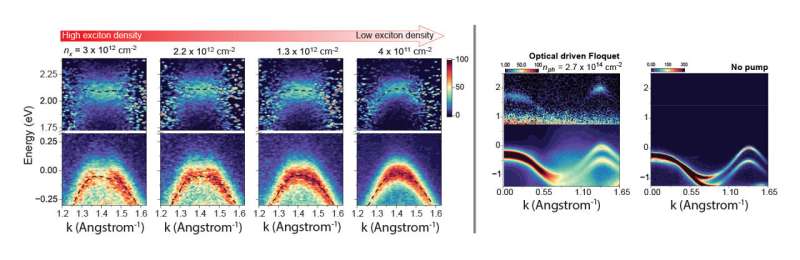
The researchers proved their concept using cutting-edge imaging technology that captures events happening in millionths of billionths of a second. They watched as excitons reshaped the energy bands of semiconductor materials in real time, creating the telltale "Mexican hat" pattern that signals successful Floquet engineering.
Why This Inspires
This breakthrough matters because it gives us a realistic path toward creating materials on demand. Need a superconductor for a specific application? Just apply the right excitonic drive to an ordinary semiconductor. The material transforms for as long as you need it, then returns to normal when you're done.
The implications stretch across quantum computing, advanced electronics, and energy technologies. Materials that would be impossible to create through traditional chemistry might become accessible through this quantum approach.
Since a bold theoretical proposal in 2009, scientists have struggled to make Floquet engineering practical. Only a handful of experiments in the past decade managed to demonstrate the effect at all. This new exciton-based method finally provides the efficiency needed to move from laboratory curiosity to real-world application.
The future of materials science might not involve mixing chemicals in beakers but rather conducting light like an orchestra to compose new substances on the fly.
More Images


Based on reporting by Phys.org
This story was written by BrightWire based on verified news reports.
Spread the positivity!
Share this good news with someone who needs it