Scientists Unlock Ancient Climate Mysteries With Groundbreaking New Earth Model
Researchers have developed an incredible high-resolution climate model that's revolutionizing our understanding of Earth's ancient climate patterns. The breakthrough technology successfully solved a long-standing puzzle about ice ages, opening exciting new doors for climate science and our planet's future.
In a thrilling scientific breakthrough, an international team of researchers has created a powerful new tool that's transforming how we understand Earth's climate history—and it's already solving mysteries that have puzzled scientists for decades.
Led by Professor Zhu Maoyan from the Chinese Academy of Sciences, the collaborative team—including experts from Peking University, the University of Leeds, and the University of Adelaide—developed CESM-SCION, a remarkably sophisticated climate model that represents a quantum leap forward in Earth science research.
What makes this achievement so exciting is the model's unprecedented level of detail. Previous climate models were like looking at Earth through foggy glasses—they could see the big picture but missed crucial details. The new CESM-SCION model, however, zooms in with crystal-clear resolution, capturing intricate climate patterns at a scale of just 3.75 degrees across the globe. This is like upgrading from standard definition to ultra-high definition television.
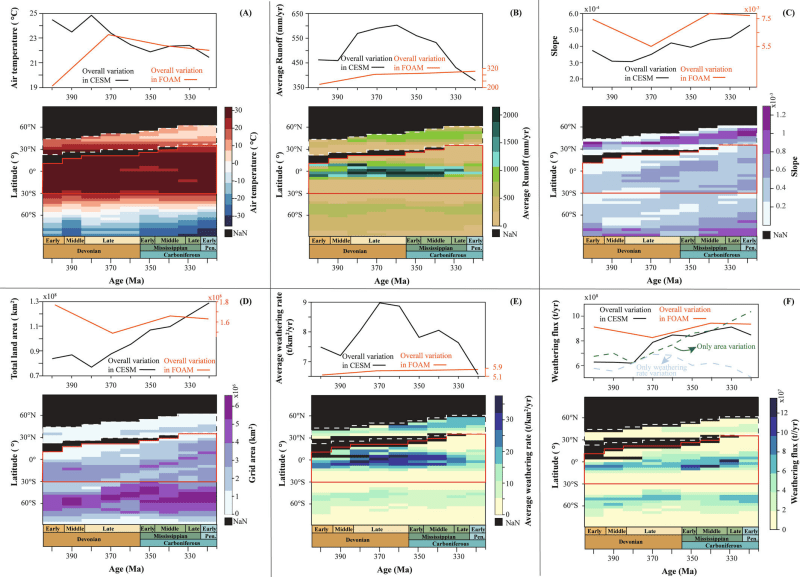
The team put their innovative model to the ultimate test by tackling one of paleoclimatology's most perplexing questions: what triggered the Late Paleozoic Ice Age, the longest icehouse period in the past 540 million years? Previous models had struggled to explain this dramatic climate shift during the mid-to-late Devonian period, even when accounting for factors like plant expansion and continental movement.
The results were remarkable. The high-resolution model revealed a previously overlooked mechanism: as ancient supercontinents assembled and sea levels fell, newly exposed land created a powerful "dual cooling effect." The expanded land surface not only reflected more sunlight back into space but also dramatically increased the area available for natural rock weathering—a process that removes carbon dioxide from the atmosphere.
This elegant discovery demonstrates how seemingly simple geological changes can trigger massive climate shifts. It's a testament to the complexity and interconnectedness of Earth's natural systems, and it showcases the beautiful mechanisms our planet has for self-regulation.
The implications of this research extend far beyond understanding ancient history. By developing tools that can accurately model Earth's climate behavior across millions of years, scientists are better equipped to understand current climate dynamics and make more informed predictions about our planet's future.
This breakthrough represents the culmination of decades of scientific progress, building on foundational work from the 1980s and incorporating cutting-edge computational techniques. It's a shining example of international scientific collaboration, bringing together expertise from multiple countries and institutions to tackle fundamental questions about our world.
The success of CESM-SCION opens exciting new possibilities for future research. Scientists can now investigate other critical periods in Earth's history with unprecedented accuracy, potentially unlocking answers to questions we haven't even thought to ask yet. Each discovery brings us closer to understanding the remarkable planet we call home.
This research, published in the prestigious journal Geophysical Research Letters, reminds us that scientific innovation continues to push boundaries, revealing the fascinating stories written in Earth's geological record and inspiring the next generation of climate scientists.
Based on reporting by Phys.org
This story was written by BrightWire based on verified news reports.
Spread the positivity! 🌟
Share this good news with someone who needs it
More Good News
 🚀 Innovation
Australian Researchers Create Game-Changing Tool to Protect Water From Toxic Chemicals
 🚀 Innovation
SK On and Seoul National University Make Exciting Battery Breakthrough
 🚀 Innovation
Revolutionary Quantum Computer Could Solve Humanity's Biggest Challenges
Joke of the Day
Why did the librarian get kicked out of class?
Explore Categories
Quote of the Day
"Do not go where the path may lead, go instead where there is no path and leave a trail."
— Ralph Waldo Emerson