Scientists Unlock Cosmic Secrets by Watching a Distant Star's Beautiful "Twinkle
Researchers at the SETI Institute spent nearly a year watching a distant pulsar's radio signals shimmer and dance through space, developing breakthrough techniques that will help astronomers make more precise measurements and improve the search for intelligent life beyond Earth.
In a fascinating demonstration of patience and precision, scientists at the SETI Institute have turned cosmic "twinkling" into a powerful new tool for understanding our universe. By watching a distant pulsar flicker for nearly 10 months, they've developed methods that will enhance both fundamental astronomy and the exciting search for extraterrestrial intelligence.
The research team, led by SETI Institute intern Grayce Brown, focused their attention on pulsar PSR J0332+5434, a remarkable cosmic lighthouse located thousands of light-years away. Pulsars are the incredibly dense remnants of massive stars that exploded long ago, and they spin rapidly while emitting radio signals with astonishing regularity. This consistency makes them nature's most precise clocks, and scientists rely on them for groundbreaking research including the detection of gravitational waves rippling through spacetime.
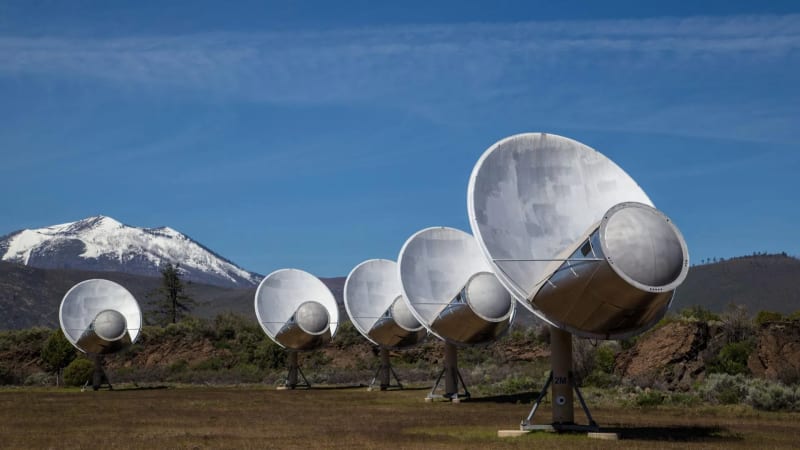
Using the powerful Allen Telescope Array in Northern California, the team observed something wonderful: the pulsar's radio signals didn't arrive with monotonous uniformity. Instead, they flickered and danced, much like stars shimmer when viewed through Earth's atmosphere on a clear night. This cosmic twinkling, known as scintillation, happens as radio waves pass through clouds of electrons floating in the space between stars.
What makes this research particularly exciting is that these patterns aren't static—they're constantly evolving as the pulsar, Earth, and the intervening gas clouds all move through space in their cosmic ballet. Over their 300 days of observations, the researchers watched these patterns shift and change, revealing cycles lasting roughly 200 days and fluctuations occurring over days and months.
"Pulsars are wonderful tools that can teach us much about the universe and our own stellar neighborhood," Brown explained enthusiastically. "Results like these help not just pulsar science, but other fields of astronomy as well, including SETI."
The practical applications of this research are truly impressive. By understanding exactly how these signals twinkle, astronomers can correct for tiny delays—sometimes just billionths of a second—that affect when pulsar signals arrive at Earth. This allows them to maintain the extraordinary precision needed for cutting-edge experiments that probe the fundamental nature of space and time.
Perhaps most thrillingly, this work directly benefits the search for extraterrestrial intelligence. Dr. Sofia Sheikh, co-author and Technosignature Research Scientist at the SETI Institute, emphasized the importance of their facility: "The Allen Telescope Array is perfectly designed for studying pulsar scintillation due to its wide bandwidths and ability to commit to projects that need to run for long stretches of time."
Understanding scintillation helps SETI scientists distinguish between natural cosmic radio signals and potential artificial transmissions from intelligent civilizations. It also helps them filter out interference from human-made technology here on Earth. In essence, by learning to read space's natural shimmer, researchers are sharpening their ability to spot signals that might represent something truly extraordinary—a message from beyond our world.
This patient, methodical work represents the best of modern astronomy: combining technological innovation, scientific rigor, and the timeless human drive to explore and understand our cosmic neighborhood.
Based on reporting by Science Daily
This story was written by BrightWire based on verified news reports.
Spread the positivity! 🌟
Share this good news with someone who needs it
More Good News
 🚀 Innovation
NASA's Roman Space Telescope: A Triumph of Science, On Time and Under Budget
 🚀 Innovation
Record-Breaking Discovery! New Observatory Finds Fastest-Spinning Asteroid Yet
 🚀 Innovation
Scientists Make Exciting Progress Toward Unlocking the Universe's Greatest Secrets
Joke of the Day
Why did the dog apply for a job at the bank?
Explore Categories
Quote of the Day
"The greatest thing you'll ever learn is just to love and be loved in return."
— Moulin Rouge (from the film, popularized by Ewan McGregor)