Scientists Unlock RNA Secret That Could Fight Tuberculosis
Rockefeller researchers discovered how two promising antibiotics shut down disease-causing bacteria while revealing a hidden piece of biology shared across all life. The breakthrough could lead to powerful new treatments for drug-resistant infections.
Scientists just cracked a decades-old puzzle about how certain antibiotics work, and the answer revealed something amazing about life itself.
Researchers at Rockefeller University figured out exactly how two experimental antibiotics stop deadly bacteria in their tracks. These drugs target RNA polymerase, the enzyme responsible for copying DNA into RNA in every living cell.
For years, scientists knew these antibiotics could halt tuberculosis and other dangerous infections, but they couldn't see how. Traditional imaging methods showed where the drugs attached to the enzyme but not what they actually did.
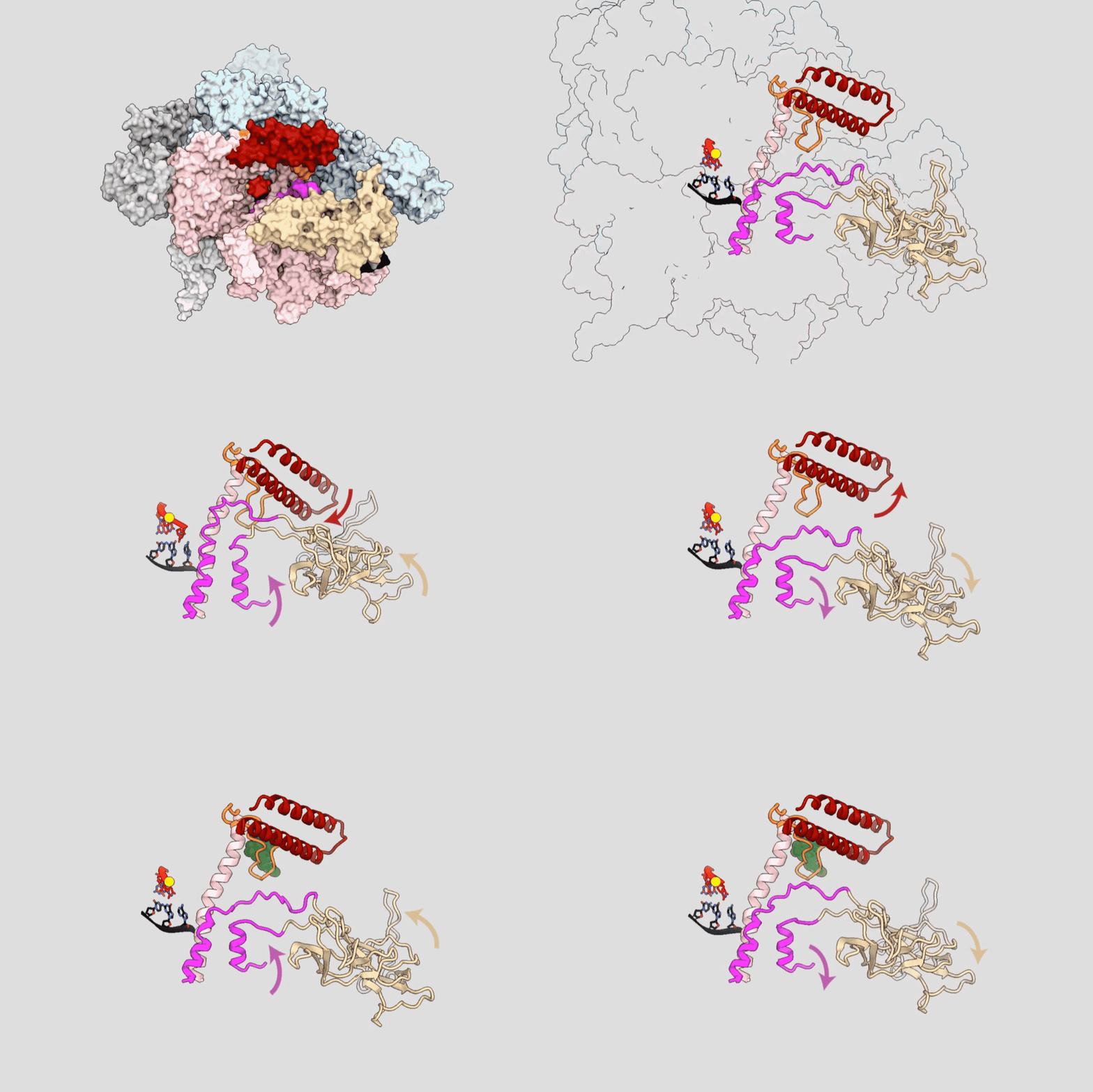
The team used cryo-electron microscopy, a powerful technique that captures proteins in motion, to watch the enzyme work in real time. What they discovered changed everything.
They found that RNA polymerase has a previously unknown moving part called the rim helices/F-loop. This component swings into place with each RNA building block the enzyme adds, stabilizing the process like a hand steadying a wobbling tower.
The antibiotics work by jamming this moving part in the open position. Without that stabilizing motion, the enzyme can't build RNA, gene expression grinds to a halt, and the bacteria die.
Here's the really exciting part: the researchers saw this same mechanism in both E. coli and tuberculosis bacteria. Since these organisms evolved separately, the discovery suggests this movement is fundamental to life across multiple domains.
Why This Inspires
This discovery does double duty for human health. First, it solves a medical mystery that's puzzled researchers for decades, explaining exactly how these promising antibiotics disable dangerous pathogens.
Second, it reveals a basic biological process we didn't know existed. Understanding how this essential enzyme works at such a detailed level opens doors across medicine and biology.
The findings provide a precise blueprint for developing next-generation antibiotics. Because these drugs target a vulnerability unique to bacterial RNA polymerase, they could fight infections without harming human cells.
That's especially critical for tuberculosis, which increasingly resists existing treatments. Nearly 1.5 million people die from TB each year, and drug-resistant strains are spreading.
Lead researcher Yukti Dhingra describes watching the enzyme shift between open and closed states, then seeing that motion disappear entirely when the antibiotic was added. The team could literally see the drug working at the molecular level.
The research team was led by Seth Darst, whose laboratory specializes in understanding molecular machinery at atomic resolution. Their work appears in the Proceedings of the National Academy of Sciences.
What started as a quest to understand two experimental drugs ended up revealing something fundamental about the machinery of life itself.
More Images


Based on reporting by Google News - Scientists Discover
This story was written by BrightWire based on verified news reports.
Spread the positivity!
Share this good news with someone who needs it