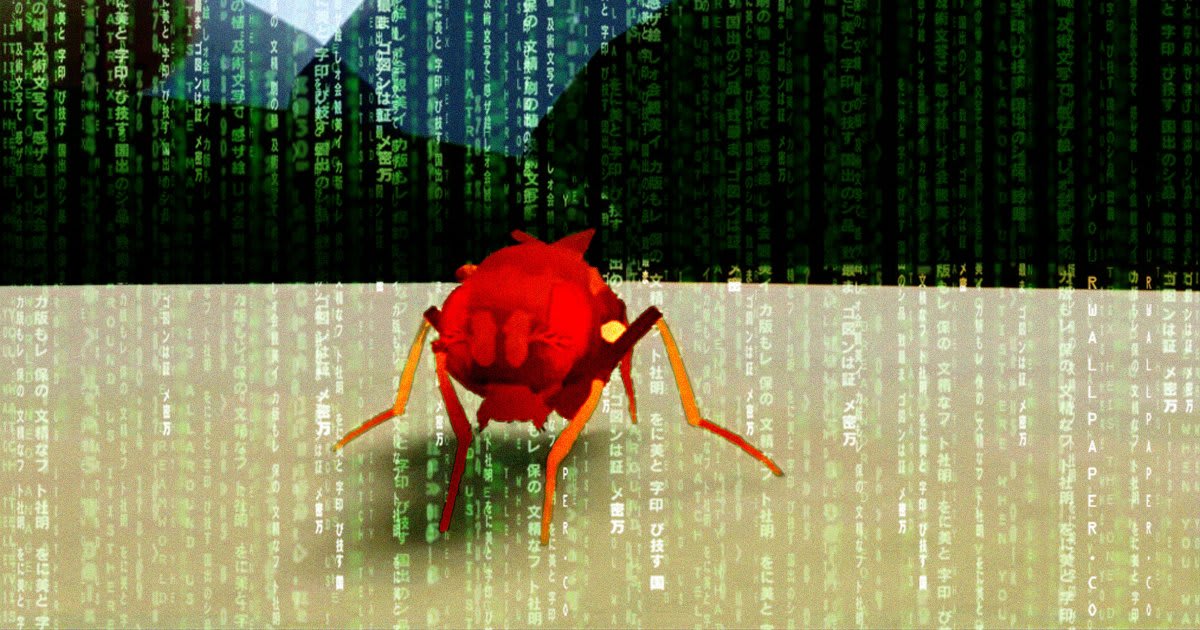
Scientists Upload Fly Brain, Watch It Move Virtual Body
Researchers successfully transferred a complete fruit fly brain into a virtual world where it controls a digital body using its own neural circuits. This breakthrough marks the first time a whole-brain emulation has produced multiple natural behaviors in a simulated environment.
A digital copy of a fruit fly's brain just took its first steps in a virtual world, and scientists say this could be the beginning of something extraordinary.
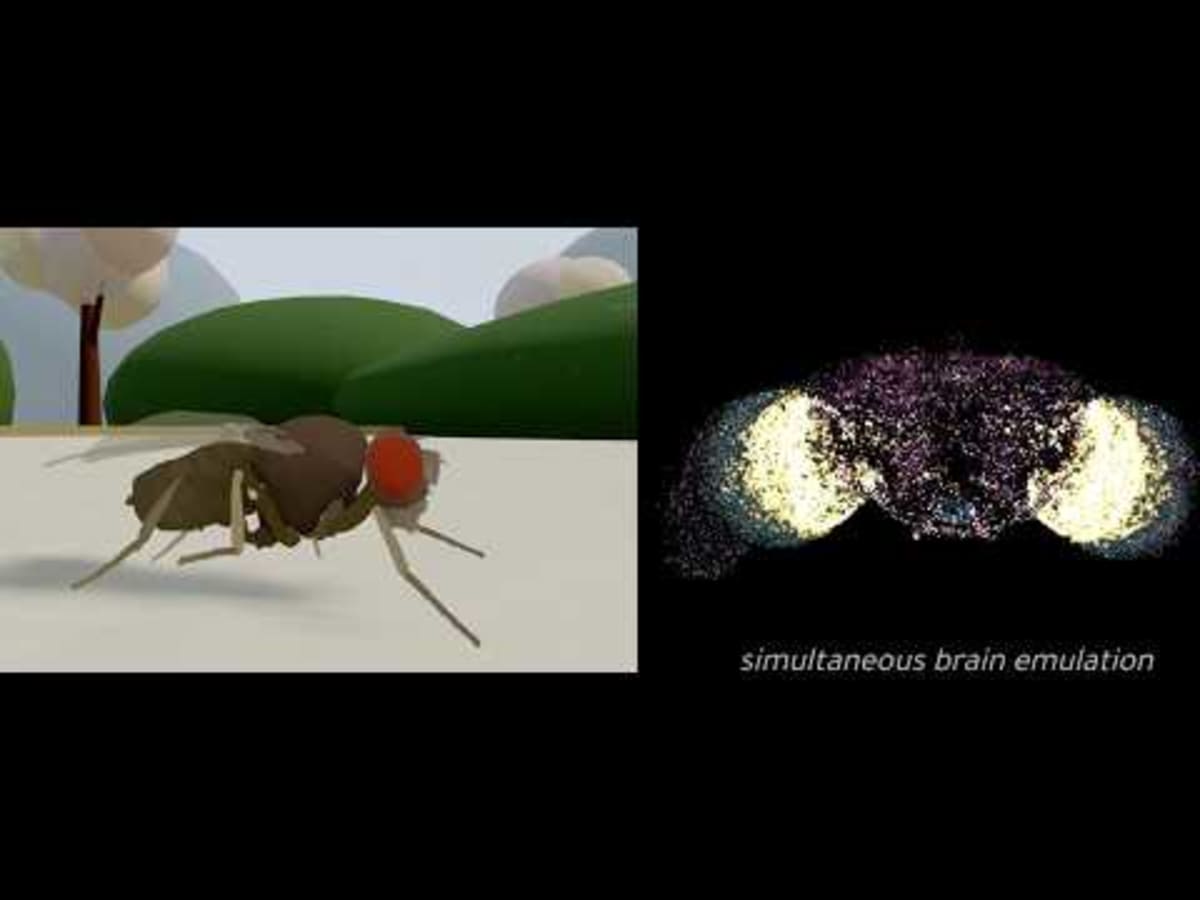
Eon Systems researchers uploaded the complete neural wiring of an adult fruit fly—all 125,000 neurons and 50 million connections—into a computer simulation. The virtual insect immediately started behaving like a real fly, stretching its legs, rubbing its feet together, and drinking from a tiny digital bowl.
What makes this different from artificial intelligence is that nothing was programmed or trained. The researchers simply copied the actual brain structure of a real fly, neuron by neuron, and let it run. When the virtual brain received sensory information, it processed the data through its natural circuits and sent motor commands to move the simulated body.
The project builds on groundbreaking work published in Nature in 2024, where researchers created a computational model that predicted fly behavior with 95 percent accuracy. Using the FlyWire connectome (a complete wiring diagram of a fruit fly brain from Princeton), they mapped how the brain controls feeding and grooming behaviors.
Now Eon Systems has taken it further by giving that brain somewhere to exist. They connected their brain emulation to NeuroMechFly v2, a physics-based body simulation developed at the Swiss Federal Technology Institute of Lausanne. The result closed the loop from perception to action for the first time in whole-brain emulation history.
Why This Inspires
This achievement represents more than just a scientific curiosity. Unlike other approaches that use reinforcement learning to mimic biological behavior, this is an actual biological brain operating in digital form. The virtual fly behaves naturally because it's using the same neural pathways that evolved over millions of years.
The implications stretch far beyond fruit flies. Eon Systems is already planning to simulate a mouse brain next, which contains over 500 times more neurons. While that presents enormous technical challenges, the team believes they've proven the concept works. The question now is about scale, not possibility.
Alex Weissner-Gross, Eon Systems cofounder, emphasized what viewers are witnessing in their demonstration video isn't animation or artificial intelligence pretending to be a fly. It's a genuine copy of a biological brain making decisions and controlling movement through its own circuit dynamics. Every behavior emerges from the brain's natural wiring, just as it would in a living insect.
The research opens doors to understanding how brains generate behavior at the most fundamental level. Scientists can now observe every neuron firing, trace every signal, and watch how sensory input transforms into physical action in ways impossible to study in living creatures.
For decades, whole-brain emulation existed only in theory and science fiction. Today, a fruit fly's consciousness (if we can call it that) exists in two places at once: in nature and in the digital realm.
More Images
Based on reporting by Futurism
This story was written by BrightWire based on verified news reports.
Spread the positivity!
Share this good news with someone who needs it

