Scientists Use $50 Hammers to Map World's Soil Health
A global team is turning earthquake science into an affordable tool that helps farmers understand and heal their soil. The Earth Rover Program uses simple hammer taps and sensors to reveal what's happening beneath our feet.
Scientists across four continents just discovered they can measure soil health with nothing more than a hammer, a metal plate, and some sensors borrowed from earthquake research.
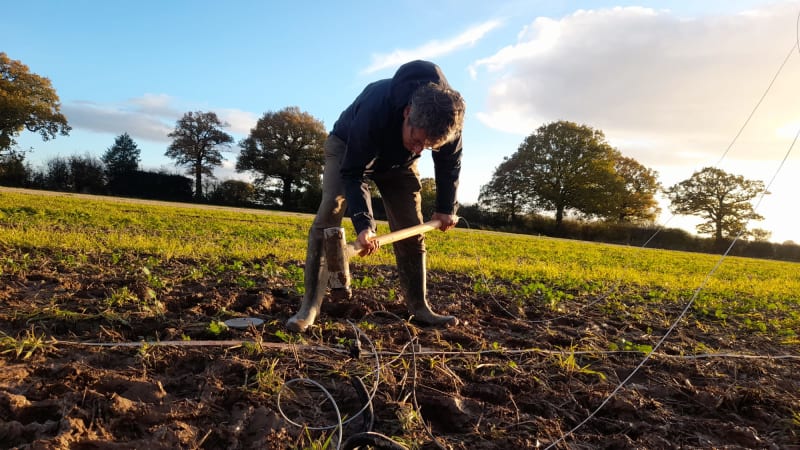
The Earth Rover Program connects farmers and researchers through "soilsmology," a playful twist on seismology that tracks how energy waves move through dirt. When a hammer strikes a metal plate on the ground, sensors pick up the vibrations and translate them into data about what's happening below the surface.
It sounds simple, but the implications are massive. Soil holds more carbon than our atmosphere and all plants combined, and nearly every bite of food we eat depends on healthy soil to grow. Yet soils worldwide are exhausted from overuse, eroding away, and struggling under climate change.
The problem until now has been measuring soil health. Traditional methods require digging deep pits that take a full day to assess just one field. They're expensive, invasive, and can't provide the big picture farmers need to make smart decisions about their land.
Simon Jeffery, a soil ecology professor at Harper Adams University in the U.K., co-founded the program with geophysicist Tarje Nissen-Meyer and journalist George Monbiot. Their goal is to give farmers worldwide access to technology that reveals critical information like soil compaction and depth.
Compacted soil is a silent killer for crops. When soil gets squashed too tightly, plant roots can't push through, water doesn't flow, and gases can't exchange. The hammer tap method can detect this compaction quickly and cheaply.
The technology also solves another frustrating gap in soil science. A 2016 map of carbon stocks across Europe had to assume all topsoil was 20 centimeters deep because measuring actual depth across large areas was nearly impossible. In reality, topsoil ranges from 5 centimeters in some spots to a full meter in others.
Leigh Ann Winowiecki, who leads soil and land health research at CIFOR-ICRAF in Nairobi, wasn't part of the Earth Rover team but recognizes the need. She says monitoring approaches must be robust, cost-effective, and scalable across diverse ecosystems if we're going to track soil health over time.
During a December 5 webinar, the team demonstrated their system working simultaneously across nine fields on four continents. As hammers struck metal plates in sync, laptops and smartphones lit up with squiggly waveforms from each location.
The Ripple Effect
The beauty of Earth Rover goes beyond individual farms. By making soil assessment affordable and accessible, the program could create the first truly global picture of soil health. Farmers who've never had access to soil data could make informed decisions about crop rotation, water management, and carbon sequestration.
Franciska de Vries, an Earth surface science professor at the University of Amsterdam, calls the potential for high-resolution, quick, and cheap soil assessment "brilliant." What once took a full day and significant expense could soon happen in minutes for a fraction of the cost.
The Earth Rover team is still in early stages, but they're building partnerships with researchers worldwide, including the Alliance of Bioversity International and International Center for Tropical Agriculture in Colombia. Their vision is ambitious: equip farmers everywhere with tools to grow crops sustainably while keeping soil healthy for generations to come.
After all, without healthy soil beneath our feet, the wonderful ecosystems we see above ground simply can't exist.
More Images


Based on reporting by Mongabay
This story was written by BrightWire based on verified news reports.
Spread the positivity!
Share this good news with someone who needs it