
Sea Clouds Boost Offshore Wind Farm Efficiency by 50%
Low-level clouds over the ocean can shrink wind turbine wakes by nearly half, potentially transforming how offshore wind farms are designed. Dutch researchers discovered nature's own efficiency hack hiding in plain sight.
Offshore wind farms just got a surprising ally: the clouds above them.
Researchers at the University of Twente in the Netherlands discovered that low-level sea clouds can dramatically improve wind farm efficiency by helping turbines recover from their own drag. The finding could reshape how we design the renewable energy infrastructure powering our future.
Here's the problem wind farms face: air slows down as it passes through turbine blades, creating a wake of sluggish air that can stretch over 60 miles. This wake hurts the performance of downstream turbines, making multiple wind farms far less efficient than a single isolated one.
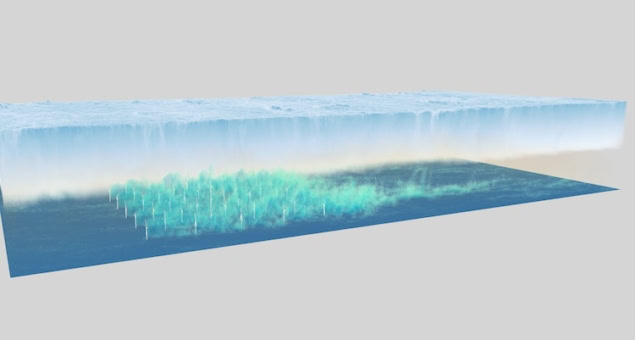
Physicist Davide Selvatici and his colleague Richard Stevens found an unexpected solution. Low-level stratocumulus clouds trigger a process called radiative cooling, where cloud tops release heat into space and cool down. This cooler, denser air sinks, creating turbulence that mixes faster wind from above down into the slow wake below.
The difference is striking. With cloud-top cooling, wind speeds recover to 90% of normal just 11 miles past a wind farm. Without clouds, wind speeds stay sluggish even 20 miles beyond the farm.
The team used sophisticated three-dimensional simulations to model how air flows through wind farms under different sky conditions. They solved complex equations tracking wind movement in all directions while accounting for temperature, water vapor, and liquid water in clouds.
Why This Inspires
Since wind power increases with the cube of wind speed, even small speed improvements create major gains. A 10% increase in wind speed means 33% more power generation.
The timing couldn't be better. The North Sea, home to many offshore wind farms, has cloud coverage above 30% year-round. Most current wind farm models either oversimplify or completely ignore cloud effects.
Stevens believes this research could help designers determine optimal spacing between wind farms. While the team isn't ready to offer specific placement recommendations yet, their simulations represented idealized conditions that need real-world testing.
The discovery highlights how nature often has solutions we overlook. The same clouds that might seem like obstacles to solar panels are actually wind energy's secret weapon, naturally enhancing the very turbulence that keeps turbines running efficiently.
Clean energy just got a little help from above.
More Images



Based on reporting by Google News - Wind Energy
This story was written by BrightWire based on verified news reports.
Building Something New? Try the BrightWire Tech Stack Advisor
Compare modern frameworks, cloud hosting, and AI tools tailored to your project budget and scale.
Spread the positivity!
Share this good news with someone who needs it


