%2Fhttps%3A%2F%2Ftf-cmsv2-smithsonianmag-media.s3.amazonaws.com%2Ffiler_public%2F00%2F9f%2F009fed7b-9f75-4578-a718-96c0c5842c92%2Fgettyimages-2154196583.jpg)
Sea Star Study Could Make Robots Nearly Indestructible
Scientists discovered sea stars can lose an arm and keep moving using decentralized control. This breakthrough could lead to robots that keep working even when parts fail.
Imagine a robot that keeps working perfectly even after losing a wheel or breaking a sensor. Scientists studying sea stars just figured out how nature already solved that problem.
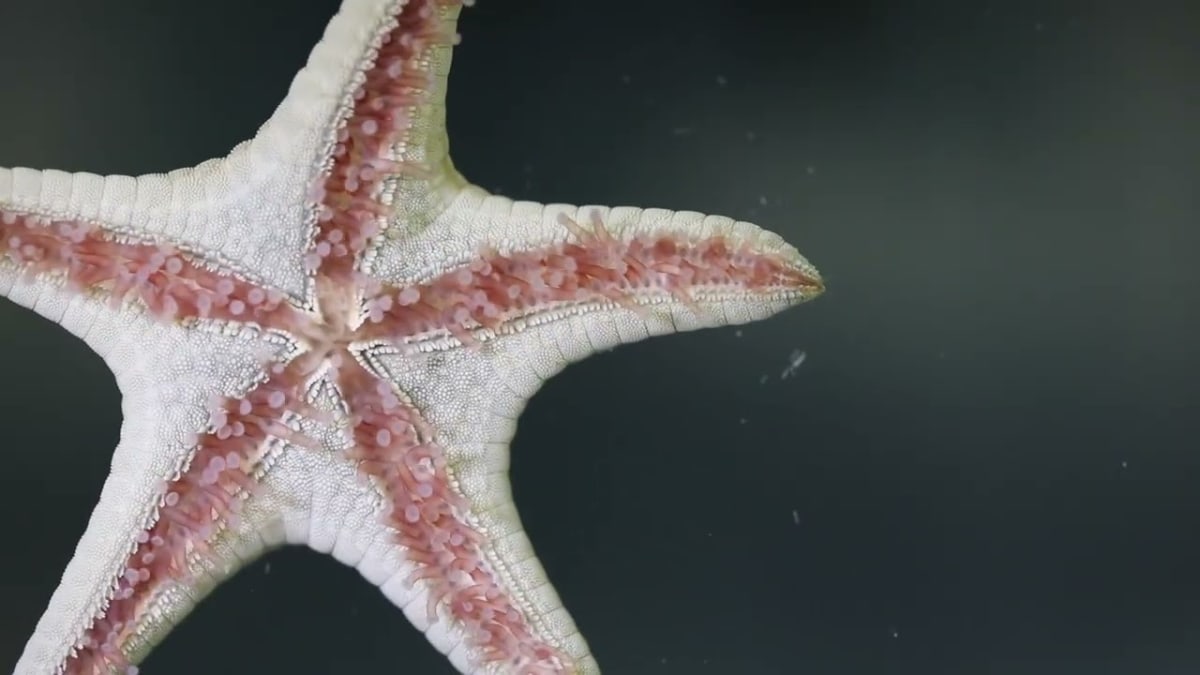
Researchers at the University of Southern California discovered that sea stars move without a brain giving orders. Instead, each of their hundreds of tiny tube feet makes its own decisions based on what it touches and feels. When one foot or even an entire arm gets damaged, the others simply carry on.
The team gave sea stars 3D-printed backpacks to test how their feet responded to extra weight. The results were remarkable. Each foot worked independently, adjusting how hard it gripped and how long it stayed attached based on local feedback from its surroundings. No central command needed.
Eva Kanso, the lead researcher, saw the potential immediately. "If they lose an arm, they continue walking," she says. "That would be very attractive to translate to engineering."
The discovery opens exciting doors for robotics. Current robots rely on a central computer to control every movement. If one part fails, the whole machine often stops working. But a robot inspired by sea stars could have parts that function independently, adapting to changing terrain without waiting for instructions.
The team has already created working mathematical models and early robot prototypes using this concept. Their vision is simple but powerful: robots where failure of some parts doesn't mean failure of the entire mission.
The Ripple Effect
This breakthrough matters most in places where fixing broken robots is nearly impossible. Think of rovers exploring Mars, drones inspecting dangerous pipelines, or underwater vehicles mapping the ocean floor. Harsh environments where electronics fail regularly could finally have machines that adapt and survive.
The same principle could transform search and rescue robots that need to navigate unpredictable disaster zones. If one sensor breaks while crawling through rubble, the robot keeps going instead of becoming another obstacle.
Scientists call this approach bioinspiration, and sea stars aren't alone in teaching us. Soft robots already mimic octopus arms, and swarm robotics takes cues from bees. But the sea star's radical simplicity offers something special: proof that you don't need complexity to achieve resilience.
The humble sea star, crawling slowly across ocean rocks, just showed us how to build machines that refuse to quit.
More Images
%2Fhttps%3A%2F%2Ftf-cmsv2-smithsonianmag-media.s3.amazonaws.com%2Ffiler_public%2F00%2F9f%2F009fed7b-9f75-4578-a718-96c0c5842c92%2Fgettyimages-2154196583.jpg)
%3Afocal(1061x707%3A1062x708)%2Fhttps%3A%2F%2Ftf-cmsv2-smithsonianmag-media.s3.amazonaws.com%2Ffiler_public%2F00%2F9f%2F009fed7b-9f75-4578-a718-96c0c5842c92%2Fgettyimages-2154196583.jpg)
%2Fhttps%3A%2F%2Ftf-cmsv2-smithsonianmag-media.s3.amazonaws.com%2Ffiler_public%2F79%2F55%2F7955529e-cee0-4dc4-9e92-d2f16f3f68e9%2Fseastartubefeet_v3.png)
Based on reporting by Smithsonian
This story was written by BrightWire based on verified news reports.
Spread the positivity!
Share this good news with someone who needs it