Senegal's Chimps Use Spears and Offer Clues to Our Past
In the hot savannas of Senegal, a rare group of 35 wild chimpanzees are doing something remarkable: crafting spears to hunt, soaking in pools to beat the heat, and showing us how our own ancestors might have survived millions of years ago. After 25 years of groundbreaking research, scientists are uncovering behaviors that could help both chimps and humans adapt to our warming world.
Deep in southeast Senegal's dry Sahel region, a community of wild chimpanzees is rewriting what we thought possible for their species.
The Fongoli chimps live in one of the hottest places any chimp has ever been studied, with temperatures soaring to 120 degrees Fahrenheit. Yet they've found ingenious ways to not just survive but thrive in conditions that would challenge most of their forest-dwelling cousins.
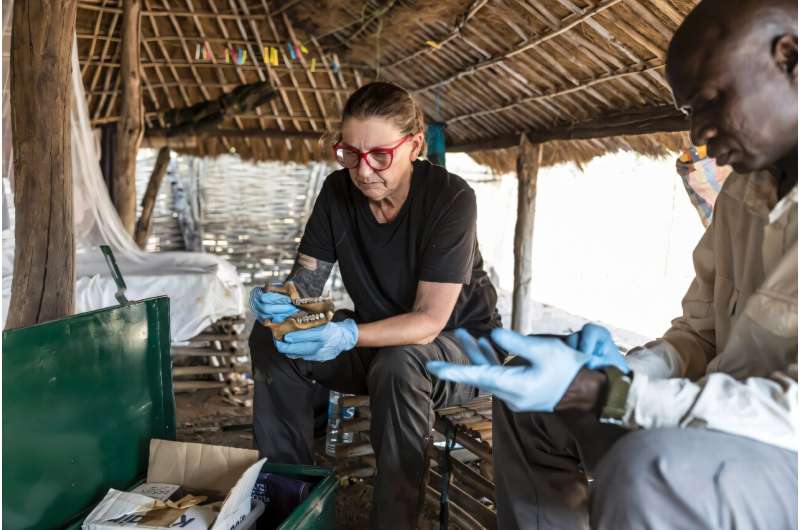
Primatologist Jill Pruetz has spent 25 years studying these remarkable animals, watching them develop behaviors never seen in other chimp communities. The females have proven especially innovative: they're the only non-human animals known to systematically craft and use tools for hunting.
Using their teeth, female chimps whittle sticks into sharp spears, then use them to hunt bush babies hiding in tree holes during the rainy season. Researchers have documented this sophisticated hunting technique nearly 600 times.
But their ingenuity doesn't stop there. When the savanna heat becomes unbearable, the Fongoli chimps take refreshing dips in natural pools, making them the only wild chimps in the world known to soak for relief. They also rest in caves where temperatures stay cooler, conserving precious energy during the brutal dry season.
The habitat these 35 chimps call home looks remarkably similar to the savanna woodlands where human ancestors lived six to seven million years ago. By studying our closest living relatives, scientists can test theories about how early humans might have behaved and adapted.
"We can help confirm some of the hypotheses about how those really early hominins, or bipedal apes, behaved," Pruetz explained to reporters during a recent visit to the research site.
The Ripple Effect
The Fongoli chimps' heat-beating strategies might offer insights beyond our evolutionary past. As climate change pushes temperatures higher worldwide, understanding how these apes cope with extreme heat could inform conservation efforts for other species facing similar challenges.
Local wildlife researcher Papa Ibnou Ndiaye notes that studying the Fongoli chimpanzees gives "the local administration accurate information to make informed decisions for the conservation of Senegal's biodiversity." The research has elevated awareness of these critically endangered West African chimpanzees, helping protect them even as new threats like gold mining emerge in their territory.
The decades-long study allows researchers to observe not just individual behaviors but how knowledge passes from one generation to the next. Young chimps like ambitious Pistache learn by watching their elders crack open baobab fruit at the tops of trees and navigate the complex social hierarchy of their community.
These resilient chimps prove that adaptation and innovation aren't uniquely human traits, and their survival strategies might just light the way forward for conservation in our warming world.
More Images


Based on reporting by Phys.org
This story was written by BrightWire based on verified news reports.
Spread the positivity! 🌟
Share this good news with someone who needs it