She Watched Moon Landing, Led India's First All-Woman Team
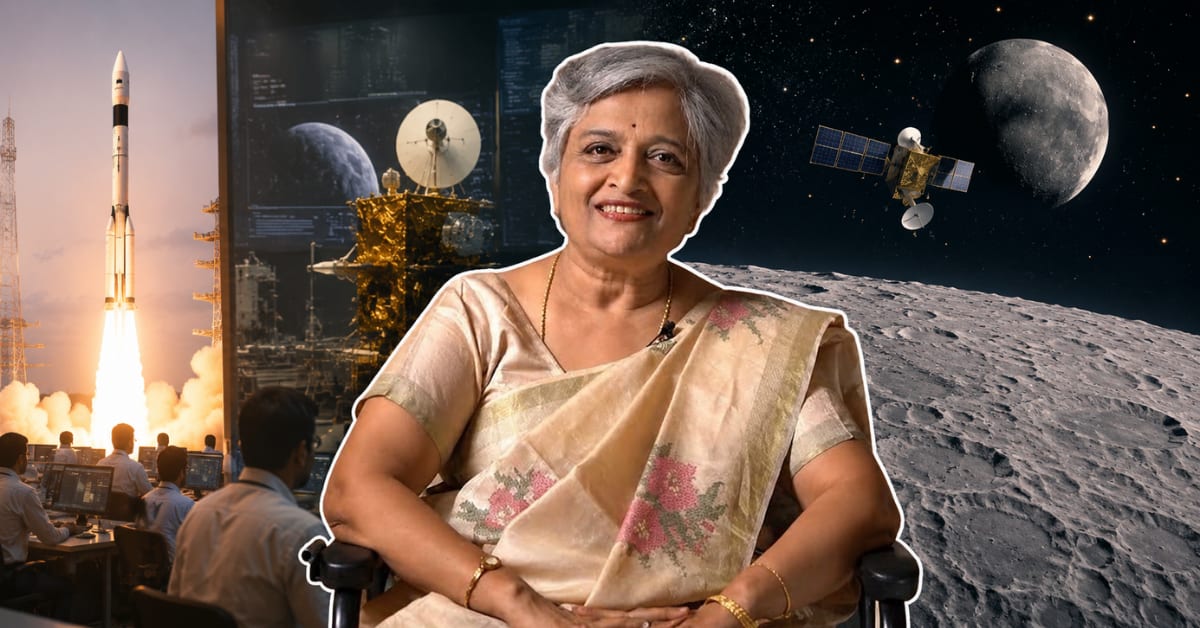
After Apollo 11 sparked her childhood dream, T K Anuradha became ISRO's first woman satellite project director. In 2011, she led an all-woman team that guided a communication satellite thousands of kilometers into space.
In 1969, a young girl in Karnataka watched astronauts walk on the Moon and decided space could be hers too. Four decades later, T K Anuradha stood in a control room thousands of kilometers away, guiding India's GSAT-12 satellite into orbit as the country's first woman satellite project director.
Born in 1960, Anuradha grew up in Shivamogga and Bengaluru with three sisters and a Sanskrit professor father who championed education. Math and science captivated her, but the Apollo 11 Moon landing transformed curiosity into purpose.
She topped her university class in Electronics and Communication Engineering at University Visvesvaraya College of Engineering in Bengaluru. Three years later, in 1982, she joined ISRO.
The work ahead proved more complex than most people realize. A satellite doesn't simply arrive at its destination after launch—it requires careful nudging and maneuvering into precise orbit positions, with engineers working in narrow windows when the spacecraft passes closest to Earth.
In July 2011, Anuradha tackled exactly this challenge as Project Director for the GSAT-12 mission. She helped develop an innovative approach to controlling geosynchronous satellites as they transition into their final orbits about 36,000 kilometers above the equator.
Get the calculations wrong, and years of work disappear into space. Her team got them right.
At ISRO's Master Control Facility in Hassan, Karnataka, Anuradha led an all-woman team monitoring every crucial maneuver. Alongside Mission Director Pramodha Hegde and Operations Director K S Anuradha, she watched the satellite's journey unfold across banks of screens and antenna systems.
When the satellite's antenna deployed successfully, the control room erupted in applause. Anuradha later described watching the satellite take its first steps as feeling "like delivering a baby."
The Ripple Effect
The technique Anuradha's team developed didn't just work for GSAT-12. It continued to be used in satellite operations after the mission, making future launches more reliable and efficient.
The all-woman leadership team wasn't intentional, but it became significant. Young women across India suddenly saw themselves reflected in one of the country's most prestigious scientific institutions.
Anuradha never set out to break gender barriers—she focused on the mission. But sometimes the most powerful change happens when talented people simply do excellent work, opening doors others didn't know existed.
That girl who watched the Moon landing didn't just reach space—she helped others believe they could too.
More Images
%2Fenglish-betterindia%2Fmedia%2Fmedia_files%2F2026%2F08%2F31%2Fanuradha-tk-2026-08-31-20-08-05.png)
%2Ffilters%3Aformat(webp)%2Fenglish-betterindia%2Fmedia%2Fmedia_files%2F2026%2F08%2F31%2Fanuradha-tk-2026-08-31-20-09-43.png)
%2Ffilters%3Aformat(webp)%2Fenglish-betterindia%2Fmedia%2Fmedia_files%2F2026%2F08%2F31%2Fanuradha-tk-2026-08-31-20-10-30.png)
Based on reporting by The Better India
This story was written by BrightWire based on verified news reports.
Spread the positivity!
Share this good news with someone who needs it