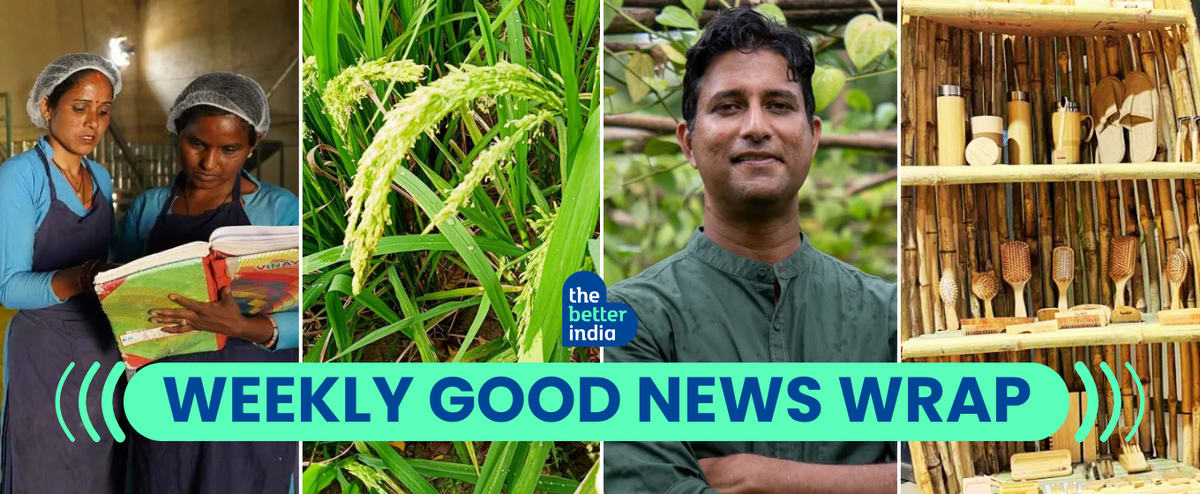
Solar, Bamboo & Rice: How Indians Build Green Incomes
Across India, entrepreneurs and farmers are turning sustainable work into reliable income streams. From solar-powered businesses in Uttar Pradesh to bamboo crafts in Rajasthan, these ventures prove green choices can strengthen livelihoods.
In rural India, power cuts used to dictate when work could happen and when it had to stop. Now, solar panels, bamboo workshops, and indigenous seeds are changing that rhythm entirely.
Suman runs a banking outlet in rural Uttar Pradesh, serving multiple villages. Before solar panels, her workday ended whenever the electricity went out. "After installing the solar panels, I don't worry about long power cuts anymore," she says. Nearby, Aarti Singh operates an RO water plant with the same reliable power source, managing timely deliveries and building stronger savings month after month.
In Rajasthan, childhood friends Anil Chauhan and Sawan Vaishnav saw potential in bamboo. Their company, Bamboo Anna, now generates Rs 1.45 crore annually while supporting over 70 local artisans who craft everyday items from the sustainable material. One artisan shares a simple truth about the steady work: "Now I am able to manage my home and my necessities."
Down in Goa's Mulgao village, microbiologist Rohan Nazareth built a zero-waste coconut brand that uses every part of the fruit. His virgin coconut oil follows a small-batch approach rooted in years of research. Local farmers and workers earn consistent income while the brand proves that careful science and community care can coexist.
Perhaps the most striking transformation is happening in the Sundarbans. What started as Sudhanshu Dey's small experiment with indigenous rice varieties has grown into a seed bank preserving 192 different types. Over 1,500 farmers now cultivate these crops, which thrive in local conditions and command strong market prices.
The Ripple Effect
These ventures share a common thread beyond sustainability. They're creating work that doesn't disappear when monsoons shift or power grids fail. Farmer Saleya Bibi describes the approach simply: "We save our own, we share our own. That is our strength."
The businesses aren't just protecting the environment. They're building economic resilience in communities where income uncertainty shapes daily decisions. When Suman's solar panels keep her banking outlet running through power cuts, more villagers can access financial services. When Bamboo Anna provides steady artisan work, 70 families plan beyond next week.
Each story demonstrates how green choices can answer practical questions about reliability and income. The solar panels, bamboo workshops, and seed banks aren't abstract climate solutions but concrete answers to real economic needs.
These entrepreneurs and farmers are proving that sustainability and stability can grow together, one solar panel and one bamboo product at a time.
More Images
%2B(1).png)
%2Fenglish-betterindia%2Fmedia%2Fmedia_files%2F2026%2F04%2F05%2Fnewsletter-header-2026-04-05-15-24-30.png)
.png)
%2Fenglish-betterindia%2Fmedia%2Fpost_attachments%2Fuploads%2F2023%2F01%2Fstepwell-telangana-1673352319.jpg)
Based on reporting by The Better India
This story was written by BrightWire based on verified news reports.
Spread the positivity!
Share this good news with someone who needs it