Solar Cells Hit 26% Efficiency and Last 1,000 Hours
Scientists just solved one of solar power's biggest problems by making perovskite cells that work better and last far longer. The breakthrough could finally bring cheap, durable solar panels to rooftops everywhere.
A team of researchers has cracked a problem that's held back solar energy for years, creating solar cells that are both incredibly efficient and surprisingly tough.
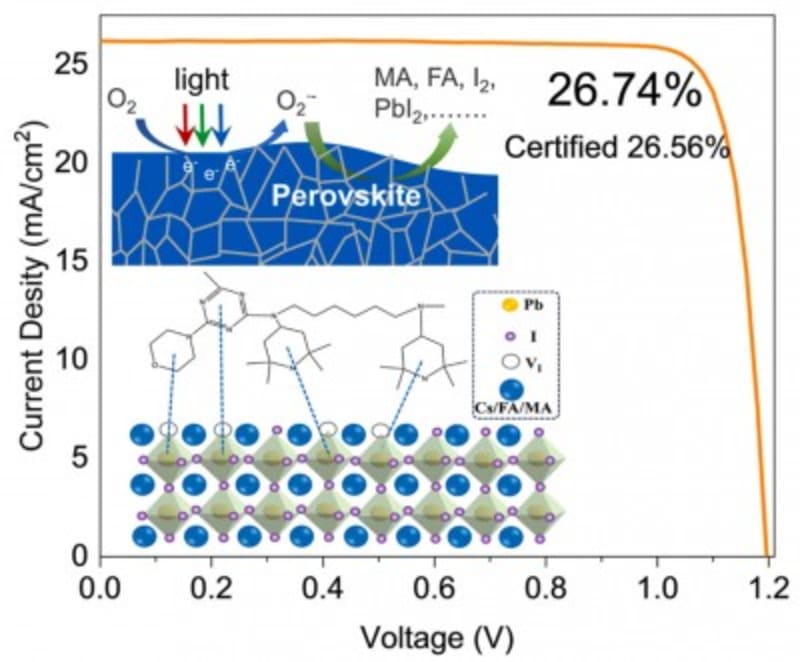
Scientists from universities in China and France developed a new type of solar cell that converts more than 26% of sunlight into electricity while staying strong under constant exposure. That's a certified record for this promising technology.
The breakthrough centers on perovskite solar cells, which have excited scientists for years because they're cheap to make and keep getting better. But they've had one major weakness: sunlight itself slowly destroys them from the inside out.
When light hits these cells, it creates destructive molecules called superoxide radicals. These attack the cell's structure like rust eating through metal, causing the panels to fail within months or even weeks.
The research team added a special protective molecule called a hindered amine light stabilizer to the cell's design. This shield works in two clever ways at once.
First, it catches and neutralizes those destructive radicals before they can cause damage. Even better, the protection keeps working continuously rather than wearing out.
Second, the same molecule fills in tiny defects in the material where problems usually start. This makes the cells smoother, more efficient, and longer-lasting all at once.
The results speak for themselves. Unencapsulated cells kept over 95% of their power after 1,000 hours of continuous light exposure. That's like leaving them in bright sun for more than 40 days straight without any protective coating.
The Ripple Effect
This advance could transform where and how we use solar power. Building-integrated solar panels need to last decades on walls and windows. Tandem solar modules that stack different cell types need every layer to stay stable.
The new approach works with existing manufacturing methods, meaning factories won't need expensive retooling. The protective molecule integrates into current designs without adding complicated steps.
Perhaps most importantly, the research team made their record-breaking cells under normal room conditions, not in specialized clean rooms. That matters for scaling up production and keeping costs low.
The same strategy of combining radical protection with defect repair might work for other light-sensitive technologies beyond solar panels. From LED displays to photo detectors, many devices face similar degradation challenges.
After years of perovskite cells showing promise in labs but failing in real conditions, this breakthrough shows the path forward isn't just about making better materials but protecting the ones we have.
Based on reporting by Google News - Solar Power Record
This story was written by BrightWire based on verified news reports.
Spread the positivity!
Share this good news with someone who needs it