Solar Panel Breakthrough Hits 23% Efficiency at Large Scale
Scientists in China just solved a major solar power challenge, boosting perovskite solar panels to 23% efficiency even at larger sizes. The innovation tackles a hidden flaw that has limited cheaper, easier-to-make solar cells for years.
Scientists in China just cracked a stubborn problem that's been holding back the next generation of solar panels, bringing affordable clean energy closer to reality.
Researchers at the Chinese Academy of Sciences developed a new method that helps perovskite solar cells work better and last longer. Their breakthrough achieved 23% efficiency in a mini-module nearly 50 square centimeters in size, with less than 3% power loss when scaling up from tiny lab versions.
Perovskite solar cells promise cheaper, easier-to-make solar power than traditional silicon panels. But there's been a catch: an invisible interface buried inside these cells has caused microscopic flaws that reduce both performance and durability over time.
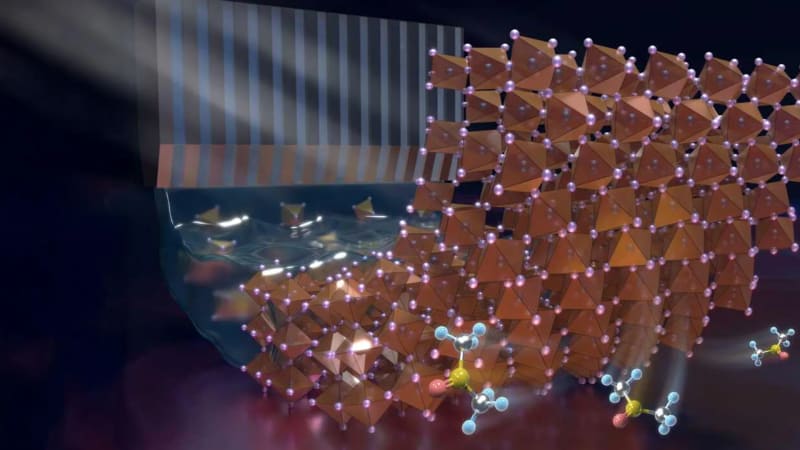
The team's solution involves spreading tiny crystal seeds across the bottom layer of the solar cell before the main material grows. These specially designed nanocrystals act like guides, directing how the solar-absorbing layer forms and helping it spread evenly across the surface.
Here's where it gets clever: the crystal seeds contain solvent molecules that release slowly during heating. This creates what researchers call a "lattice-confined solvent annealing" environment that helps the material reorganize into a smoother, denser structure right where it's needed most.
Dr. Xiuhong Sun, who co-led the study published in Nature Synthesis, explained they developed an integrated approach that tackles both crystal formation and stability at once. The method addresses a buried interface that's notoriously difficult to control precisely.
The result is a perovskite film with fewer gaps and better alignment at the molecular level. This improved structure makes the solar cells more resistant to heat and light stress, two factors that typically degrade performance over time.
The Ripple Effect
This technology does more than just improve one type of solar panel. The crystal-seeding approach creates a versatile platform that can be adapted by swapping different organic materials and solvents.
That flexibility means the method could help engineer better interfaces in other soft-lattice semiconductor devices beyond solar panels. Professor Shuping Pang noted the technique overcomes longstanding scaling bottlenecks that have plagued the field.
The breakthrough matters because perovskite cells work well with solution-based manufacturing processes suited for large-scale production. Traditional silicon solar panels require energy-intensive, high-temperature manufacturing, while perovskite cells can be processed more easily and cheaply.
By maintaining high efficiency when moving from laboratory samples to larger modules, the researchers demonstrated their method works at sizes closer to real-world applications. That's a critical step toward commercial viability that many promising lab discoveries never achieve.
The team combined their crystal-seeding technique with slot-die coating, a scalable printing method that could eventually be used in mass production. This pairing of materials innovation with manufacturing compatibility points toward practical deployment.
Clean energy technology just took another meaningful step forward, bringing us closer to solar power that's both highly efficient and affordable to produce.
Based on reporting by Science Daily
This story was written by BrightWire based on verified news reports.
Spread the positivity!
Share this good news with someone who needs it