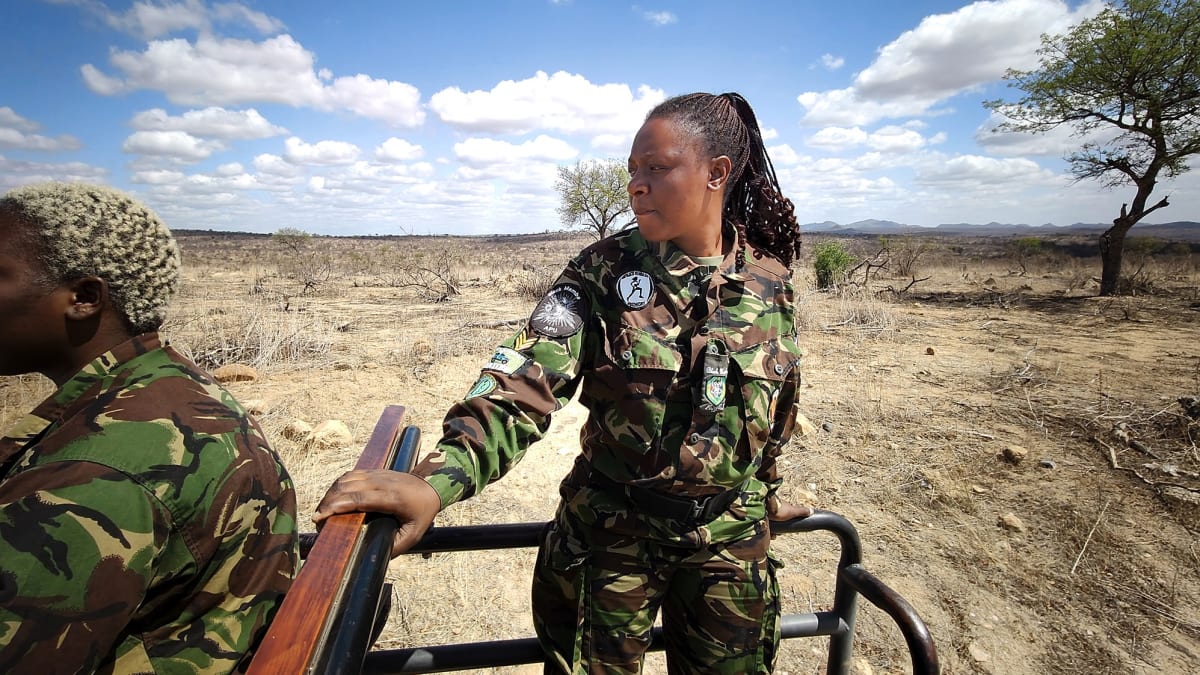
%2Ffile%2Fattachments%2Forphans%2FMzimbaandherteamdriveintothebushfortheirdailypatrolPhoto_KemuntoOgutu_204212.jpg)
South African Ranger Protects Wildlife Without Weapons
Nkateko Mzimba patrols Greater Kruger unarmed as a Black Mamba ranger, then teaches village children why protecting wildlife matters. Her dual mission bridges the gap between conservation and community, proving protection works better with trust than guns.
By day, Nkateko Mzimba walks the South African bush with nothing but a torch and radio, tracking poachers who threaten endangered rhinos. By evening, she trades her ranger boots for chalk, teaching preschoolers in her home village why the animals she protects matter to their future.
Mzimba belongs to the Black Mambas, an all-women anti-poaching unit operating in Greater Kruger, the network of reserves bordering Kruger National Park. Unlike most ranger teams, all 36 members patrol without weapons.
The choice is deliberate. The unarmed approach builds trust with local communities instead of treating conservation as a war zone.
Their methods work. The Black Mambas have helped reduce snaring and poaching across the region while creating frontline conservation jobs for women.
Mzimba's typical day starts before dawn, checking fences for breaks and freeing trapped animals. Night patrols follow, searching for poachers with only flashlights for protection.
"We protect the animals, but we also protect our future," she explains. "Because when these animals are gone, the jobs are gone, the tourism is gone, everything is gone."
The work carries real danger. In 2022, her uncle Anton Mzimba, a ranger with 25 years' experience, was killed at his home in front of his family. No one has been arrested for his murder.
Rather than let fear stop her, Mzimba channels her passion into education. She volunteers at Mbuwetelo Crèche in her village of Hluvukani, about 30 kilometers from Kruger's western boundary.
There, children learn through songs and stories why the wildlife matters. They discover how conservation creates jobs and brings tourism money to their community.
Mzimba built her mother's home with savings from a two-year stint training conservation workers in Saudi Arabia. Her mother Betty beams with pride about having two daughters in the Black Mambas, though she worries for their safety.
The rangers face pressures beyond poachers. Low pay leaves some vulnerable to bribes, sometimes worth 50,000 rand or more.
"If someone comes with that money, a ranger under financial strain could be tempted," Mzimba says. "But if we stand together for the voiceless animals, no one can corrupt us."
South Africa lost 103 rhinos to poaching in just the first quarter of 2025, mostly in Kruger and surrounding areas. The crisis demands urgent action.
The Ripple Effect
The Black Mambas prove that protection doesn't require militarization. Their community-focused approach creates safer conditions for both wildlife and people while opening conservation careers to women.
By teaching children, Mzimba plants seeds for the next generation of protectors. Kids who understand why wildlife matters grow into adults who defend it.
Her work shows that the strongest weapon against poaching might not be a gun at all, but trust, education, and women willing to walk unarmed into the wild for what they believe in.
More Images
%2Ffile%2Fattachments%2Forphans%2FWhileSouthAfricaishometosomeoftheworldsrichestwildlifemanycommunitiesnearparkshaveneverseentheseanimalsPhoto_KemuntoOgutu_598306.jpg)
%2Ffile%2Fattachments%2Forphans%2FNkatekoMzimbaandEksodaMazumbukoworktogethertoteachchildreninHluvukaniabouttheimportanceofconservationPhoto_KemuntoOgutu_627946.jpg)
%2Ffile%2Fattachments%2Forphans%2FNkatekoMzimbahopestobuildherowncrcheonthislandPhoto_KemuntoOgutu_522941.jpg)
Based on reporting by Daily Maverick
This story was written by BrightWire based on verified news reports.
Spread the positivity!
Share this good news with someone who needs it
%2Ffile%2Fattachments%2Forphans%2FGathering-Community10_644148.jpg)
%2Ffile%2Fattachments%2Forphans%2FGathering-RippleEffect11_274821.jpg)