South Korea Invests $1B in Robot Training Revolution
South Korea is building the world's first dedicated robot training center to teach AI how to move, grip, and work in the real world. The $1 billion investment could transform manufacturing and bring intelligent robots into everyday workplaces.
South Korea just announced a massive bet on the future: a $1 billion investment to build infrastructure that will train robots to work alongside humans in factories, farms, and beyond.
The centerpiece is a first-of-its-kind robot training center that will collect real-world behavioral data. Think of it as a driving school for robots, where machines learn to reach, grasp, twist, and pull objects with human-like precision.
The Ministry of Science and ICT is leading the charge because they've identified a critical problem. While chatbots learned from billions of internet pages, physical robots need something different: actual experience moving through real environments.
The government plans to gather behavioral data from small and midsize businesses, regional demonstration sites, and startups. When real-world data runs short, they'll use synthetic data to fill the gaps by creating virtual training scenarios with different lighting, angles, and work conditions.
Consider something as simple as picking fruit. For a robot, that's actually a complex chain of tasks requiring object recognition, precise arm movement, controlled finger pressure, and coordinated twisting and pulling motions.
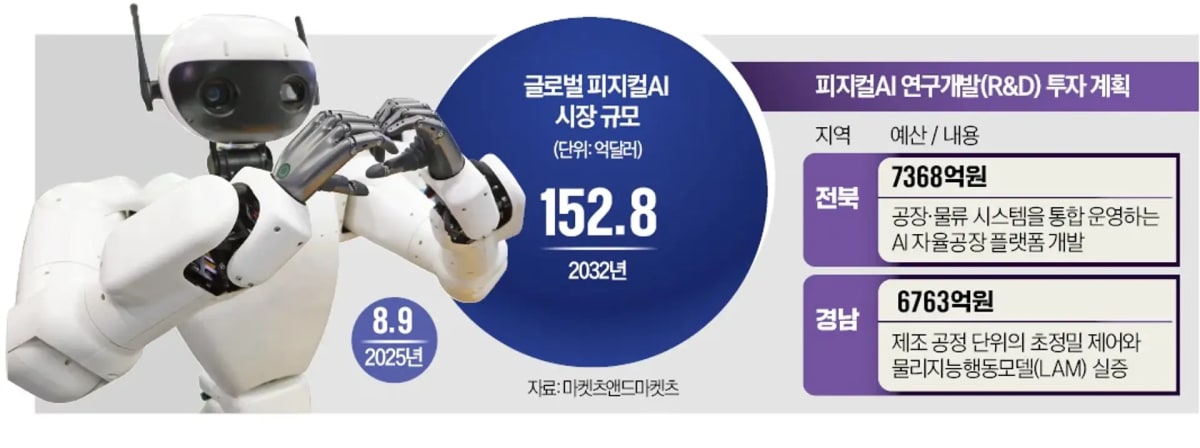
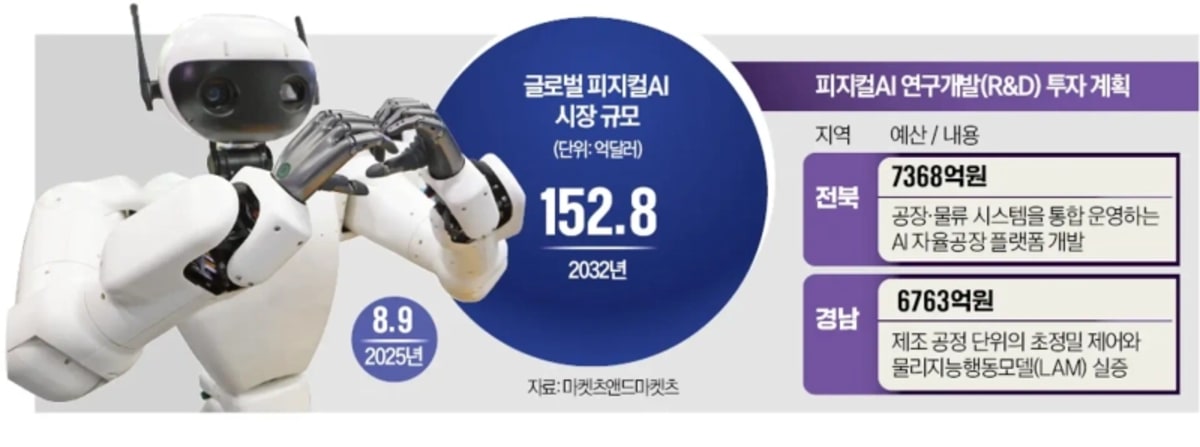
The five-year program runs from 2026 to 2030, with about $489 million going to South Gyeongsang Province and $533 million to North Jeolla Province. These regions will become testing grounds for "human-AI collaborative" manufacturing systems.
In South Gyeongsang, researchers will develop technology that embeds physical laws like thermodynamics and fluid mechanics directly into AI models. This physics-informed approach means robots won't just memorize movements but actually understand the forces and principles behind them.
The goal is ambitious: strengthen Korea's manufacturing competitiveness by creating autonomous factories where robots handle precision tasks while humans focus on oversight and problem-solving.
The Ripple Effect
This investment signals a fundamental shift in how countries think about their industrial future. By solving the data bottleneck that's holding back physical AI, South Korea is creating infrastructure that could benefit robotics companies worldwide.
The training center will make Korea a magnet for robotics innovation, potentially spawning new startups and attracting global partnerships. More importantly, it addresses a universal challenge: how to safely and effectively integrate intelligent machines into workplaces without replacing human workers but enhancing what they can accomplish.
As robots become capable of handling dangerous, repetitive, or precision tasks, human workers can shift to roles requiring creativity, judgment, and interpersonal skills.
Korea's investment today could help write the playbook for the collaborative human-robot workplaces of tomorrow.
More Images


Based on reporting by Regional: south korea technology (KR)
This story was written by BrightWire based on verified news reports.
Spread the positivity!
Share this good news with someone who needs it