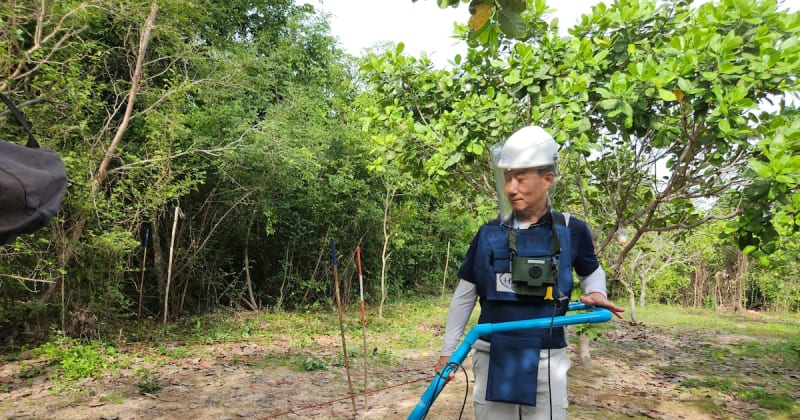
South Korea Veteran Pushes for Mine-Clearing Standards
A retired Army colonel is working to safely return land near 30 bases still marked as mine risk areas to public use. His solution: adopt international standards that could finally release thousands of acres for families and communities.
Mountains near Seoul, Busan, and dozens of other South Korean cities remain off-limits today because of landmines planted decades ago to protect air defense bases. But a retired military engineer says the country already has the tools to safely return this land to the people.
Jeong Tae-seong spent over 10 years clearing mines during his military service and now leads the Mine Action Technology Association. He's pushing South Korea to adopt the same international standards that have helped countries like Cambodia successfully return cleared land to public use.
The numbers tell a surprising story. About 60,000 anti-personnel mines were planted at 40 air defense bases across South Korea between the 1960s and 1980s. Since 1998, the military has removed most of them, but areas around 30 bases remain designated as mine risk zones.
Here's the challenge: at Umyeonsan in Seoul, four separate clearance operations found 988 out of 1,000 planted mines. International standards would consider this area safe after such thorough efforts. But without official national standards, the military cannot legally declare the land released for public use.
Jeong points to successful examples worldwide. Countries establish National Mine Action Standards that define "all reasonable effort" and "acceptable risk" based on intended land use. For farmland where anti-personnel mines were buried, detection to 15 centimeters deep is sufficient because deeper mines won't detonate even under the weight of someone in full combat gear.
After retiring in 2023, Jeong worked with mine clearance projects in Congo, Myanmar, and Cambodia through Korea's international cooperation agency. Cambodia now operates eight public and private mine clearance teams working under clear national standards.
The Ripple Effect
South Korea passed a Mine Action Act in 2024 that took effect in February 2025. The framework exists, but Jeong says the country needs to move faster on implementation. Establishing clear standards and procedures would do more than just release land. It would mobilize private clearance teams, create jobs in a specialized field, and potentially allow Korea to share its expertise with other mine-affected countries.
The approach isn't about cutting corners. It's about using proven international methods that balance safety with practicality. Repeating clearance operations indefinitely isn't economical or rational when areas have already been thoroughly searched multiple times.
Thousands of acres near population centers could become parks, farmland, or housing if South Korea adopts standards that have worked in dozens of countries. The mines were planted to protect communities decades ago, and now those same areas could finally serve the people they were meant to defend.
Based on reporting by Regional: south korea technology (KR)
This story was written by BrightWire based on verified news reports.
Spread the positivity!
Share this good news with someone who needs it

%2Ffile%2Fdailymaverick%2Fwp-content%2Fuploads%2F2023%2F03%2FInset-9-General-shot.jpg)