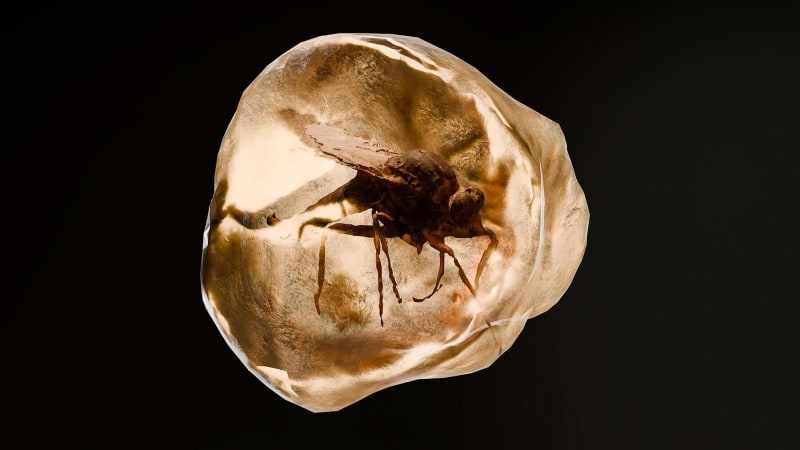
Spain Cave Reveals Perfectly Preserved 105-Million-Year Wasp
Scientists in northern Spain discovered a complete wasp frozen in amber for 105 million years, revealing a brand new species that's rewriting the insect family tree. The tiny time capsule from the age of dinosaurs shows how nature can preserve life in stunning detail.
Deep in a Spanish cave, researchers just opened a golden window into a world that existed before flowers covered the earth.
Inside a fragment of amber from El Soplao cave in Cantabria, they found something extraordinary: a complete wasp, perfectly preserved for 105 million years. The discovery is so unique that scientists named it an entirely new species, Cretevania orgonomecorum.
Most fossils come to us in pieces. A tooth here, a bone fragment there, faint impressions in rock that require imagination to interpret. This wasp tells a different story.
Trapped in tree resin during the Cretaceous period, the tiny creature was sealed away with every detail intact. Its antennae structure, wing vein patterns, and body remained untouched by time. Researchers could study features that rarely survive millions of years.
The find is already changing how scientists classify ancient wasps. This species is larger than its relatives and has anatomical features never seen before. Those unique traits now give researchers new tools to identify and date other Cretaceous deposits around the world.
Enrique Peñalver, a researcher at Spain's Geological and Mining Institute, calls the discovery a showcase of "the extraordinary paleontological richness of Spanish amber." The El Soplao cave has become famous for these amber treasures, with over 1,500 fossil inclusions documented since 2008 and thirty species described so far.
Why This Inspires
This discovery reminds us that Earth still holds countless secrets waiting to be revealed. While some researchers look to the stars for answers, paleontologists are finding entire lost worlds right beneath our feet.
The wasp lived when dinosaurs roamed and the Amazon rainforest didn't yet exist. Now, 105 million years later, it's teaching us about life's incredible diversity and resilience. Each new species discovered fills in another piece of the puzzle, helping us understand how life evolved and adapted through dramatic planetary changes.
Modern technology makes these discoveries even more valuable. Today's scientists use CT scanning, isotopic analysis, and computer modeling to extract information that would have been impossible to gather just decades ago. Every fossil becomes a richer source of knowledge.
Spain's Cantabrian region continues proving itself as one of the world's premier fossil sites, standing alongside famous locations like Peru's desert landscapes. The amber deposits there act like nature's perfect filing system, preserving moments in time with breathtaking clarity.
This tiny wasp survived longer than entire mountain ranges, and now it's helping us write new chapters in the story of life on Earth.
Based on reporting by Google: fossil discovery
This story was written by BrightWire based on verified news reports.
Spread the positivity!
Share this good news with someone who needs it