
Spanish Explorer to Cross Antarctica With Zero-Emission Sled
A Spanish explorer will cross 3,400 kilometers of Antarctica using only wind-powered kites and solar energy, proving sustainable polar exploration is possible. The 80-day expedition will conduct 16 scientific studies in regions where almost no data exists.
Imagine crossing an entire continent without burning a single drop of fuel. Spanish polar explorer Ramón Larramendi is about to do exactly that in Antarctica.
Starting October 18, Larramendi will lead a four-person team on an 80-day journey across 3,400 kilometers of the coldest, most remote regions on Earth. Their secret weapon is the Wind Sled, a 15-meter vehicle powered entirely by kites and solar panels that Larramendi spent 25 years perfecting.
The design draws inspiration from Inuit culture, blending traditional Arctic techniques with modern technology. The sled uses 20 different kites ranging from five to 150 square meters, deployed based on wind conditions. In favorable weather, it can reach speeds of 80 kilometers per hour.
The environmental difference is staggering. A similar 2011-2012 Antarctic expedition using conventional vehicles burned through 170,000 liters of fuel in two months. This journey will use zero.
But speed isn't the mission. The expedition will carry 250 kilos of scientific instruments to conduct 16 research projects in areas where satellites and permanent stations can't reach. Scientists from NASA, Spanish universities, and international organizations will study everything from microplastics in pristine ice to whether microbial life can survive inside salt rocks at extreme temperatures.
One project will use ground-penetrating radar to analyze how snow accumulates and moves, helping predict how Antarctica's ice mass will respond to climate change. Another will test Europe's Galileo navigation systems in one of the planet's most challenging environments.
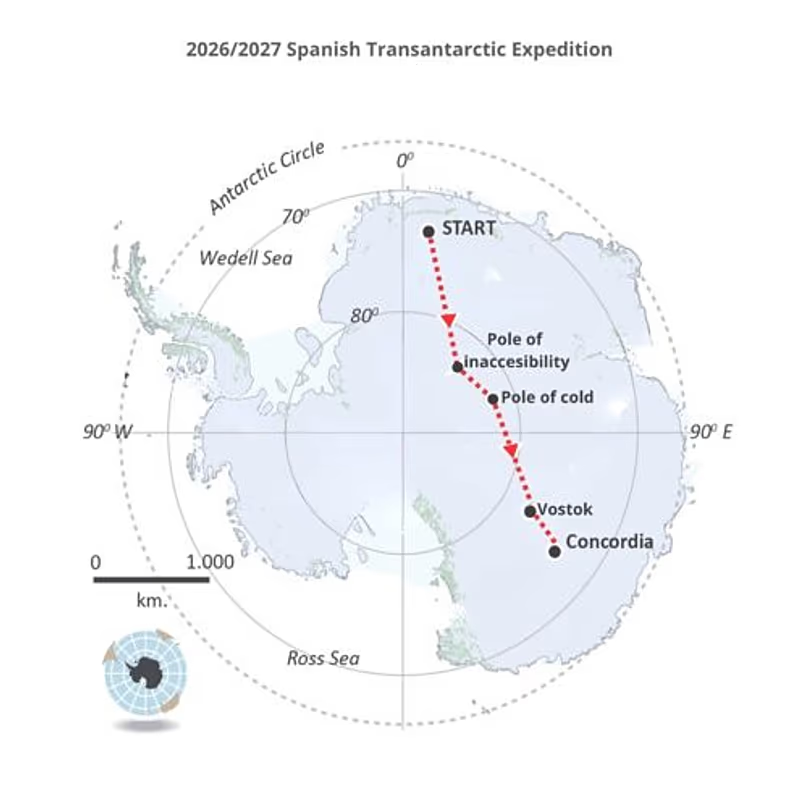
The route starts near Russia's Novolazarevskaya base and ends at the French-Italian Concordia station, passing through the Pole of Inaccessibility and skirting the Pole of Cold. These are places where conventional expeditions rarely venture because the logistical costs and difficulties are too high.
Larramendi has already traveled more than 28,000 kilometers over ice during test expeditions. He believes the Wind Sled proves that sustainability and serious scientific exploration aren't competing goals.
The Ripple Effect
The expedition demonstrates that even the most extreme human activities can operate without fossil fuels. If researchers can cross Antarctica using only wind and sun, the implications reach far beyond polar science.
The four-person crew will spend 85 days in complete isolation, an experience that also serves as research for future space missions. They're proving that human ingenuity can solve problems without compromising the environments we're trying to study.
Other renewable energy systems may eventually cross Antarctica, but Larramendi argues none will match the Wind Sled's minimal footprint. The vehicle carries everything it needs without aerial resupply, leaving virtually no trace on the continent's pristine ice.
The expedition returns in early February with data from regions scientists have barely touched, opening new windows into how our planet's frozen frontier is changing.
More Images



Based on reporting by Euronews
This story was written by BrightWire based on verified news reports.
Building Something New? Try the BrightWire Tech Stack Advisor
Compare modern frameworks, cloud hosting, and AI tools tailored to your project budget and scale.
Spread the positivity!
Share this good news with someone who needs it


