Spider Monkeys Share Food Tips Like a Social Network
Spider monkeys have developed a clever system of switching friend groups to share insider knowledge about the best places to find ripe fruit. Scientists discovered this collective intelligence allows them to know their forest better than any single monkey could alone.
Spider monkeys are teaching us a surprising lesson about teamwork by constantly switching up their social circles to share food tips.
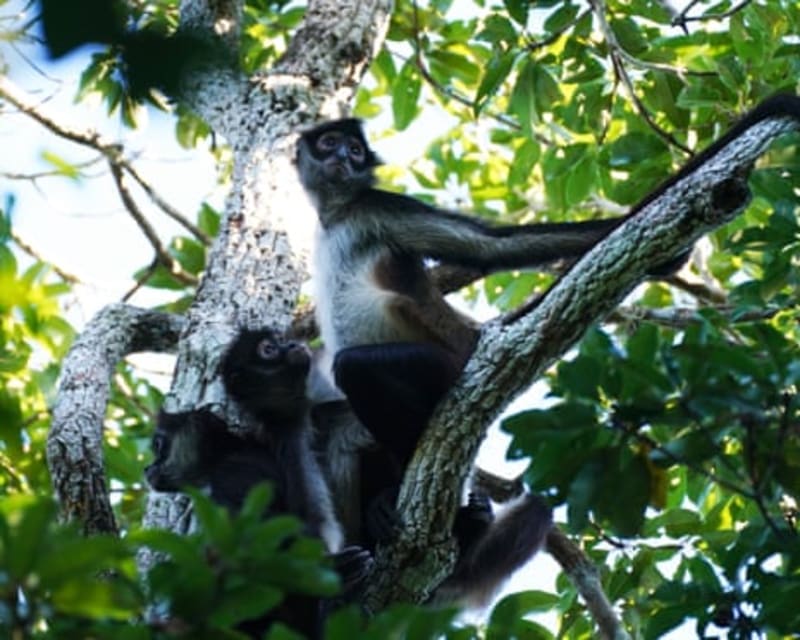
Scientists studying Geoffroy's spider monkeys in Mexico's Yucatán peninsula discovered the primates have created a natural information network. They constantly form and reform small groups of three or more, allowing them to pass along knowledge about where fruit trees are located and when they'll be ripe.
The research team from Heriot-Watt University, the University of Edinburgh, and the National Autonomous University of Mexico spent seven years observing this behavior. What they found amazed them: the monkeys don't just share what they know. They actually combine information from different monkeys to create brand new knowledge.
Here's how it works. One monkey might know where a great fruit tree is located. Another might know when that tree typically produces ripe fruit. When they meet up and share this information, suddenly both monkeys know exactly where to go and when to arrive at peak ripeness.
Dr. Matthew Silk, an ecologist from the University of Edinburgh, explained it's far from random mingling. Each monkey has its own core territory it knows well, like having a favorite neighborhood. Some areas overlap with other monkeys' territories, creating natural meeting spots. But each monkey also explores unique areas, maximizing the group's total coverage of the forest.
The research found an optimal balance. Monkeys need to spread out enough to scout different areas, but reconnect often enough to share what they've learned. The same subgroup might never forage together twice, ensuring maximum information exchange across the entire community.
The Ripple Effect
This discovery represents a compelling example of collective intelligence in wild animals. The spider monkeys have essentially created a crowdsourced map of their forest home, with each individual contributing unique pieces of the puzzle.
Prof. Gabriel Ramos-Fernandez from the National Autonomous University of Mexico highlighted the bigger picture. By exploring their environment in a distributed way and coming together to share uniquely obtained information, the group as a whole knows the forest better than any single monkey could on its own.
The findings, published in the journal njp Complexity, could help us better understand how endangered species adapt and survive. Geoffroy's spider monkeys, also known as Central American spider monkeys, are currently listed as endangered, making their survival strategies especially important to document.
Ross Walker, a PhD student at Heriot-Watt who developed mathematical models to analyze the monkeys' relationships, found that their system hits a sweet spot between togetherness and independence. It's a delicate balance that maximizes everyone's success.
These clever primates remind us that the best knowledge often comes from bringing different perspectives together.
More Images



Based on reporting by Google News - Researchers Find
This story was written by BrightWire based on verified news reports.
Spread the positivity!
Share this good news with someone who needs it