Spiny Dragon' Fossil Rewrites Dinosaur Skin Science
Scientists in China discovered a juvenile dinosaur with hollow spikes preserved down to individual cells, revealing body coverings never seen before. The 125-million-year-old fossil proves dinosaur skin was far more diverse than the "scales or feathers" model scientists long believed.
A fossil sitting in northeastern China just changed everything scientists thought they knew about dinosaur skin.
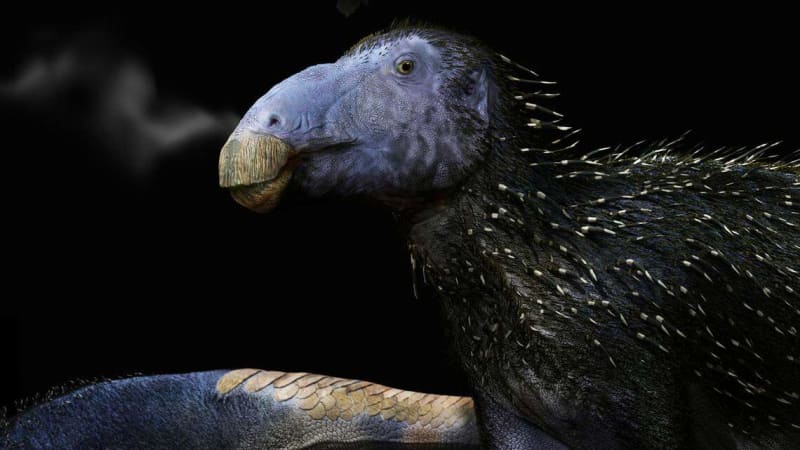
Researchers examining Haolong dongi (meaning "spiny dragon") discovered hollow, cylindrical spikes made of hardened skin preserved so perfectly they could see individual cell nuclei. Nothing like it has ever been found on a non-avian dinosaur.
The eight-foot juvenile dinosaur dates back 125 million years to the Early Cretaceous period. It was unearthed from the Yixian Formation, a site already famous for exceptionally preserved fossils, but this specimen stood apart.
The entire skeleton survived intact, along with soft tissue and skin. That kind of preservation is rare enough, but what covered the skin shocked paleontologists.
Using advanced imaging and microscopic analysis, the research team found three distinct skin structures layered across the body. Small scales covered most areas, large overlapping scales ran along the tail, and scattered among everything were those mysterious hollow spikes.
Most spines measured just 2 to 3 millimeters, easy to miss without close examination. But the longest reached 1.7 inches long and was composed of multi-layered, hardened skin preserved to the cellular level.
These weren't related to feathers or to spines found on modern reptiles. They evolved independently, making them a genuinely new structure in the fossil record.
Haolong dongi was an herbivore belonging to the iguanodontia group, ancestors of the famous duck-billed hadrosaurs. The spikes likely served as defense against small carnivorous dinosaurs prowling the same ecosystem, much like a porcupine's quills today.
The research team, publishing their findings in Nature Ecology & Evolution this February, noted the spikes "made the prey more difficult and time-consuming to kill and ingest." They may have also helped with temperature regulation or sensory functions.
Why This Inspires
For decades, scientists operated on a simple model: dinosaurs had scales or feathers. This eight-foot juvenile just proved that framework was incomplete.
The discovery opens questions that ripple forward. Since this was a young dinosaur, researchers don't know if adults carried the same spikes or developed even more elaborate structures. Did the spikes grow more pronounced with age or serve different purposes at different life stages?
One fossil from a 125-million-year-old lakebed added an entirely new category to the catalog of dinosaur body coverings. The lead researcher named the species to honor Dong Zhiming, an influential Chinese paleontologist who died in 2024, ensuring his legacy lives on in this groundbreaking find.
Every time scientists think they understand prehistoric life, the earth reveals something that rewrites the textbooks.
Based on reporting by Google: fossil discovery
This story was written by BrightWire based on verified news reports.
Spread the positivity!
Share this good news with someone who needs it