Stars Survive Black Hole Attacks by Spinning Fast
Scientists solved a cosmic mystery: some stars survive being ripped apart by supermassive black holes, returning for repeat encounters. The secret is how fast they were spinning before their first brush with destruction.
Some stars have found a way to cheat death at the hands of the most destructive forces in the universe.
Astrophysicists at Syracuse University discovered that certain stars can survive multiple close encounters with supermassive black holes by using their own rapid spin as a shield. The finding solves a puzzle that has stumped astronomers for years.
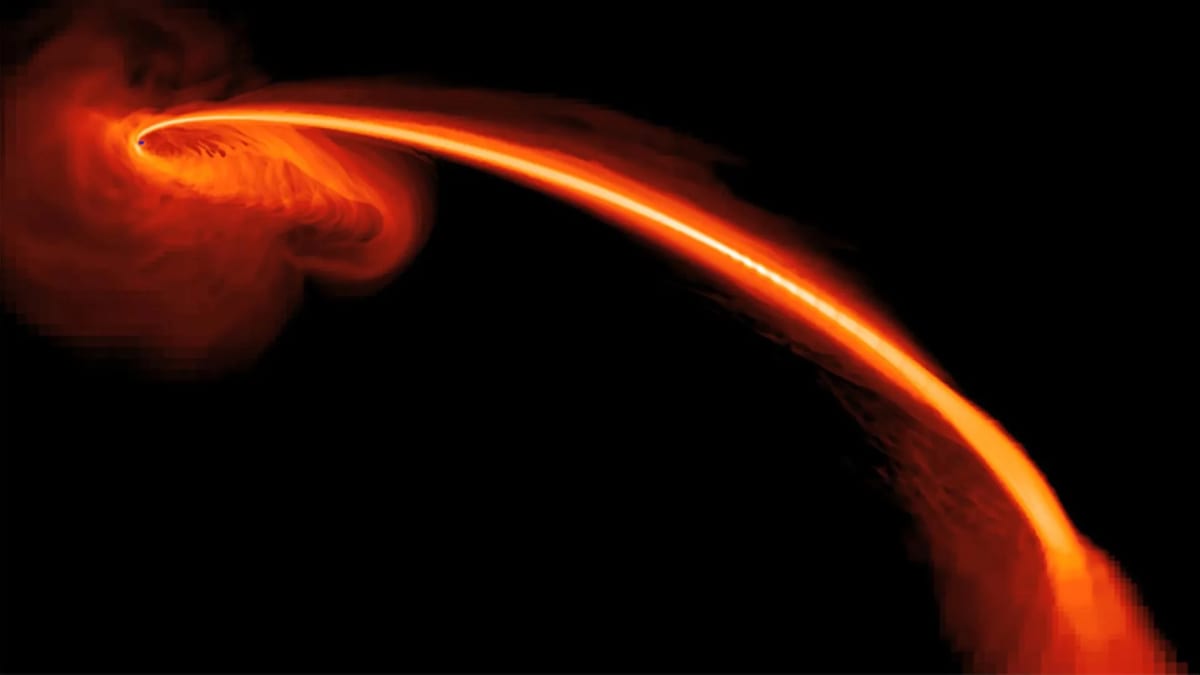
Most galaxies contain a supermassive black hole at their center, some weighing billions of times more than our sun. When a star wanders too close, the black hole's gravity usually tears it completely apart in what scientists call a tidal disruption event.
But some stars get lucky. They pass just close enough to lose only part of their mass, then escape back into orbit for another round months or years later.
Here's where things got weird. Astronomers noticed that about 10 of these repeating systems have been spotted so far, and four of them produce dimmer light bursts with each return visit. Computer models couldn't explain why.
Doctoral student Ananya Bandopadhyay and her team tried adding what she calls "a new ingredient" to their simulations. They tested what would happen if the star was already spinning extremely fast before its first black hole encounter.
The answer changed everything. A rapidly spinning star can't be spun up much more by the black hole's forces during later passes. Without that extra rotation boost, less material gets stripped away each time, producing the fainter flares astronomers actually observe.
The discovery does more than solve a cosmic mystery. It helps explain how these stars ended up in such dangerously tight orbits in the first place.
Why This Inspires
This research shows how persistence pays off in science. Bandopadhyay admits her team was "puzzled by this for two years" before finding the solution.
Their breakthrough also reveals something beautiful about the universe. Even in the most extreme gravitational environments imaginable, where spacetime itself warps and bends, some stars have exactly the right properties to survive what should destroy them.
Wide-field telescopes that repeatedly scan the sky have made it possible to watch these cosmic near-death experiences unfold in real time. Each observation teaches us more about both black holes, which emit no light themselves, and the remarkable resilience of stars.
The study appeared in The Astrophysical Journal, adding another piece to our understanding of how the universe works at its most extreme edges.
Based on reporting by Science Daily
This story was written by BrightWire based on verified news reports.
Spread the positivity!
Share this good news with someone who needs it