Stockholm's Electric Ferry Cuts Emissions 94% and Commutes in Half
A "flying" hydrofoil ferry in Stockholm has slashed a 55-minute commute to 30 minutes while cutting carbon emissions by 94 percent. The success is prompting cities worldwide to rethink how waterways can solve urban congestion.
Stockholm just proved that the future of city transit might not be on roads at all, but gliding above the water.
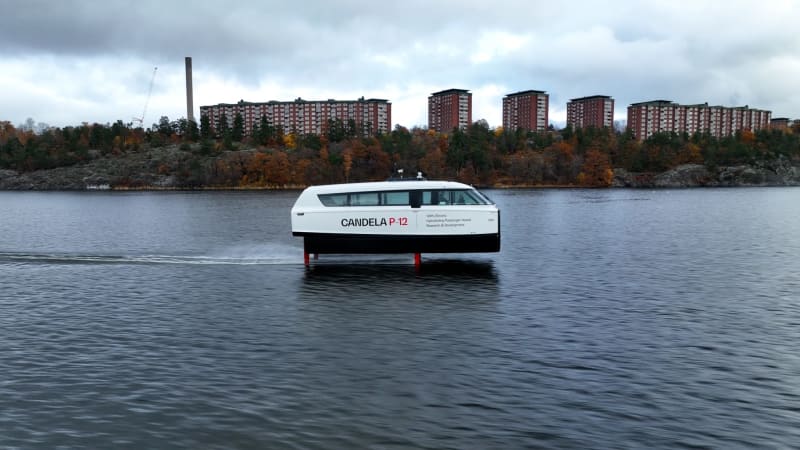
In late 2024, Sweden's capital introduced the Candela P-12 Shuttle, a hydrofoiling electric ferry that literally rises above the surface as it speeds across the water. After a year of testing, the results are in: the Swedish Transport Administration is calling it a clear success that could transform how waterfront cities move people around.
The numbers tell a compelling story. The ferry cut the commute between suburban Ekerö and downtown Stockholm from 55 minutes to just 30 minutes. Carbon dioxide emissions dropped 94 percent compared to diesel ferries, which currently account for nearly half of Stockholm's public transport emissions. Passenger numbers jumped 22.5 percent as commuters flocked to the faster, smoother option.
The technology behind the ferry sounds like science fiction but works on simple physics. Carbon fiber wings beneath the hull generate lift as the vessel accelerates, raising the boat above the water's surface. An onboard computer constantly adjusts the wing angles using sensors, keeping the ride stable while dramatically reducing drag. The result is both speed and efficiency that traditional ferries can't match.
What makes this particularly exciting for cities is the minimal disruption. The ferry's wake is comparable to a small motorboat, reducing shoreline erosion and protecting coastal ecosystems. Noise levels measure about the same as a car driving 28 miles per hour, and the vessel is barely audible from 80 feet away. It moves fast without making waves, literally or figuratively.
The Ripple Effect
Stockholm's success is already inspiring other cities to rethink their waterways. Berlin and Mumbai have announced plans to introduce similar vessels in 2026, while tourist destinations in the Maldives and Thailand are preparing to adopt the technology.
The economic case is equally strong. The Swedish Transport Administration estimates that replacing two diesel ferries with six P-12 vessels could boost departure frequency from once an hour to every 15 minutes. Passenger capacity would increase by 150 percent, and the projected economic benefit is roughly $13.1 million while lowering the cost per journey.
Operating costs favor the electric hydrofoils too. The vessels require less fuel and maintenance than traditional ferries, and dockside charging infrastructure is relatively affordable compared to other electric ferry upgrades. The ferry's minimal wake even earned it a speed exemption, allowing it to travel at 25 knots instead of the usual 12-knot limit.
For Candela founder Gustav Hasselskog, the vision extends far beyond one ferry route. "The Candela P-12 can transform urban waterways," he said. "By combining high speed, minimal energy use, and near-zero emissions, we can unlock faster, cleaner, and more cost-efficient waterborne transport for cities worldwide."
As cities worldwide struggle with traffic congestion and climate commitments, Stockholm's experiment offers an elegant solution: sometimes progress means looking at what's already there and imagining it working better.
Based on reporting by Optimist Daily
This story was written by BrightWire based on verified news reports.
Spread the positivity!
Share this good news with someone who needs it