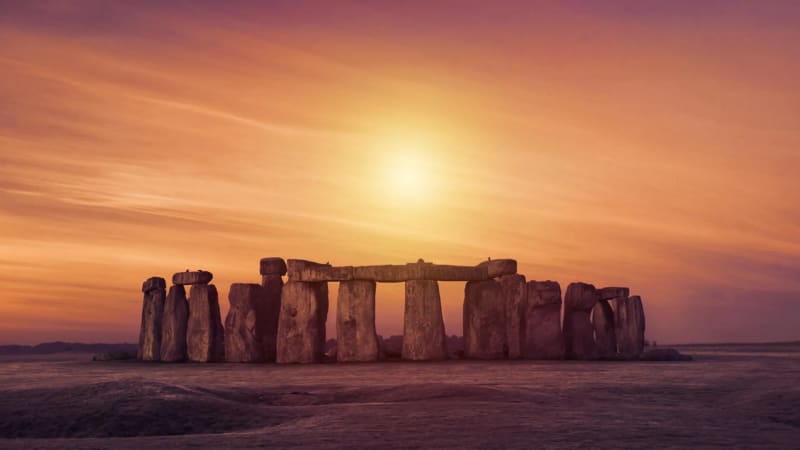
Stonehenge Mystery Solved: Humans, Not Ice, Moved Stones
Scientists just ruled out a century-old theory about how Stonehenge's massive stones arrived at the ancient site. New mineral analysis proves glaciers never reached the monument, meaning ancient people moved those six-ton rocks themselves.
For over 100 years, researchers have argued about whether ice or humans transported Stonehenge's famous bluestones across Britain. Now scientists at Curtin University have found the answer, and it's even more impressive than we imagined.
The team analyzed over 500 microscopic zircon crystals from river sediments near Stonehenge in southern England. These tiny mineral fragments act like geological time capsules, showing how rocks and sediments moved across the landscape over millions of years.
What did they find? Absolutely no evidence that glaciers ever reached Salisbury Plain, where Stonehenge stands today.
"If glaciers had carried rocks all the way from Scotland or Wales to Stonehenge, they would have left a clear mineral signature on the Salisbury Plain," said lead researcher Dr. Anthony Clarke. "We looked at the river sands near Stonehenge for some of those grains the glaciers might have carried and we did not find any."
The discovery means ancient people deliberately transported stones weighing up to six tons across hundreds of miles. That's roughly the weight of four modern cars, moved without machinery, trucks, or even wheels as we know them.
How exactly they accomplished this feat remains unknown. Some researchers suggest the stones might have been floated down rivers on rafts, while others think logs were used to roll them overland.
The findings build on another major discovery from 2024, when the same team traced Stonehenge's central Altar Stone all the way back to Scotland. Together, these studies paint a picture of Neolithic builders who were far more organized and ambitious than previously believed.
Why This Inspires
This discovery reminds us that human determination and ingenuity have always been our greatest tools. Thousands of years before modern technology, people worked together to move mountains, literally, creating something that still stands today.
The research also shows how modern science can finally answer questions that have puzzled humanity for generations. By examining minerals smaller than a grain of sand, scientists solved a mystery that's been debated since the 1920s.
Professor Chris Kirkland, study co-author, captured it perfectly: "Stonehenge continues to surprise us. By analyzing minerals smaller than a grain of sand, we have been able to test theories that have persisted for more than a century."
The monument likely served many purposes: a calendar, a temple, a gathering place for feasts and ceremonies. But now we know for certain that every stone there represents an intentional choice and an extraordinary effort by our ancestors.
Ancient people looked at massive rocks hundreds of miles away and said, "We need those there," then figured out how to make it happen.
Based on reporting by Science Daily
This story was written by BrightWire based on verified news reports.
Spread the positivity!
Share this good news with someone who needs it