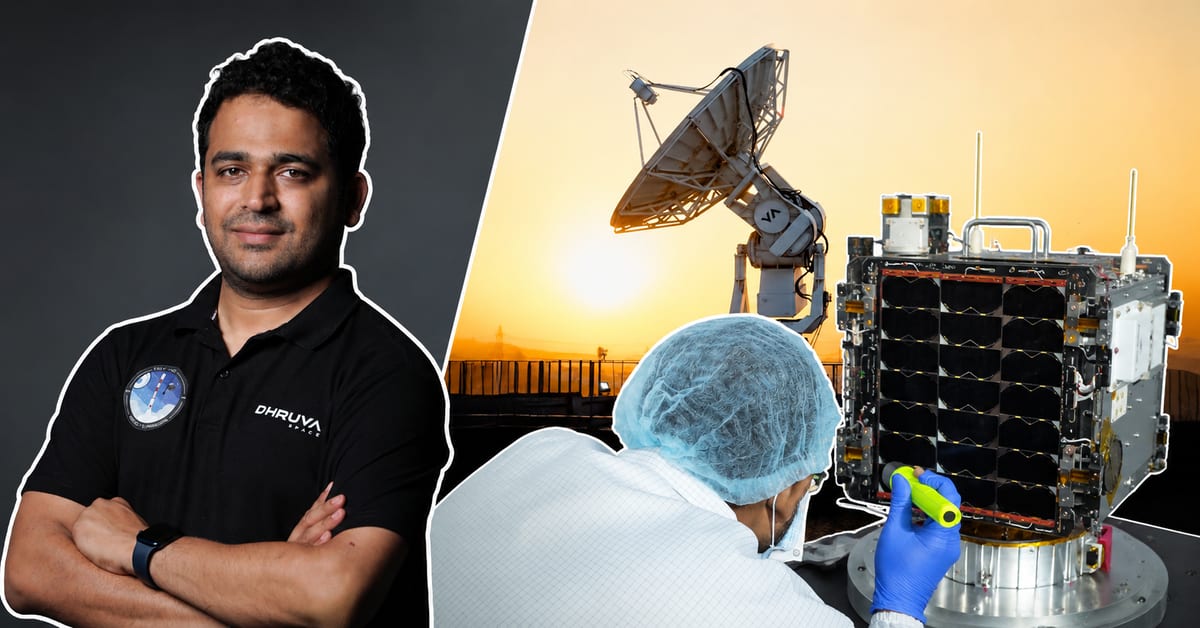
Teen's Earthquake Question Leads to Indian Satellite Startup
When a 13-year-old watched HAM radio operators save lives during Gujarat's 2001 earthquake, he wondered if space technology could do even more. That question launched Dhruva Space, now building satellites that help tackle disasters and climate challenges across India.
When the Gujarat earthquake struck in January 2001, communication networks collapsed just when rescuers needed them most. Amateur HAM radio operators became lifelines, coordinating relief efforts when phones and mobile networks failed.
Among those watching was 13-year-old Sanjay Nekkanti. While others saw tragedy, he saw a question that would shape his life: if simple radio technology could work when everything else failed, what could space-based systems accomplish?
That curiosity led Sanjay to join India's first student satellite mission at age 19. Working on SRMSAT with ISRO support, he learned how satellites are designed and operated, but he also noticed something missing.
India had impressive space capabilities through ISRO, but almost no private companies were building the technology to support a growing space industry. The country had the engineering talent but lacked the commercial infrastructure.
In 2012, Sanjay cofounded Dhruva Space in Hyderabad with Krishna Teja Penamakuru, Abhay Egoor, and Chaitanya Dora Surapureddy. Their vision wasn't just to build satellites but to create complete space infrastructure that organizations could access through a single company.
The timing was bold. India's private space sector was still in its infancy, with very few companies manufacturing space technologies domestically. The founders believed India's engineering talent could change that landscape.
Today, Dhruva Space develops end-to-end satellite systems supporting disaster response, climate monitoring, agriculture, communications, and scientific research. Instead of coordinating with multiple vendors, organizations can now access every stage of a satellite mission through one provider.
The Ripple Effect
Dhruva Space represents more than one company's success. It's helping build the industrial ecosystem India needs to design, manufacture, and operate space technologies at scale, creating skilled jobs and strengthening domestic supply chains along the way.
The company is part of a new generation of Indian space ventures proving that private companies can complement ISRO's achievements. While the space agency earned international recognition for reaching Mars and landing on the moon, private firms are now expanding what's possible commercially.
For Sanjay, it all traces back to that teenage question during a devastating earthquake. Sometimes the most important innovations start with someone simply wondering if there's a better way to help when it matters most.
More Images
%2Fenglish-betterindia%2Fmedia%2Fmedia_files%2F2026%2F07%2F20%2Fdhruva-space-satellites-2026-07-20-17-49-12.png)

%2Ffilters%3Aformat(webp)%2Fenglish-betterindia%2Fmedia%2Fmedia_files%2F2026%2F07%2F20%2Fdhruva-space-satellites-2026-07-20-17-52-36.png)
%2Ffilters%3Aformat(webp)%2Fenglish-betterindia%2Fmedia%2Fmedia_files%2F2026%2F07%2F20%2Fdhruva-space-satellites-2026-07-20-17-54-08.png)
Based on reporting by The Better India
This story was written by BrightWire based on verified news reports.
Spread the positivity!
Share this good news with someone who needs it