Tiny Blue Octopus Discovery Unlocks Deep-Sea Secrets
Scientists discovered a golf-ball-sized blue octopus in the Galapagos Islands, revealing how little we know about deep-sea life in the tropical Pacific. The adorable creature is opening doors to understanding one of Earth's least explored ecosystems.
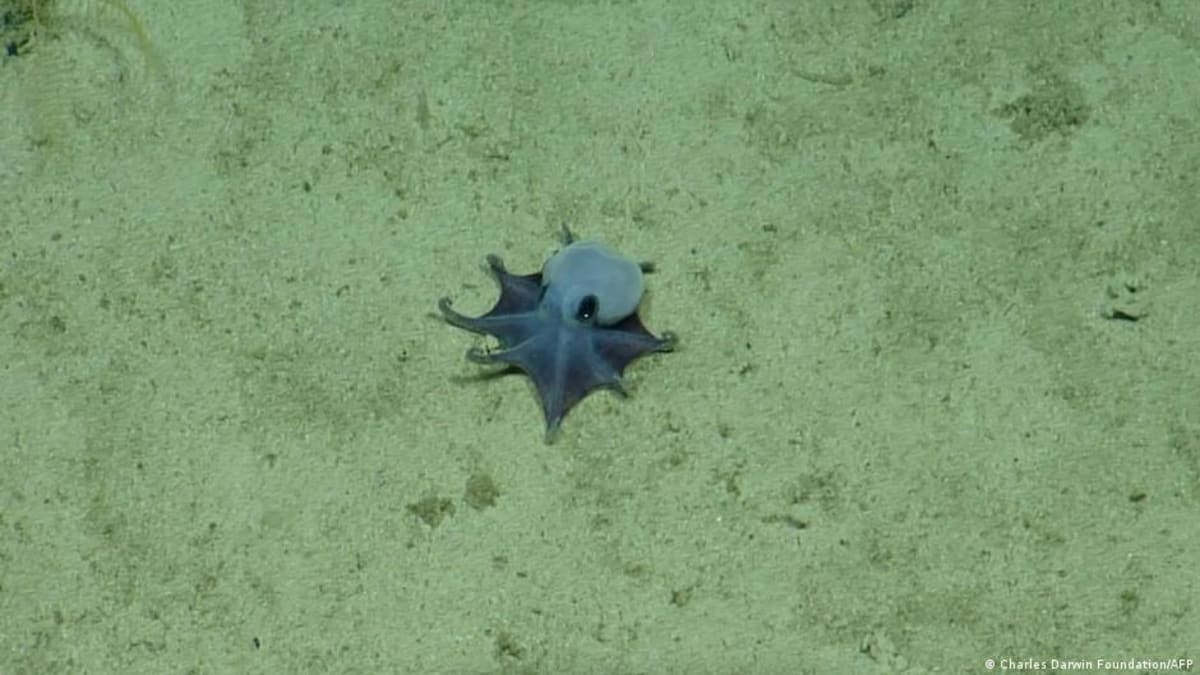
A golf-ball-sized blue octopus discovered nearly 6,000 feet below the ocean's surface is giving scientists a precious glimpse into one of the planet's most mysterious ecosystems.
Researchers aboard a submersible near the Galapagos Islands spotted the tiny creature in 2015, and their excitement was immediate. "He's tiny!" and "It's blue!" echoed through the research vessel as the remotely operated camera captured the unusual octopus scurrying across the deep-sea floor.
Janet Voight, a scientist at Chicago's Field Museum, knew she was looking at something special the moment she saw it. "Right away, I knew it was something really special," said Voight, who has studied octopus evolution for four decades. "I'd never seen anything like it."
The discovery became official this week when the study was published in the journal Zootaxa, introducing the world to Microeledone galapagensis. The name may be a mouthful, but the octopus itself fits in the palm of your hand.
Getting to know this little creature required some creative thinking. Because researchers only had one specimen, Voight couldn't use traditional methods that would have destroyed it. Instead, her team created micro CT scans and built a detailed 3D model of the octopus, inside and out.
It was the first new octopus species Voight had described in her entire career. "These are little octopuses that live in the deep sea, and hardly anybody on Earth has ever gotten to see them," she said. "I just feel lucky that I got to work with them."
The Galapagos Islands have fascinated scientists since Charles Darwin visited in the mid-1800s and developed his theory of evolution. The archipelago's surrounding waters remain largely unexplored, home to creatures found nowhere else on Earth.
The Ripple Effect
This tiny blue octopus represents something much bigger than its golf-ball size suggests. Scientists know very little about octopuses living in the deep tropical Pacific Ocean, making every discovery a key to understanding these hidden ecosystems.
The waters around the Galapagos are protected, giving researchers a rare opportunity to study deep-sea life without the interference of heavy fishing or pollution. Each new species discovered helps scientists understand how these creatures evolved in isolation and how they contribute to the ocean's health.
The crew spotted two other octopuses that looked similar during their expedition, suggesting there may be a healthy population thriving in the deep. That's encouraging news for an ecosystem we're only beginning to understand.
There's something wonderfully hopeful about scientists spending years carefully studying a single tiny creature, treating it with such care and respect that they built a 3D model rather than risk damaging it. In a world rushing ahead, sometimes the smallest discoveries remind us to slow down and appreciate the wonders still waiting beneath the waves.
Based on reporting by DW News
This story was written by BrightWire based on verified news reports.
Spread the positivity!
Share this good news with someone who needs it