Tiny Eye Implant Helps 81% of Blind Patients Read Again
A wireless retinal implant smaller than a grain of rice is restoring vision to people blinded by macular degeneration, with over 80% of trial participants now able to read letters and words after years in darkness. The breakthrough offers hope to 5 million people worldwide living with advanced AMD.
After years of watching her world fade to black, a woman with advanced macular degeneration can now read the pages of a book again.
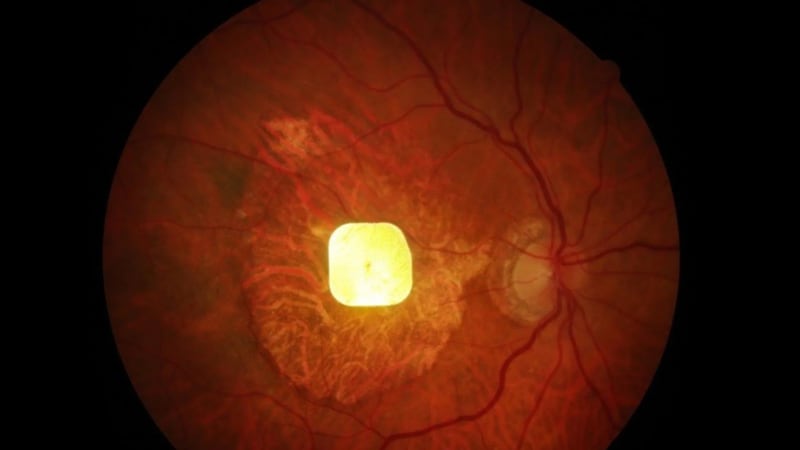
She's one of 32 patients who received a revolutionary wireless eye implant that's changing what doctors thought possible for treating blindness. The tiny 2×2 millimeter device sits inside the retina and acts like artificial photoreceptors, converting light into electrical signals the brain can understand.
The results published in the New England Journal of Medicine stunned researchers. Among those who completed one year of follow-up, 81% experienced meaningful improvements in vision. On average, patients gained five full lines on a standard eye chart.
"It's the first time that any attempt at vision restoration has achieved such results in a large number of patients," said Dr. José-Alain Sahel, director of the UPMC Vision Institute and senior author of the study. One participant improved by an astounding 12 lines on the vision chart.
The PRIMA system works through a clever combination of technology and biology. Patients wear specialized glasses with a built-in camera that captures images and sends them to the implant using invisible near-infrared light. The implant then transforms that light into electrical pulses that stimulate surviving retinal cells, restoring the pathway between eye and brain.
The international trial enrolled 38 people age 60 and older across 17 medical centers in France, Germany, Italy, the Netherlands, and the United Kingdom. After 12 months, all procedure-related side effects had resolved, and 84% of participants reported using their artificial vision at home to read numbers or words.
Age-related macular degeneration affects more than 5 million people worldwide and is the leading cause of permanent blindness in older adults. The advanced form, called geographic atrophy, destroys the light-sensing cells in the central retina, leaving patients unable to see faces, read, or recognize loved ones.
The Ripple Effect
The success of this trial represents 15 years of collaboration between researchers at the University of Pittsburgh, Stanford University, and the University of Bonn. What started as a dream is now changing lives across continents.
Beyond reading words on a page, participants report regaining independence in daily tasks they'd lost years ago. The device manufacturer, Science Corporation, has now submitted applications for clinical approval in both Europe and the United States.
Researchers at UPMC are already investigating methods to push vision restoration even further, potentially taking patients above the threshold for legal blindness. While the implant alone doesn't restore perfect 20/20 vision yet, the dramatic improvements represent a frontier crossed in treating previously untreatable blindness.
For millions living in darkness, the light at the end of the tunnel just got brighter.
Based on reporting by Health Daily
This story was written by BrightWire based on verified news reports.
Spread the positivity!
Share this good news with someone who needs it