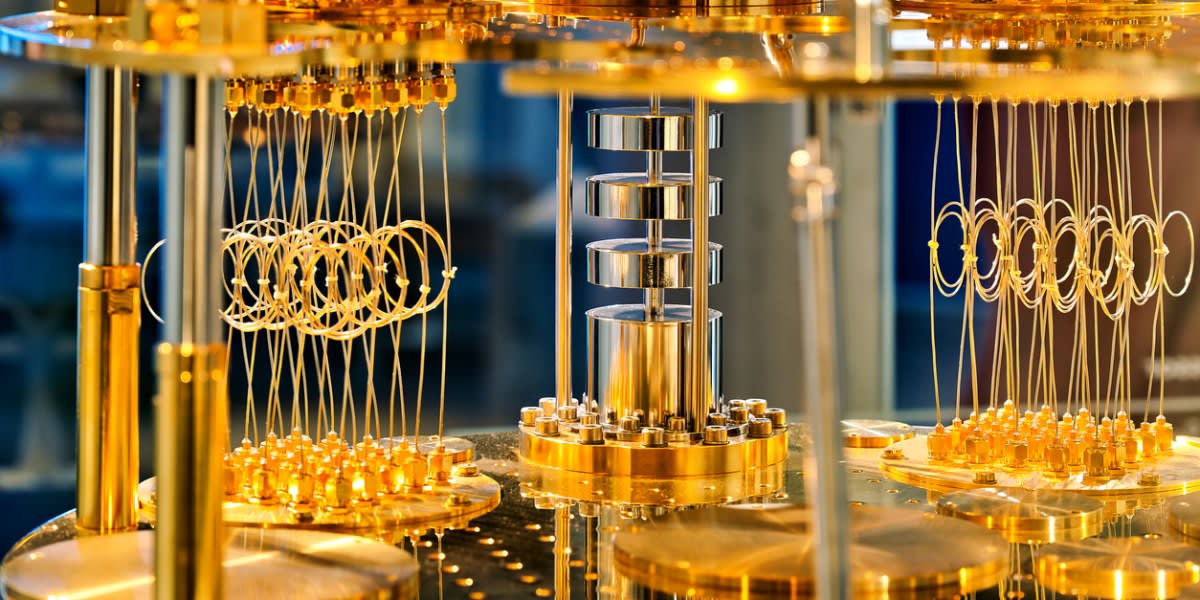
Tiny Quantum Engine Could Unlock Million-Qubit Computers
Scientists built the world's first superconducting quantum heat engine that turns near-absolute-zero heat into useful work. The breakthrough could eliminate millions of costly cables currently needed for large-scale quantum computers.
A tiny engine cooled to nearly absolute zero just solved one of quantum computing's biggest headaches.
Researchers at Aalto University in Finland have created the first cyclic quantum heat engine built inside a superconducting circuit. The microscopic device successfully converts quantum-scale heat into measurable work, proving a concept that could revolutionize how we build massive quantum computers.
The engine combines three components: a transmon qubit (a basic quantum computing building block), a resonator, and a quantum refrigerator. Together, they recreate an Otto cycle, the same thermodynamic process that powers car engines, but at temperatures near absolute zero where quantum effects dominate.
"We built a nanofabricated heat engine using superconducting circuits and operated it in a cryostat near absolute zero," says Tuomas Uusnäkki, the study's first author. The team used carefully timed control pulses to drive the engine through its cycle while monitoring the qubit's state, confirming it was producing positive work from the tiny amounts of available heat.
What makes this engine special is its quantum refrigerator, which can both heat and cool the qubit on demand. Traditional heat engines need separate hot and cold environments, but this single controllable component handles both roles, making the system simpler and more versatile.
The real excitement comes from what future versions could do. Academy Professor Mikko Möttönen, who led the study, points to Finland's ambitious goal: a quantum computer with one thousand logical qubits by 2035, requiring hundreds of thousands of physical qubits.
"Doing that with current technology requires millions of microwave cables costing thousand euros each," Möttönen explains. "The cables also introduce noise into the system."
The Ripple Effect
Autonomous heat engines integrated directly into quantum circuits could replace most of those expensive, noise-producing cables. Instead of carrying microwave pulses from near absolute zero all the way to room temperature to read qubit states, these tiny engines could do the work internally.
That solves two massive challenges simultaneously: the enormous hardware costs of scaling up quantum computers and the unwanted interference that current cable systems create. Fewer cables means lower costs, less complexity, and cleaner quantum operations.
The breakthrough also bridges two fundamental areas of physics. Quantum mechanics describes the behavior of matter at scales smaller than atoms, while thermodynamics governs heat and energy in much larger systems. Bringing them together reveals how familiar thermodynamic principles behave when quantum effects like superposition and entanglement enter the picture.
The team is now working to improve the design and develop fully autonomous versions of their engine.
The quantum computers of tomorrow just got a little closer to reality.
Based on reporting by Science Daily
This story was written by BrightWire based on verified news reports.
Spread the positivity!
Share this good news with someone who needs it