Train Commuter Spots First Dark Matter Clue Outside Milky Way
A former astronomer scrolling through research on his morning commute discovered a rare stellar stream that could unlock the secrets of dark matter. The chance find opens a pristine laboratory for studying the invisible substance that makes up most of our universe.
David Hendel wasn't looking for a scientific breakthrough on his morning train to work. But when he spotted a thin ribbon of stars in a Hubble image on his phone, he knew he'd found something extraordinary.
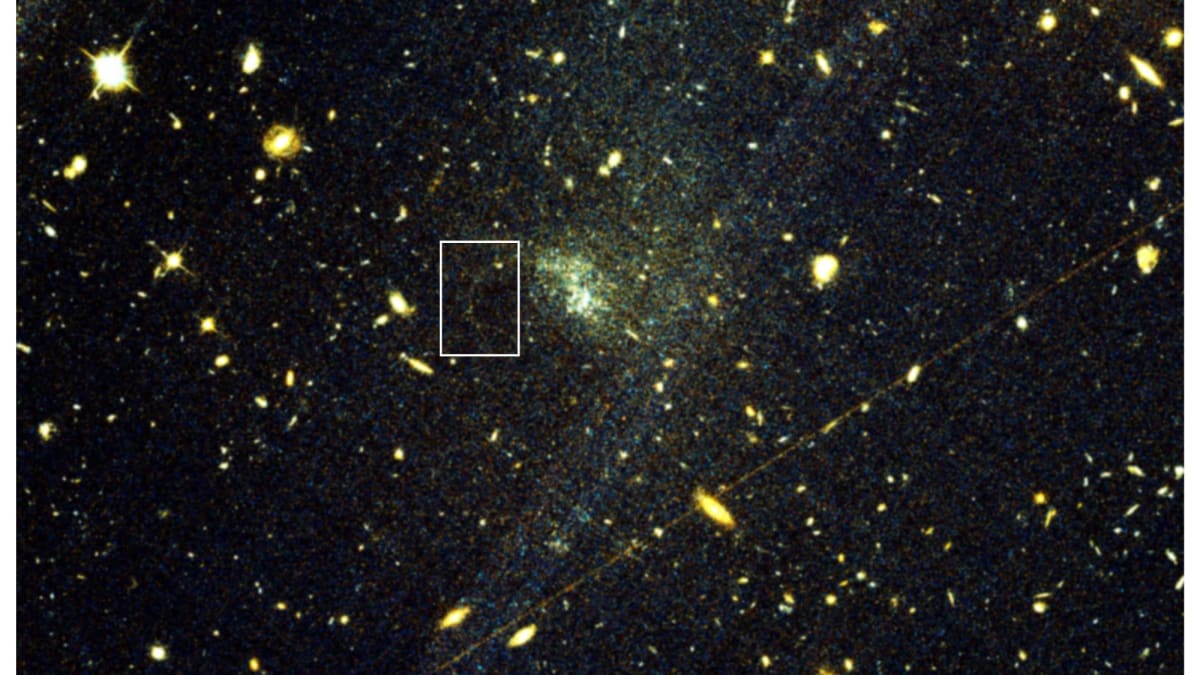
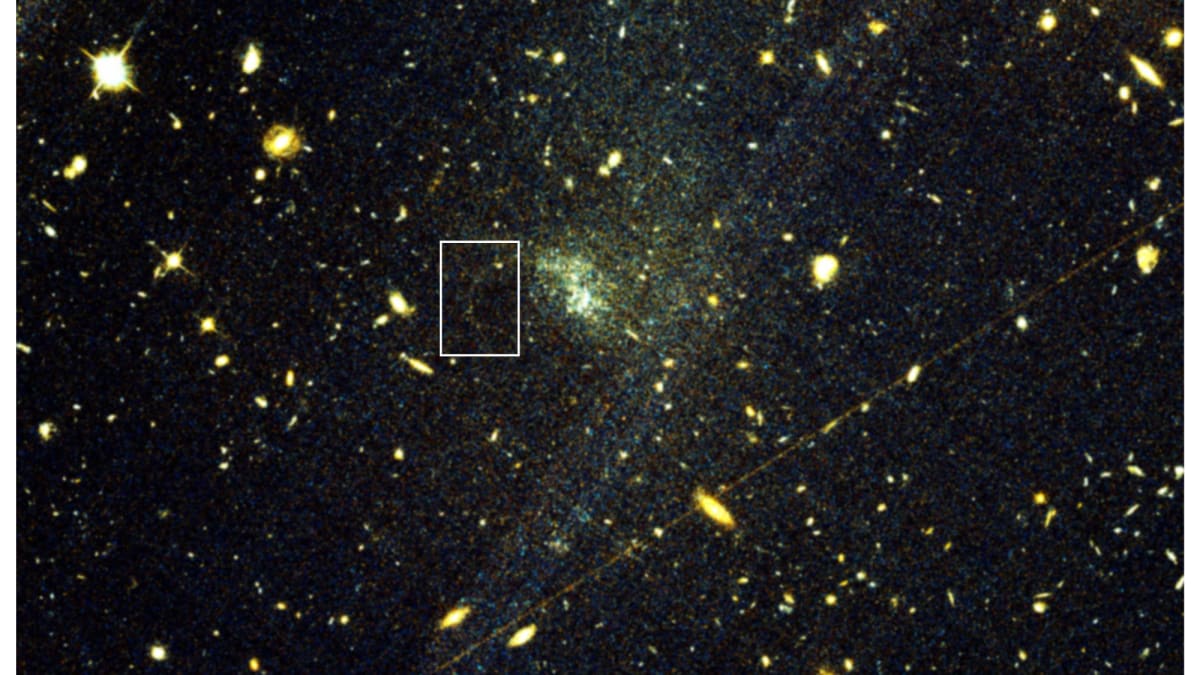
The image showed a faint stream of stars trailing from a dwarf galaxy 115 million light-years away. Hendel, who left astronomy for finance but still follows the field, recognized it immediately as a stellar stream being torn from a globular cluster by gravity.
It would be the first such stream ever found outside our own galaxy.
"It almost seemed too good to be true," Hendel told Space.com. "At this point I felt the excitement of a discovery to such a degree that I recall looking up and around the train for someone to tell!"
Before reaching his stop, he screenshotted the image and sent it to his friend Sarah Pearson, an astrophysics professor. That text message kicked off a collaboration that would confirm the discovery and name the stream Oyashio, after a cold Pacific current.
The find matters because stellar streams like Oyashio offer a clean way to study dark matter. This invisible substance makes up more than 80% of the universe's matter but has never been directly detected.
Within the Milky Way, astronomers have found roughly 100 similar streams. But finding one in another galaxy is extraordinarily rare because they form deep inside their host, where brighter stars wash them out.
Oyashio only became visible because its host galaxy is so sparse and diffuse. The dim backdrop gave the stream just enough contrast to peek through.
Why This Inspires
Hendel's discovery proves that curiosity never retires. He left professional astronomy years ago, but his trained eye and passion for the field turned a routine commute into a scientific milestone.
The team ran thousands of simulations to understand what Oyashio reveals about its host galaxy's dark matter. Their models suggest the galaxy harbors far more dark matter than visible stars, exactly what theories predict.
Emily Cunningham, a Boston University professor who studies stellar streams, calls the discovery "a very exciting step forward." Upcoming telescopes like the Vera Rubin Observatory and Nancy Grace Roman Space Telescope should find many more streams around distant galaxies.
A large catalog of these streams in different environments would let astronomers tease out the subtle fingerprints that dark matter leaves at the smallest scales. "This is one of the most promising avenues for new astrophysical constraints on dark matter's nature," Hendel said.
The stream gets its name from a tradition of honoring Indigenous astronomical knowledge. Researchers name these faint stellar trails after bodies of water in Indigenous languages, recognizing cultures worldwide with long traditions of studying the sky.
Sometimes the biggest discoveries happen in the smallest moments, when someone with knowledge and wonder looks up from the everyday and sees something no one else has noticed.
More Images


Based on reporting by Space.com
This story was written by BrightWire based on verified news reports.
Spread the positivity!
Share this good news with someone who needs it