UCLA Cracks Major Barrier in Next-Gen Electronics
Scientists at UCLA just solved a stubborn problem that's been holding back an entire class of promising materials. Their breakthrough could make future electronics faster, cheaper, and more energy-efficient.
Researchers at UCLA have found an elegant solution to a problem that's been blocking progress in next-generation electronics for years.
The team discovered how to dramatically improve the way electricity flows into perovskite semiconductors, a class of materials that could transform everything from solar panels to sensors. These materials have enormous potential because they're highly efficient and inexpensive to make, but until now, they've been plagued by a frustrating bottleneck.
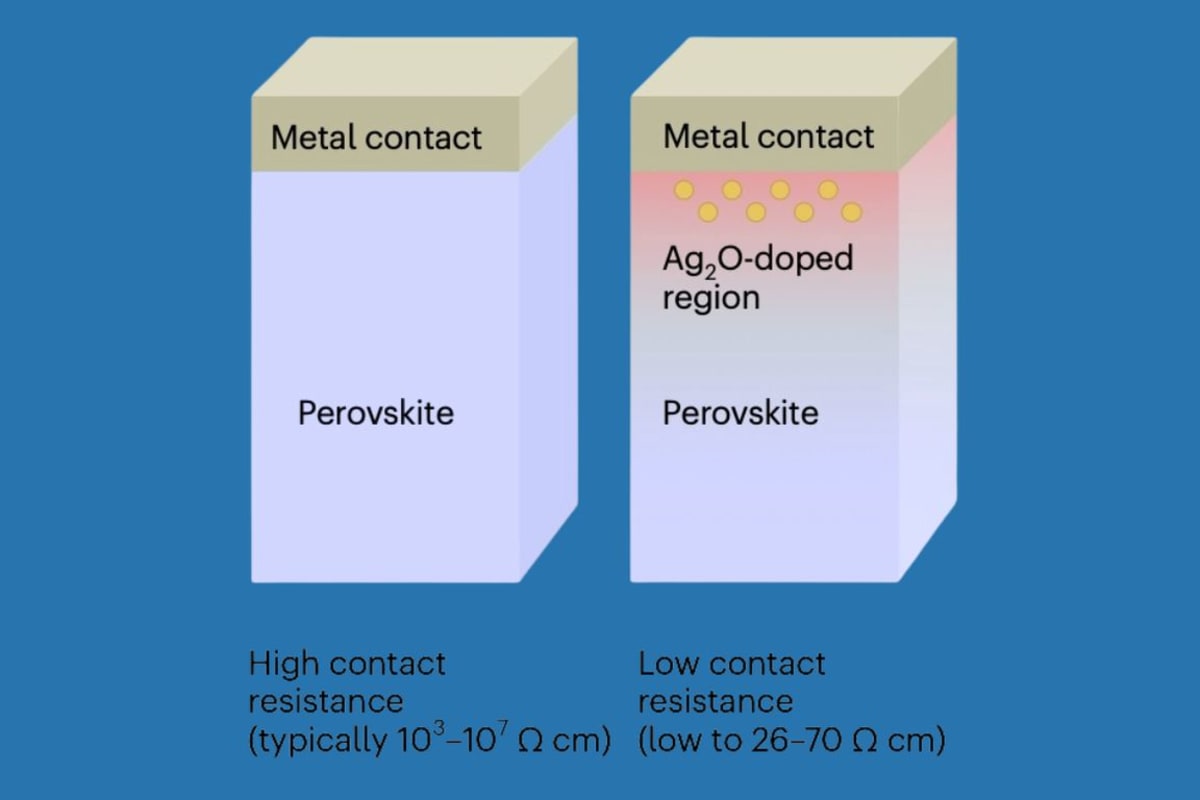
The problem lies at the contact point where metal electrodes meet the semiconductor material. Think of it like a clogged doorway where electricity struggles to pass through, wasting energy and slowing everything down.
Traditional solutions involve a technique called doping, which introduces extra charge carriers throughout the material to improve conductivity. But perovskites are relatively soft and chemically sensitive, making this approach difficult to implement without damaging the material.
Instead of modifying the entire material, the UCLA team took a smarter approach. They focused on engineering just the tiny region directly beneath the metal contact.
The researchers developed a method using silver oxide nanoclusters that act like electron magnets at the interface. By placing a specially designed metal electrode on the perovskite surface and using gentle heat and ultraviolet light, they created a locally modified region that's incredibly thin—less than 25 nanometers compared to the previous 250 nanometers.
This narrower barrier allows electrons to slip through using a quantum mechanical process called tunneling. The result is dramatically reduced resistance and more efficient current flow at lower voltages.
The Ripple Effect
This discovery opens doors far beyond the laboratory. Perovskite materials could soon power more efficient solar cells that cost less to manufacture, making clean energy more accessible to communities worldwide.
The technology could also enable new types of photodetectors for medical imaging, faster sensors for autonomous vehicles, and advanced electronics that consume far less power. Lower power consumption means longer battery life in everything from smartphones to medical devices.
Perhaps most exciting is what this breakthrough represents for scientific innovation. The research team's approach of focusing on localized modifications rather than bulk changes could inspire new solutions for other emerging materials facing similar challenges.
The work is currently at the proof-of-concept stage, but the results demonstrate a clear path forward. What was once a fundamental obstacle preventing these materials from leaving the lab now has a practical solution.
For researchers worldwide who've been working with perovskites, this breakthrough removes a major roadblock on the path to turning laboratory discoveries into technologies that could improve daily life for millions of people.
Based on reporting by Google News - Tech Breakthrough
This story was written by BrightWire based on verified news reports.
Spread the positivity!
Share this good news with someone who needs it