UCT Cracks Code: Hydrogen Fuel Tanks Modeled 40x Faster
A South African research team has developed software that models liquid hydrogen storage 40 times faster than existing tools, potentially accelerating the future of clean aviation. NASA scientists are taking notice.
The future of carbon-free flight just got a major boost from an unexpected place: the University of Cape Town.
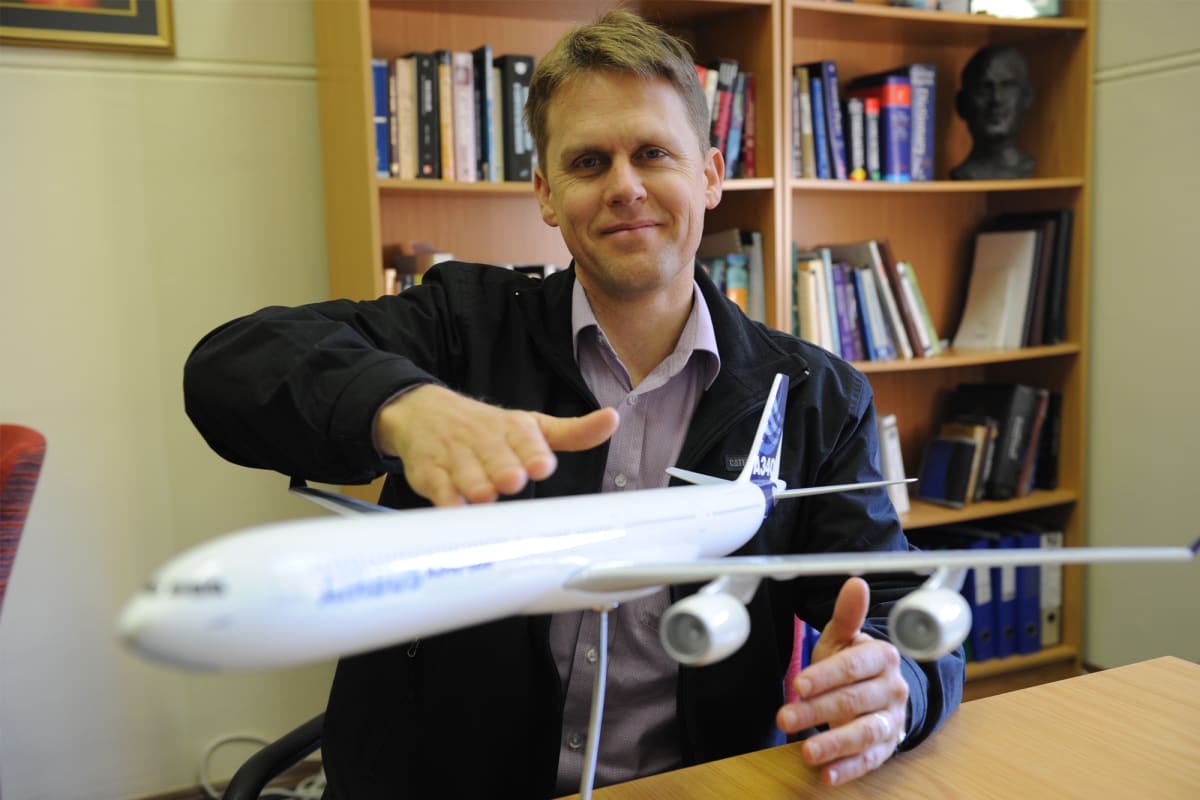
Professor Arnaud Malan and his team have cracked one of aerospace engineering's toughest puzzles. Their new software, AlphaFlow, can model liquid hydrogen fuel tanks up to 40 times faster than conventional approaches, a breakthrough that could dramatically speed up the development of clean aircraft and spacecraft.
On February 24, Malan presented the innovation to a team of experts at NASA's Glenn Research Center. The virtual seminar, organized by the National Center for Space Exploration Research, focused on solving a problem that has stumped engineers for years: how to accurately predict what happens inside ultra-cold hydrogen storage tanks.
Liquid hydrogen is a dream fuel for aviation. It's lightweight, energy-dense, and produces zero carbon emissions when burned. But storing it is incredibly complex because the liquid and vapor phases constantly interact, pressure and temperature are tightly linked, and tiny errors in modeling can throw off entire predictions.
Traditional computer modeling tools struggle with these calculations, often taking weeks to simulate what happens in minutes of real time. "If you're making a small error at every time step, within a million time steps, it adds up," Malan explained to the NASA audience.
His team's solution was to fundamentally rethink the mathematical equations. Instead of letting competing calculations "fight each other," they separated the thermodynamic behavior from the rate processes. The software automatically creates pressure-temperature diagrams that predict whether the system will evaporate, condense, or reach equilibrium before the detailed calculations even begin.
The results are stunning. In one test, AlphaFlow modeled 423 seconds of tank behavior in just 14 minutes. "That's almost real-time computing right here," Malan told the NASA team. "If we had a factor of two, we'd be doing this in real time."
AlphaFlow emerged from a public-private partnership between Malan's research chair in Industrial Computational Fluid Dynamics and UCT spin-off company Elemental Numerics. The team includes PhD researchers like Yusufali Oomar, who developed the new governing equation and is now a senior engineer at Elemental Numerics, and Dr. Francesco Gambioli, whose research created the semi-analytical thermodynamic models.
The Ripple Effect
This breakthrough could reshape how quickly aerospace companies develop hydrogen-powered aircraft. What once took weeks of computing time can now happen in hours, allowing engineers to test more designs, identify problems faster, and bring cleaner aviation technology to market sooner.
The work also demonstrates how cutting-edge innovation can emerge from partnerships between universities and startups, especially in regions not traditionally associated with aerospace engineering. South Africa's computational expertise is now helping solve challenges that matter globally.
For an industry racing to decarbonize, every acceleration matters. Malan's team has just given clean aviation a serious speed boost.
Based on reporting by Regional: south africa breakthrough (ZA)
This story was written by BrightWire based on verified news reports.
Spread the positivity!
Share this good news with someone who needs it