Ultra-Thin Surface Controls Light in Two Ways at Once
Scientists in China just cracked a tricky physics problem that could transform everything from cameras to medical imaging. Their breakthrough lets a surface thinner than paper control two types of light completely independently across a rainbow of colors.
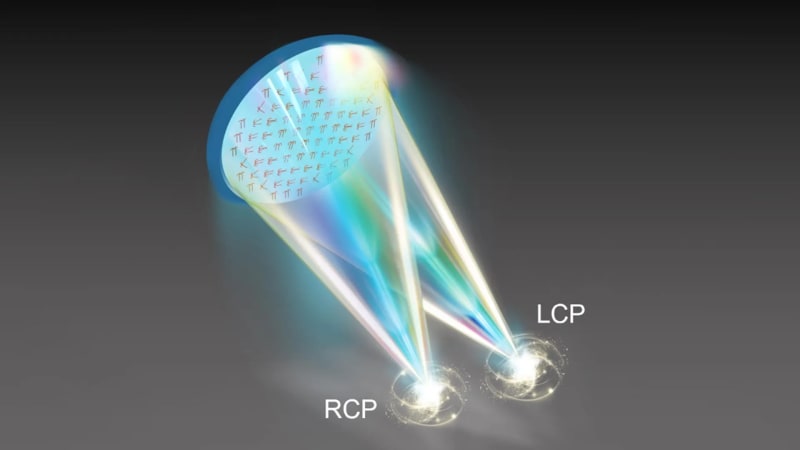
A team at Nanjing University has created an ultra-thin device that does something light has never done before: it bends and focuses two different spins of light in completely separate ways, all without blurring colors.
Think of it like this: imagine a single lens that could focus red light for one eye and blue light for the other, perfectly sharp, at the same time. That's the kind of independent control Professor Yijun Feng and Professor Ke Chen achieved with their new metasurface design.
The device is just a single layer of carefully arranged tiny structures, each smaller than the wavelength of light itself. What makes it special is how it combines two different geometric effects called Aharonov-Anandan and Pancharatnam-Berry phases. One unlocks the ability to separate right-spinning and left-spinning light, while the other extends the control range without creating interference.
The researchers tested their approach with devices that could steer light beams and focus them at different points, all while keeping colors crisp across wide frequency ranges. They demonstrated it working in microwave frequencies and terahertz ranges, proving the concept works across different parts of the light spectrum.
Before this breakthrough, most flat optical devices could only control one type of light spin at a time, or they forced both spins to behave the same way. That limitation meant designers had to choose between compact size and full functionality. This new approach eliminates that compromise entirely.
The Ripple Effect
The implications reach far beyond the laboratory. Full-color cameras could become smaller and sharper without the bulky lens systems we use today. Medical imaging devices might capture more information in a single scan, reducing patient time and improving diagnosis.
The team sees their hybrid-phase design strategy scaling all the way into visible light for everyday applications. They're already exploring how artificial intelligence and machine learning could speed up the design process, making custom optical devices faster and cheaper to create.
Multi-spectral sensors for environmental monitoring, polarization-based security systems, and next-generation telecommunications could all benefit from this dual-spin control. The single-layer design means devices stay thin, lightweight, and easy to manufacture.
The breakthrough transforms a fundamental limitation into a new degree of freedom for optical engineers. By treating the two light spins as truly independent channels, designers can now pack multiple functions into devices that would have required separate components before.
This is the kind of foundational advance that opens doors we didn't know were locked.
Based on reporting by Science Daily
This story was written by BrightWire based on verified news reports.
Spread the positivity!
Share this good news with someone who needs it