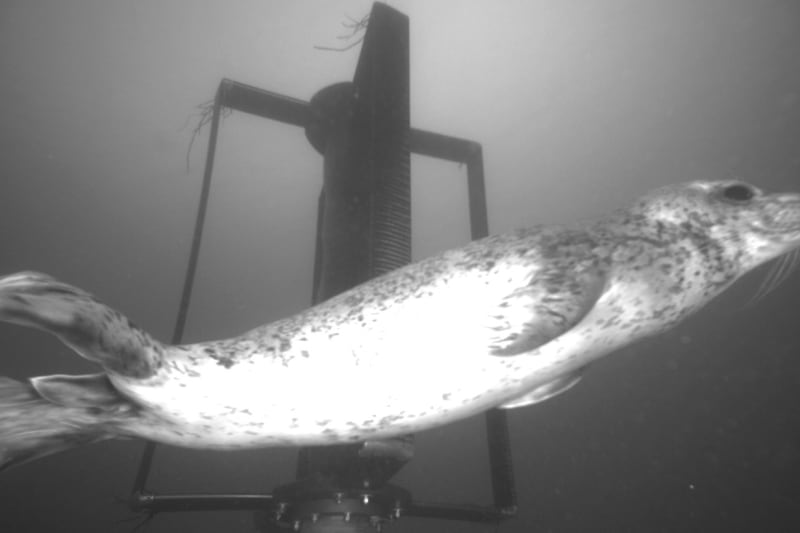
Underwater Cameras Prove Tidal Energy Safe for Marine Life
A groundbreaking study in Washington state watched sea creatures interact with an underwater turbine for 109 days and found almost zero collisions. The findings could finally unlock America's stalled tidal energy industry, which has enough potential to power 21 million homes.
Imagine harnessing the ocean's endless tides to power millions of homes without harming a single seal or seabird. Scientists just proved it's possible.
For 109 days, underwater cameras watched the entrance to Sequim Bay in Washington state, capturing something remarkable. Harbor seals swam curiously toward a spinning tidal turbine, schools of Pacific herring glided through its rotors, and diving cormorants instinctively steered clear.
Out of 1,044 unique interactions between marine life and the turbine, not one seal or seabird collided with it. Only four fish out of 224 made contact, and three of those kept swimming. The 98 percent safety rate for fish exceeded even the researchers' expectations.
The study, released Wednesday by Pacific Northwest National Laboratory and the University of Washington, provides the first hard data of its kind in North America. For years, tidal energy has been stuck in regulatory limbo because critics claimed the turbines would act like underwater blenders for marine life.
"Harbor seals were clearly in control and avoided making impact with the turbine," said Christopher Bassett, a research scientist at the University of Washington who co-authored the study. The seals' distinctive dog-like snouts appeared repeatedly on camera, showing strong swimming skills and awareness of their surroundings.
Tidal energy offers something wind and solar cannot: complete predictability. The tides never fail, never fluctuate unexpectedly. The Department of Energy estimates America's tidal resources could power 21 million homes with zero carbon emissions.
Yet while South Korea operates a tidal power station serving 500,000 people, American projects rarely make it past the permit stage. Without concrete safety data, regulators have defaulted to caution and denial.
The Ripple Effect
The new research used AI-driven cameras trained to ignore drifting debris and capture images only when marine animals appeared. Strobe lights illuminated the pitch-black water, revealing behavior scientists had never witnessed before.
Ninety-two seal interactions occurred day and night, all collision-free. Pigeon guillemots and double-crested cormorants showed up 406 times, mostly foraging at high tide when the turbine naturally stopped spinning. The software even spotted kelp crabs, jellyfish, and krill passing safely through.
"Findings from long-term research showing no collisions between marine life and tidal technology are a positive milestone for the industry," said Elisa Obermann, executive director of Marine Renewables Canada. She called it a significant step forward after years of regulatory deadlock.
The study gives regulators the site-specific data they've been demanding. It proves marine mammals possess the awareness and agility to navigate around turbines. It demonstrates that fish survival rates remain remarkably high even in close encounters.
Now the question shifts from "Is it safe?" to "How do we scale it up?" Researchers are already planning how to assess larger, grid-scale turbines using the same camera technology.
America's coastlines hold enough tidal power to transform our energy future, and the wildlife that call those waters home just showed us they can share the space.
Based on reporting by Google News - Clean Energy
This story was written by BrightWire based on verified news reports.
Spread the positivity! 🌟
Share this good news with someone who needs it


