
U.S. Latinos Now World's 4th Largest Economy at $4.4T
U.S. Latinos have built an economy bigger than Japan's, reaching $4.4 trillion in 2024 and outgrowing China for the first time. The numbers prove what this community has always known: they're not a burden, they're America's fastest growth engine.
The U.S. Latino economy just did something remarkable. It grew faster than China.
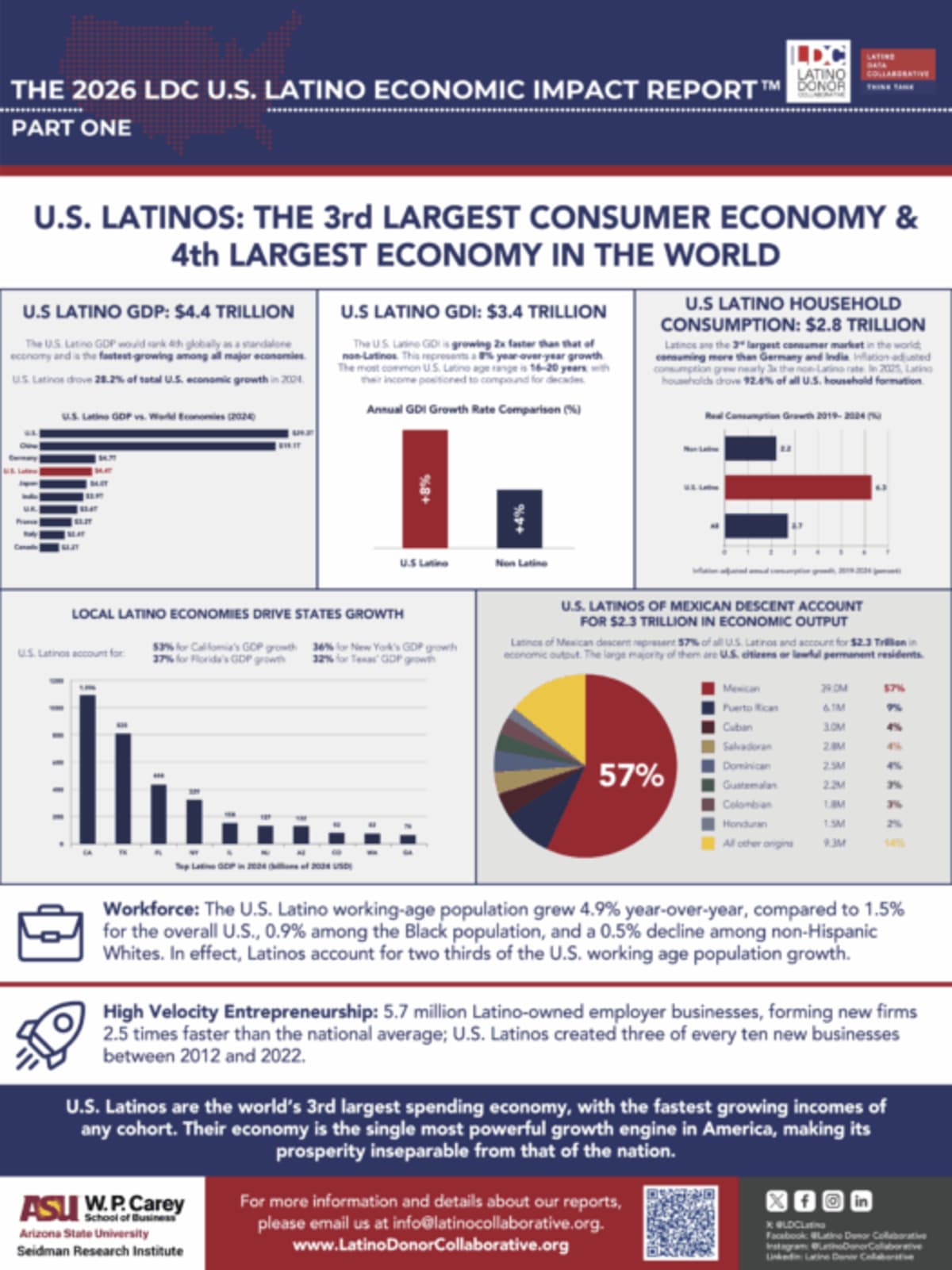
A new report from Arizona State University found that U.S. Latino GDP hit $4.4 trillion in 2024. If it were a standalone country, it would rank fourth in the world, ahead of economic powerhouses like Japan, India, and the United Kingdom.
But size isn't the story here. Growth is.
Between 2019 and 2024, the U.S. Latino economy grew at 5.4% per year. China grew at 4.9%. The overall U.S. economy? Just 2.4%.
No major economy on earth grew faster during that period. And Latinos represent only 20% of the U.S. population.
The Latino Donor Collaborative released the 2026 economic impact report in May, and the numbers reveal an economic engine that politicians and media have consistently misunderstood. "What this report represents is not advocacy. It is arithmetic," the authors wrote.
In 2024 alone, Latinos accounted for 28.2% of total U.S. economic growth, contributing $419 billion in new GDP. That single year contribution exceeded their five year average of $270 billion.
The workforce story explains why this growth won't slow down anytime soon. Latinos made up two thirds of all U.S. working age population growth last year, while the non-Hispanic white working age population actually declined by 0.5%.
Latino household spending reached $2.8 trillion in 2024, more than Germany's total household consumption and more than India's, a country with 1.4 billion people. After adjusting for inflation, Latino household spending grew at 6.3% annually, nearly triple the rate of non-Latino households.
The housing market tells an even more striking story. Latino households added 441,000 new households in 2025, the largest single year gain by any group since the Census Bureau started tracking this data in 1975. Every other demographic group lost households that year.
Without Latino household formation, total U.S. household formation would have collapsed to just 125,000. Latinos drove 92.6% of all new households.
Latino entrepreneurs are building at record pace too. There are now 5.7 million Latino owned businesses in the United States, forming at 2.5 times the rate of non-Latino firms. Between 2012 and 2022, Latino business owners created three out of every ten new businesses nationwide.
These businesses aren't concentrated in low margin sectors either. The five largest areas include manufacturing ($540 billion), real estate ($405 billion), and healthcare ($311 billion), each growing between 7% and 12.3% annually.
The Ripple Effect
California's Latino economy alone reached $1.1 trillion and drove 53% of the state's total economic growth. Texas generated $820 billion, Florida $444 billion, and New York $329 billion, with Latinos contributing between 32% and 37% of growth in each state.
The demographic advantage points to decades more growth ahead. The most common age range among U.S. Latinos is 16 to 20, compared to 61 to 65 among non-Latinos. This community is still entering its peak earning years.
The gap between political rhetoric and economic reality keeps widening, and the data makes one thing clear: America's economic future is inseparable from Latino prosperity.
More Images

Based on reporting by Google: economic growth report
This story was written by BrightWire based on verified news reports.
Spread the positivity!
Share this good news with someone who needs it