USU Student Maps Paths Out of Addiction in Utah Valley
A Utah State senior spent her summer interviewing people in recovery to identify what helps and what hurts when someone's fighting to reclaim their life from addiction. Her research could help communities remove barriers that make staying sober nearly impossible.
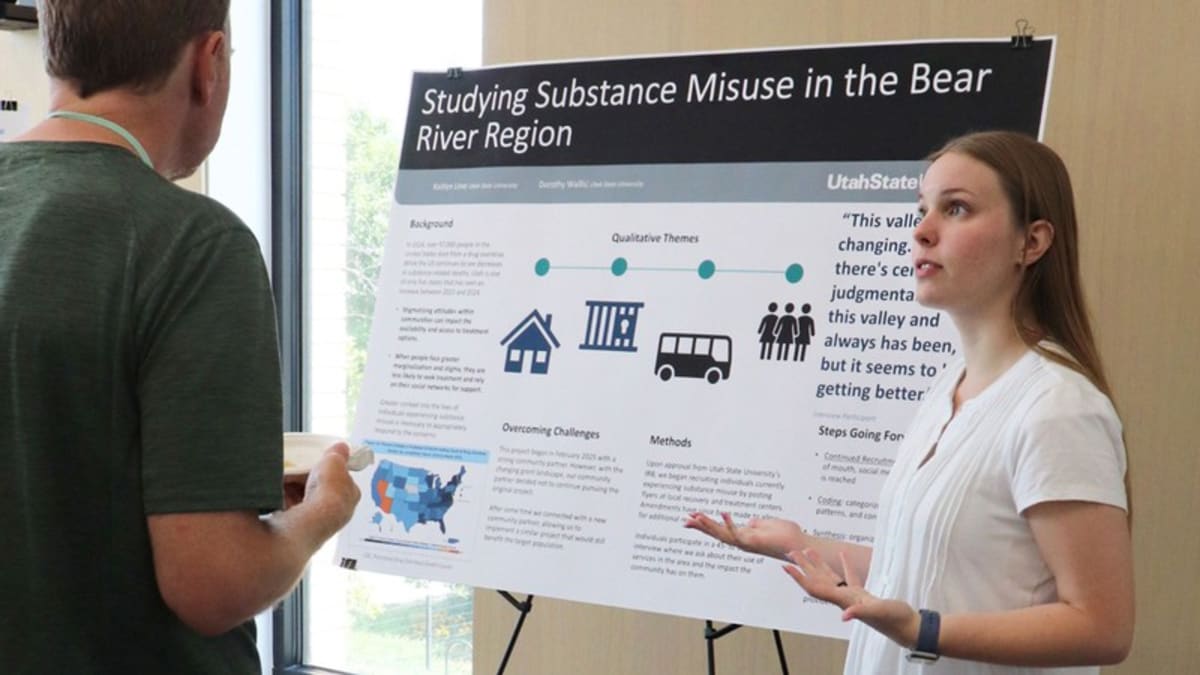
Kaitlyn Walker Line spent her summer talking to people at their lowest points and their bravest moments. The Utah State University social work student interviewed dozens of people fighting addiction in Cache Valley, Utah, mapping every obstacle between them and recovery.
What she found was sobering. Treatment costs money, but getting treatment makes working nearly impossible. Families and employers aren't always supportive. Communities often reject programs like sober living homes that could save lives.
Line became fascinated with addiction recovery during an elective course taught by Professor Dorothy Wallis. She learned how substances rewire the brain, turning initial choices into compulsive behavior that destroys relationships, jobs, and financial stability.
When Line won a Peak Undergraduate Research Fellowship, she planned to study harm reduction programs. But federal funding cuts forced her to pivot. Extension professor Tim Keady connected her with inpatient treatment centers in Cache and Box Elder counties instead.
The timing demanded flexibility. People in recovery attend sessions all day. Line needed to interview them whenever they were free, often at night. The fellowship paid her enough to work part time instead of full time, making the research possible.
The Ripple Effect
Line discovered that stigma creates a vicious cycle. People lose everything to addiction: partners, children, homes, jobs. Recovery requires intense, full time effort. But without community support, housing, or income, one setback can erase months of progress.
The research revealed gaps in basic services. Line documented which inpatient and outpatient programs exist, where support groups like Alcoholics Anonymous meet, and how people afford food and shelter while getting well. She found that communities unwilling to fund recovery infrastructure make sobriety exponentially harder.
Her mentor Wallis taught her to approach vulnerable people ethically, asking difficult questions with empathy. Professor Cris Meier showed her how to analyze data accurately. After her summer fellowship ended, Utah State's Transforming Communities Institute funded her to continue the work.
Line graduates this spring with her bachelor's degree and starts her master's in social work this summer. She plans to pursue a doctorate to keep researching how communities can support recovery instead of blocking it.
She will present her findings at the National Conference on Undergraduate Research in Virginia this April, where she was named Scholar of the Year for the College of Arts and Sciences. Her message is simple: people are working hard at recovery, and removing obstacles like homelessness and limited care access could save lives.
Community support, Line learned, isn't just helpful for people fighting addiction—it's everything.
Based on reporting by Google News - Recovery Story
This story was written by BrightWire based on verified news reports.
Spread the positivity!
Share this good news with someone who needs it