UVA Lab School Brings Robotics to Every Middle Schooler
A groundbreaking partnership between the University of Virginia and Charlottesville schools is teaching every seventh grader to build animatronic animals using microcontrollers and sensors. The Innovation Hub is already being recognized as a leading STEM education model in Virginia.
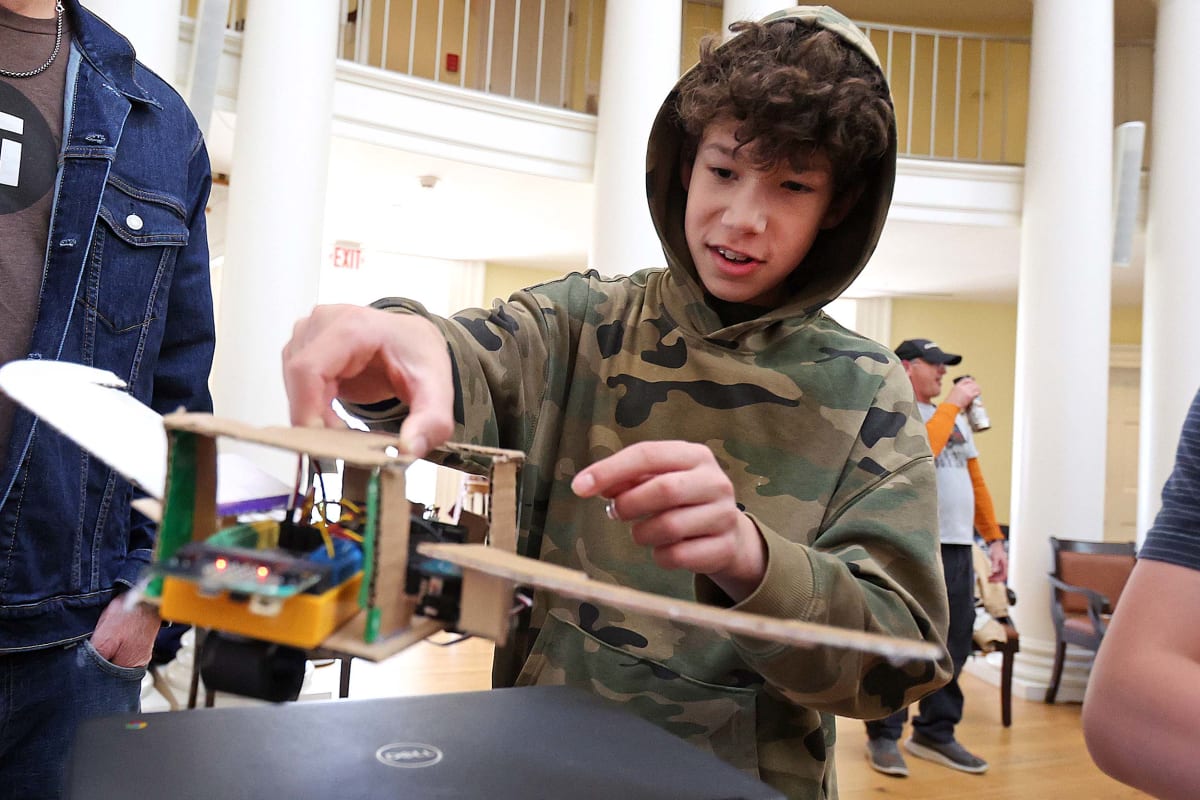
Seventh grader Cecilia Lally watched her handmade Venus flytrap sense approaching objects and snap its jaws shut, just like the real thing. She programmed it herself using rotation servos and distance sensors, solving engineering problems that once seemed impossible.
This week, cardboard animals came alive inside UVA's historic Rotunda. Students presented bio bots they designed and coded: dogs that wagged tails, anglerfish that flashed LED lures, squids that waved tentacles. Each creation mimicked real animal adaptations through student-programmed technology.
The showcase highlighted the Innovation Hub, a lab school partnership between Charlottesville City Schools and UVA's School of Education and Human Development. Launched last fall at Charlottesville Middle School, the program teaches computational thinking through regular science classes.
What makes this program special is its reach. Every student at the school participates through their normal coursework, making it the only lab school in Virginia where STEM innovation isn't reserved for select groups. No applications, no exclusions, just universal access to hands-on engineering and computer science.
"We were given a lot of creative freedom with how we were building stuff," Lally said. "It was a really fun project to do, and we haven't really done anything in the past like that."
The curriculum weaves technology and data science into core subjects, letting students tackle real-world problems with genuine autonomy. A full-time researcher ensures student voices shape the program's direction.
Teachers learn alongside their students through yearlong fellowships. This year, four science teachers joined colleagues from math, English and history to integrate computer science into their teaching. Seventh-grade teacher Elke Doby noticed the difference immediately.
"They learned a lot more by being able to apply the knowledge they learned in class," she said. "I saw a lot more participation and engagement."
The Ripple Effect
The Innovation Hub's success earned recognition from the Virginia Mathematics and Science Coalition as a leading STEM education model. But Director Conner Brew sees the real impact extending far beyond test scores.
The program now partners with Starr Hill Pathways, Computers4Kids, and the Boys & Girls Club, where it sponsored the club's first Lego Robotics competition team. Summer projects bring bio bot building to students who might not otherwise access these opportunities.
"Humans don't learn only in the classroom," Brew said. "They learn in their homes, in community spaces, and in so many environments that exist outside of formal school."
Research shows these informal learning experiences help close opportunity gaps. By bringing cutting-edge technology education to every student and extending into the broader community, the Innovation Hub is building confidence and critical thinking skills that reach far beyond middle school.
Associate Professor Jennie Chiu explains the long-term vision: using computing skills to solve meaningful problems promotes understanding of career opportunities while deepening students' understanding of themselves and the world around them.
The cardboard creatures may seem simple, but they represent something profound: a generation of students discovering they can build, program, and engineer solutions to real problems, no barriers required.
Based on reporting by Google News - School Innovation
This story was written by BrightWire based on verified news reports.
Spread the positivity!
Share this good news with someone who needs it