Waterloo Startup's Quantum Sensors Work Where GPS Can't
A University of Waterloo startup is developing quantum sensors so sensitive they can detect a single photon, unlocking navigation and monitoring in extreme environments from ocean depths to outer space. Phantom Photonics has already grown from three founders to 10 employees since launching in 2023.
📺 Watch the full story above
Submarines might soon navigate underwater without surfacing, thanks to quantum sensors that work where GPS signals can't reach.
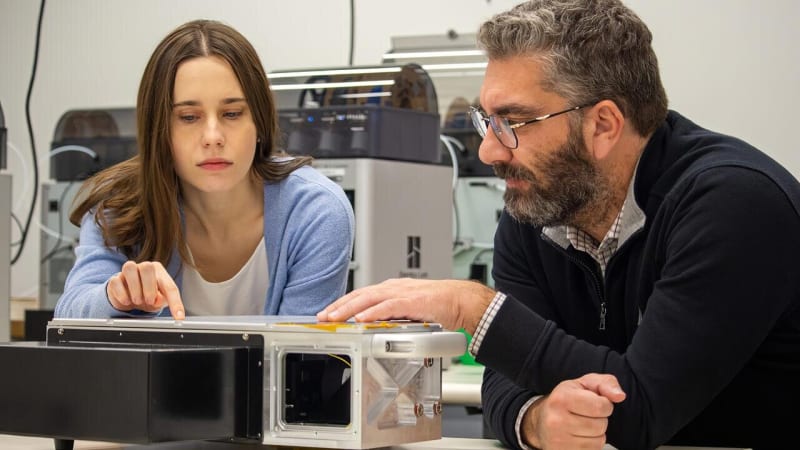
Alex Maierean launched Phantom Photonics in 2023 while completing her master's degree at the University of Waterloo's Institute for Quantum Computing. Her company is developing ultra-sensitive quantum sensors that can detect signals as faint as a single photon, the smallest unit of light.
The technology uses quantum coherence that resists interference from external factors, making it perfect for harsh environments. Submarines could pinpoint their location deep underwater, and operators could analyze chemical makeup of fluids from a distance without direct contact.
"I was lucky because the sensor research I was working on turned out to be commercializable and I had no reason not to run with it," Maierean says. The idea started in a research lab led by Dr. Thomas Jennewein, but a postdoctoral researcher encouraged her to transform the science into a business.
The startup now operates from Velocity, Waterloo's startup incubator, where the team has built dedicated lab space. They've grown from three co-founders to 10 full-time employees focused on developing and selling their product.
Maritime industries represent a major market, but the applications extend far beyond submarines. Oil and gas companies, offshore infrastructure operators, and space agencies all need safe monitoring of remote and dangerous conditions where traditional sensors fail.
The Ripple Effect
The technology becomes even more transformative as it shrinks. Once Phantom Photonics miniaturizes the sensors to chip size, they could revolutionize industrial robotics in manufacturing and even consumer electronics.
Investor interest in quantum startups is surging as the technology proves itself beyond laboratory settings. "There's more curiosity and more knowledge and acceptance around quantum technology being more than just hype," Maierean says. "Investors are serious."
Early stage funding required Maierean's full-time commitment, and her academic supervisors supported her taking time off to build the business. That flexibility proved crucial for getting Phantom Photonics from research concept to commercial reality.
Maierean encourages other quantum researchers to pursue commercialization now while the field remains wide open. "The technology is still so new that successful products are likely to become truly disruptive."
The sensors work anywhere GPS fails, opening possibilities that seemed impossible just years ago.
More Images
Based on reporting by Phys.org
This story was written by BrightWire based on verified news reports.
Spread the positivity!
Share this good news with someone who needs it